
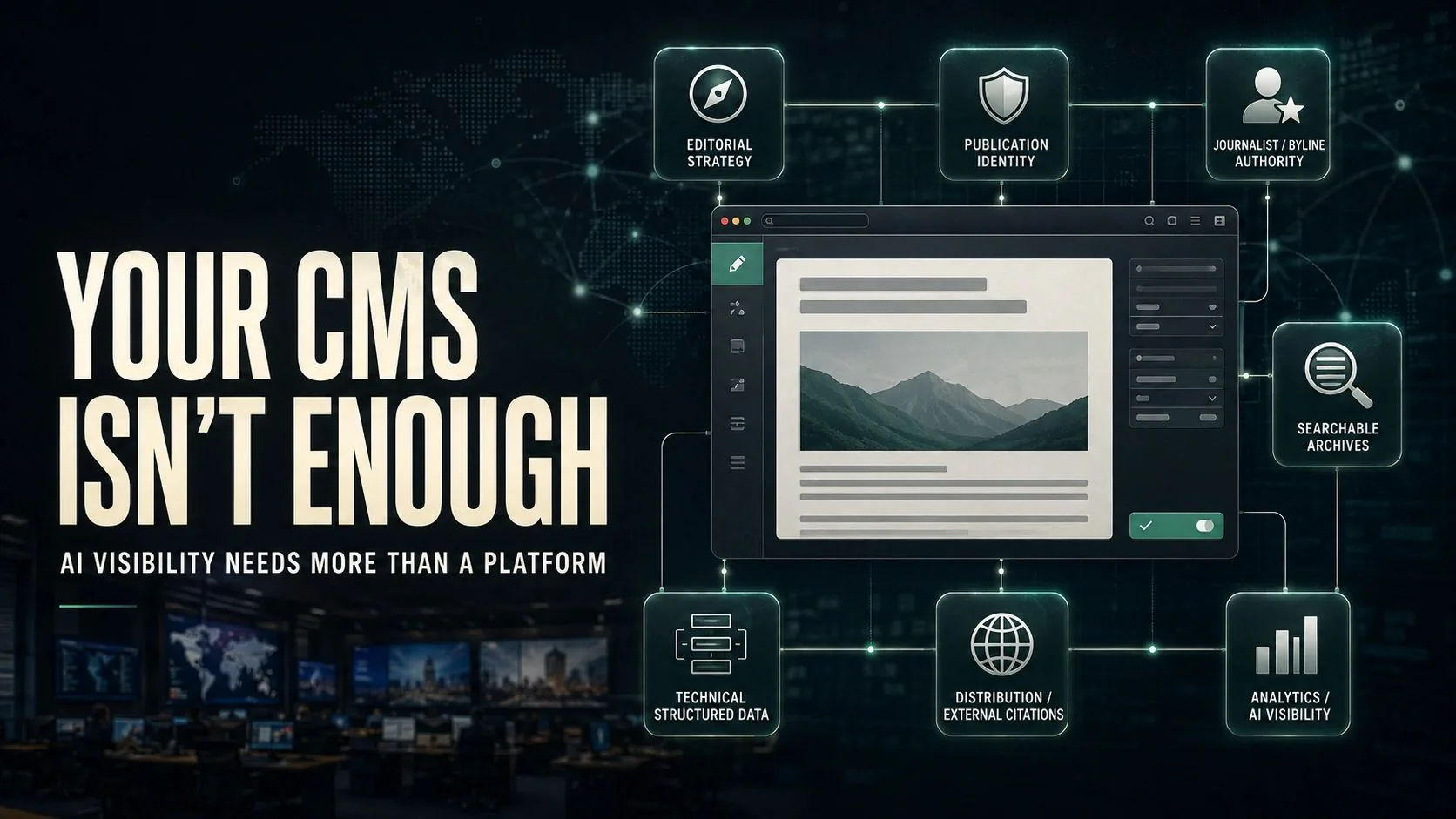
Your media company has a content management system.
Editors can create articles, upload images, assign authors, schedule publication and organize content into sections.
The website may look polished. New stories may publish on time. The CMS may even generate sitemaps, canonical tags and basic structured data automatically.
So why is your strongest reporting still difficult to find?
Why do years of editorial work disappear beneath an archive search that few readers use?
Why do AI platforms cite larger competitors for topics your journalists have covered with greater local or industry depth?
Why can a reader recognize the relationship between your company, publications and writers while a search engine struggles to connect them?
Because a CMS is a publishing tool.
It is not an authority strategy.
It can store and deliver content. It cannot decide what your media brand should be known for, prove why its journalists deserve trust or create the external evidence that makes a publication citation-worthy.
For media companies, the distinction matters more as discovery expands across traditional search, Google’s AI features, ChatGPT and other conversational platforms.
Your CMS is necessary.
It is only one layer.
What a CMS Is Designed to Do
A content management system helps teams create, manage and publish digital material without rebuilding every webpage manually.
Depending on the platform and configuration, a media CMS may support:
- Article creation and editing
- Editorial permissions and approval workflows
- Scheduled publishing
- Reusable page templates
- Image and video management
- Categories, tags and sections
- Author assignments
- Subscription or registration controls
- Search and archive interfaces
- Syndication feeds
- Sitemap generation
- Structured-data fields
- Analytics and advertising integrations
Those capabilities are important. A publisher cannot operate efficiently at scale without dependable content infrastructure.
But a list of available features is not the same as a coherent discovery system.
A CMS can provide an author field.
It cannot ensure that the author has a complete profile, a consistent identity, visible expertise and an internally linked body of work.
A CMS can provide categories.
It cannot decide whether the taxonomy reflects what audiences search for, how advertisers understand the publication or which topics the newsroom can credibly own.
A CMS can generate a sitemap.
It cannot determine whether the correct pages are indexable, canonical, internally supported and valuable enough to earn visibility.
The platform supplies capabilities.
The publisher must supply intent, governance and quality.
The CMS Fallacy
The CMS fallacy is the belief that because content has been published, the work of digital visibility has been completed.
In reality, publication is the beginning of discovery.
After an article goes live, multiple systems still need to understand:
- What the page is about
- Who wrote and reviewed it
- Which publication released it
- Which media company owns that publication
- Which audience and geography it serves
- Whether the page is original, current and accessible
- How it connects to related coverage
- Why the source deserves trust
- Whether other credible sites recognize its authority
No CMS setting can answer all of those questions by itself.
They are answered through the combined effect of editorial decisions, information architecture, authorship, technical implementation, internal linking, distribution, external mentions and long-term archive management.
When those systems are disconnected, the CMS becomes a warehouse.
The content exists, but its meaning is difficult to retrieve.
A CMS Cannot Define Your Editorial Authority
Editorial authority comes from consistently producing useful, original and trustworthy work around a recognizable set of subjects.
A regional magazine may have deep authority in local dining, design, philanthropy, real estate and culture.
A business publication may have years of reporting on particular industries, executives and markets.
A custom media company may operate multiple consumer and trade titles, each with a distinct audience and purpose.
The CMS can hold all of that content.
It cannot decide how those bodies of work should connect into a clear authority position.
Without an intentional editorial architecture, content often fragments across:
- Broad categories created years ago
- Overlapping tags with inconsistent names
- Print departments that do not match digital search behavior
- Microsites and campaign pages
- Digital-edition viewers
- Acquired publication domains
- Contributor pages with no lasting identity
- Event, newsletter and podcast platforms outside the main archive
The result is a publisher with substantial expertise but weak signals of concentration.
AI platforms and search engines do not see the editorial planning meeting. They see the public evidence left behind by the website and the wider web.
If that evidence is scattered, the brand’s real authority can remain hidden.
A CMS Cannot Clarify a Confusing Brand Architecture
Many media companies operate more than one identity.
There may be a parent company, a corporate services site, regional publications, industry titles, newsletters, event brands, podcasts and sponsored-content studios.
Humans may understand these relationships immediately because they have seen the mastheads, media kits and sales presentations.
Machines need explicit, consistent evidence.
They need to understand:
- Which organization owns each publication
- Whether two titles are separate brands or sections of the same brand
- Which markets and audiences each title serves
- Where the official company and publication descriptions live
- Which social profiles belong to which entity
- How authors, editors and contributors connect to each publication
- Whether corporate, editorial and advertising operations are clearly distinguished
A CMS may expose fields for logos, descriptions and organization markup.
It will not resolve contradictions between a corporate website, publication footer, social profile, author page and third-party directory.
That requires an entity strategy and coordinated implementation across every public touchpoint.
A CMS Cannot Rescue a Broken Archive
Publishers often possess their strongest competitive advantage without realizing it.
The archive may contain years or decades of original interviews, profiles, reporting, photography and local knowledge that competitors cannot easily recreate.
Yet older stories are frequently buried inside:
- PDF issues
- Image-based digital replicas
- Legacy subdomains
- Retired URL structures
- Broken internal searches
- Unlinked year-and-month folders
- Pages without authors or publication information
- Migrated content missing images and captions
- Duplicate versions created during redesigns
- Paywalls that provide too little public context
Moving those stories into a newer CMS does not automatically make the archive useful.
A migration can preserve the same structural problems inside a cleaner interface.
Archive recovery requires deliberate decisions about:
- Which historical stories deserve permanent public pages
- How old URLs redirect to their most relevant destinations
- Whether original publication dates and bylines remain accurate
- How topics, people, organizations and places are connected
- Which articles need transcripts, captions or accessibility repairs
- How cornerstone archive pages surface the strongest coverage
- Which outdated material should be corrected, consolidated or retired
The CMS executes those decisions.
It does not make them.
A CMS Cannot Build Journalist Authority Automatically
An author dropdown is not an authority system.
Media companies often publish articles under abbreviated names, staff labels, publication accounts or contributor profiles that contain little more than a headshot.
Writers may have multiple profiles across redesigned sites. Former staff pages may disappear even while their articles remain. Freelancers may be identified inconsistently. Editors and reviewers may never be visible.
That weakens attribution for readers and machines.
A stronger author system connects each journalist to:
- A stable profile URL
- A clear name and role
- Relevant biography and subject expertise
- The publication or company they represent
- Recent and historical work
- Appropriate professional profiles
- Contact or editorial information when relevant
- Consistent authorship across article templates and structured data
Google’s ProfilePage guidance describes structured information that can help clarify the person or organization a profile page represents. Google’s Article guidance also supports author details on article pages.
Those technical fields are helpful.
They become meaningful only when the visible profile and editorial record support them.
Schema cannot manufacture expertise.
The CMS cannot replace a real biography, consistent byline and body of original work.
A CMS Cannot Create Useful Internal Connections on Its Own
Internal links help readers move from one relevant story to another. They also help search systems discover pages and understand relationships across a site.
Google’s link guidance explains that crawlable links help it find pages and interpret relevance.
Most CMS platforms can generate menus, category pages, breadcrumbs and automated related-story modules.
Those features are useful, but automation often creates shallow connections.
A generic “More Stories” block may prioritize recency rather than relevance.
A category page may contain hundreds of articles without identifying the publication’s most authoritative work.
A tag may connect stories that share a label but not a meaningful reader journey.
Editorially useful internal linking requires judgment.
Writers and editors should connect:
- A developing story to earlier coverage
- A profile to related interviews and organizations
- A local guide to supporting neighborhood reporting
- A trend analysis to original data or source material
- A current article to an evergreen explainer
- A broad topic hub to the publication’s strongest work
The CMS can render the link.
The newsroom decides why the relationship matters.
A CMS Cannot Guarantee Technical Accessibility
A story can look correct in a browser while remaining difficult for search and AI crawlers to access or interpret.
Technical visibility depends on more than choosing a respected platform.
Publishers still need to validate:
- Robots.txt and crawler access
- Noindex directives
- Canonical URLs
- HTTP status codes
- Redirect behavior
- Server-side and JavaScript rendering
- Mobile accessibility
- Page speed and stability
- Crawlable internal links
- XML and news sitemaps
- Structured-data accuracy
- Subscription and paywall implementation
OpenAI’s publisher guidance explains that publishers can allow OAI-SearchBot to access content intended for ChatGPT search. Google likewise emphasizes publicly accessible, crawlable content for discovery in its search and generative AI experiences.
A CMS may generate some of these elements by default.
Themes, plugins, custom code, security layers, paywalls, ad technology and migration decisions can change the final output.
The only reliable answer comes from testing what the live website actually serves.
A CMS Cannot Guarantee Structured Data Quality
Structured data can help systems understand a page’s subject and properties.
For publishers, relevant implementations may include:
- Article or NewsArticle information
- Headline and description
- Author and author profile
- Publication and publisher identity
- Publication and modification information
- Primary images
- Organization details
- Profile pages
- Subscription and paywall information
Google explains that Article structured data can help it understand article pages and display better title, image and publication information in supported search experiences.
But structured data is not self-validating.
A CMS template may output:
- A generic corporate name instead of the correct publication
- The last template edit as the article modification time
- An empty or duplicated author entity
- A low-quality default image
- Conflicting canonical URLs
- Markup that does not match visible content
- The same organization data across unrelated publication brands
Structured data also does not guarantee rankings, rich results or AI citations.
It clarifies evidence that already exists.
Publishers must define the right model, validate the live output and monitor changes after templates, plugins or code are updated.
A CMS Cannot Solve the Paywall Strategy
Subscriptions can be essential to a sustainable publishing business.
The question is not whether a publisher should protect valuable work.
The question is whether the access model communicates enough accurate information for readers and discovery systems to understand what exists behind the boundary.
Google provides structured-data guidance for subscription and paywalled content so publishers can identify protected sections while distinguishing them from cloaking.
Implementation still requires strategic choices:
- Which content is fully public
- Which pages offer a preview or summary
- How much context a non-subscriber can see
- Whether headlines, bylines and descriptions remain accessible
- How registered and subscriber-only experiences are delivered
- Which crawler policies align with the business model
- How conversions from search and AI referrals are measured
The CMS or paywall vendor can enforce access rules.
Leadership must decide what the rules are designed to accomplish.
A CMS Cannot Earn External Authority
No publisher becomes authoritative only by describing itself as authoritative.
External evidence matters.
That evidence may include:
- Citations from other publications
- Links from credible organizations
- References from local institutions and industry associations
- Journalist appearances and expert commentary
- Syndication relationships
- Event partnerships
- Awards and professional recognition
- Reader discussion and branded search demand
- Inclusion in relevant directories and knowledge sources
A CMS can publish an awards page or media kit.
It cannot cause respected third parties to cite the newsroom’s reporting.
External authority is earned through the usefulness, originality and reputation of the work—and strengthened by active distribution and relationship building.
A CMS Cannot Measure AI Visibility by Default
Traditional publisher dashboards often focus on pageviews, sessions, engaged time, subscriptions and advertising performance.
Those metrics remain important.
They do not answer every question created by AI-powered discovery.
Media companies should also examine:
- Whether the brand appears for relevant non-branded prompts
- Which publications and articles are cited
- Which competitors are cited instead
- What questions generate AI referrals
- Whether referral visits reach high-value archive or subscription pages
- Which journalists and topics earn repeated visibility
- Whether AI citations change after editorial or technical improvements
OpenAI notes that referral links from ChatGPT search include a source parameter that publishers can identify in analytics.
That provides one useful measurement path.
It does not replace structured prompt testing, citation tracking and competitive review.
A CMS may integrate analytics tags.
It does not define the measurement framework.
A Headless CMS Is Still Only a CMS
Headless architecture can give publishers greater flexibility over front-end experiences, applications and distribution channels.
It can also separate content from presentation in a useful way.
But headless does not automatically mean discoverable.
A headless implementation can still produce:
- Incomplete server-rendered content
- Weak link discovery
- Conflicting URLs
- Missing metadata
- Unclear author relationships
- Duplicate pages across channels
- Slow or unstable experiences
- Structured data that does not match visible content
The architecture may create better options.
The implementation determines whether those options become advantages.
Changing platforms without changing the content model, governance and discovery strategy often moves the same problems into a more expensive environment.
What Your CMS Should Do Well
The answer is not to abandon the CMS.
It is to define its responsibilities clearly.
A modern publisher should expect the platform and implementation to support:
- Clean, stable and readable URLs
- Flexible article and publication content types
- Required author and editor fields
- Visible publication and modification information
- Accurate canonical controls
- Structured-data templates that can be validated
- XML and news sitemap management
- Accessible HTML, images, audio and video
- Redirect management during migrations
- Crawlable navigation and editorial links
- Subscription and paywall configuration
- Reusable topic, location, person and organization relationships
- Analytics, testing and referral tracking
- Editorial workflows that protect accuracy without creating avoidable delay
These are infrastructure requirements.
They help the newsroom’s real work become understandable and durable.
What Must Exist Beyond the CMS
Strong Publisher AI Visibility requires an operating system around the platform.
Editorial Authority Strategy
Define the topics, audiences, markets and questions each publication can serve with genuine depth.
Publication and Entity Architecture
Clarify how the parent company, titles, verticals, journalists, events and channels relate to one another.
Archive Recovery and Governance
Preserve valuable historical work, redirect old URLs, repair missing attribution and create useful paths into the archive.
Journalist Authority Program
Build complete profiles, consistent bylines, subject expertise and internally connected bodies of work.
Technical Search and AI Controls
Test crawlability, rendering, canonicals, sitemaps, structured data, paywalls and bot access on the live site.
Editorial Distribution
Extend original reporting through newsletters, social channels, partnerships, events, syndication and expert relationships.
Measurement and Governance
Track citations, referrals, competitive visibility and the effect of changes while assigning clear ownership for ongoing quality.
The CMS supports each layer.
It does not replace any of them.
A Practical CMS and AI Visibility Review
Media leaders can begin with a focused review.
Content Model
- Can every article identify the correct publication, author, editor, topic and audience?
- Are locations, people and organizations treated consistently?
- Can one story belong to meaningful collections without creating duplicate pages?
Archive
- Are historical stories available at stable URLs?
- Did past migrations preserve redirects, bylines, images and publication information?
- Can readers reach cornerstone reporting without relying on the site-search box?
Authorship
- Does every active journalist have one complete profile?
- Do article pages link to that profile?
- Are expertise, role and body of work clear?
Technical Output
- Can search and approved AI crawlers access intended public content?
- Are canonicals, sitemaps, robots directives and status codes correct?
- Does structured data match what readers can see?
Internal Discovery
- Do topic pages surface authoritative work or only reverse-chronological feeds?
- Are related-story modules genuinely relevant?
- Do editors connect new reporting to important archive coverage?
Distribution and Authority
- Is original reporting actively promoted to the organizations and communities it serves?
- Are third-party citations and backlinks monitored?
- Can the publication demonstrate authority beyond its own domain?
Measurement
- Are AI referrals identifiable in analytics?
- Are brand appearances and source citations tested regularly?
- Does leadership know which competitors earn visibility for priority topics?
If several answers are unclear, the problem is larger than a CMS configuration.
It is a publishing-system problem.
The Right Question Is Not “Which CMS Do We Use?”
Platform selection matters.
The wrong CMS can restrict workflows, slow development, create migration risk and make important technical controls difficult.
But the more valuable leadership question is:
“Does our publishing system make our best journalism easy to discover, understand, trust and cite?”
That question includes the CMS without allowing the platform to dominate the strategy.
It focuses the organization on the outcome.
A media company does not need to rebuild its entire website every time visibility stalls.
It needs to identify which layer is failing.
Sometimes the issue is technical.
Sometimes it is editorial architecture.
Sometimes the archive is disconnected.
Sometimes the publication identity is unclear.
Sometimes the authority exists but has never been distributed or measured.
The CMS cannot diagnose that alone.
Sources Used
- OpenAI — Publishers and Developers FAQ
- Google Search Central — AI Features and Your Website
- Google Search Central — Article Structured Data
- Google Search Central — Profile Page Structured Data
- Google Search Central — Organization Structured Data
- Google Search Central — Link Best Practices
- Google Search Central — News Sitemaps
- Google Search Central — Paywalled Content
Build the Publishing System Around Your CMS
The Digital Roots Agency helps media companies evaluate the complete system that connects editorial work to search and AI discovery.
Our Media AI Visibility audits examine:
- Publication and corporate identity
- Editorial authority and content architecture
- Archive accessibility
- Journalist and editor attribution
- Technical crawlability
- Structured information
- Internal linking
- External citations
- AI-search visibility
- Measurement and governance
The goal is not to replace a capable CMS.
It is to make sure the platform supports a publishing strategy that readers, search engines and AI systems can understand.
Because your CMS can publish your authority.
It cannot build that authority for you.
Review Your AI Search Readiness
If AI can’t understand your media brand, it can’t cite or recommend it.