
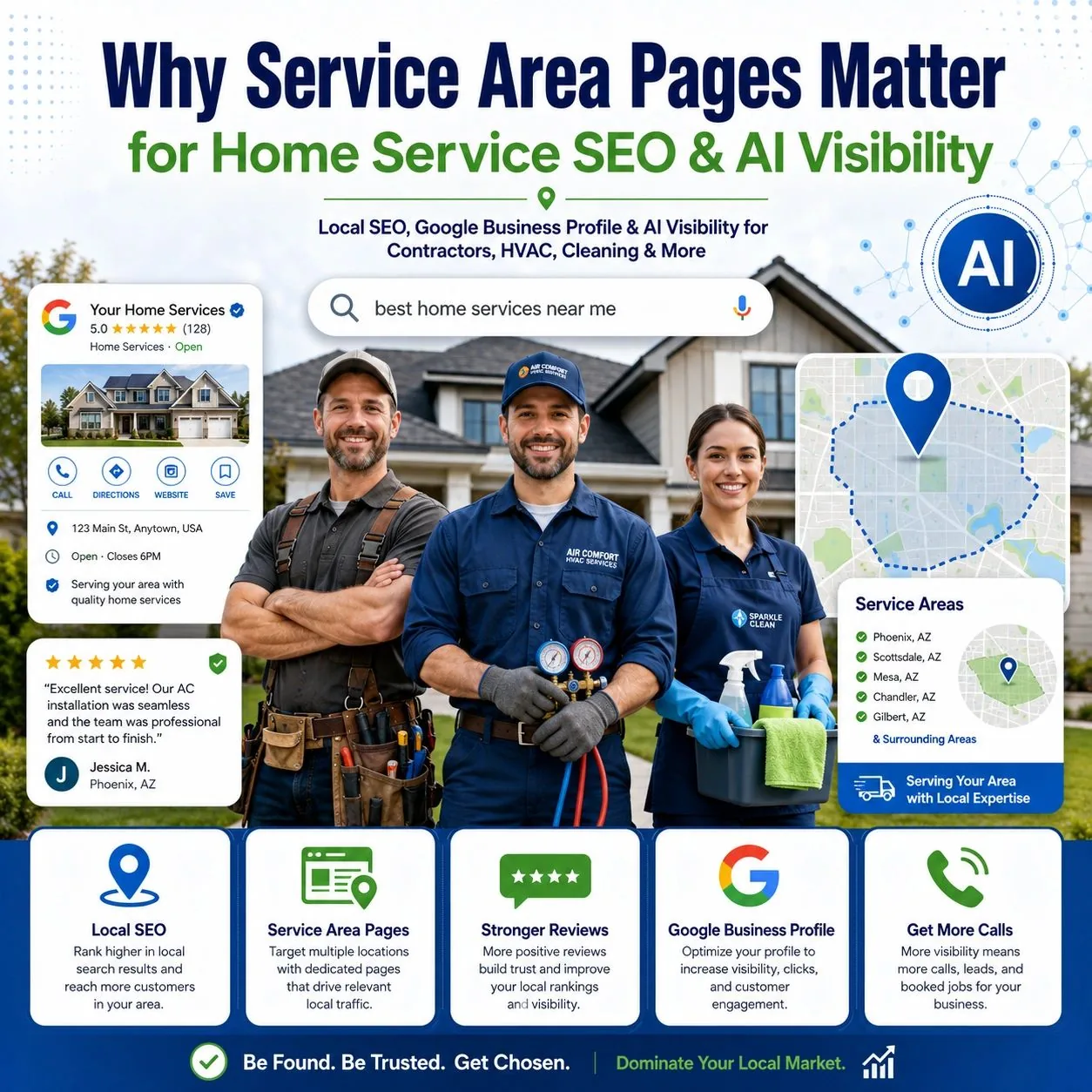
Home service businesses are local by nature.
A homeowner is not just searching for a contractor, HVAC company, cleaning business, plumber, roofer, electrician, landscaper, or remodeler.
They are searching for someone who serves their area.
That detail matters.
A homeowner may search for “AC repair near me,” “bathroom remodeling in Rochester,” “move out cleaning in Victor,” “roof repair in Pittsford,” “plumber near Brighton,” or “landscaping company in Canandaigua.”
Those searches are not just about the service.
They are about the service and the location.
That is why service area pages matter.
Service area pages help connect what your business does with where your business works.
They give homeowners confidence that you serve their city, town, neighborhood, or region.
They also give Google, AI platforms, and other search engines more context about when your business should appear in local results.
In 2026, that matters more than ever.
Homeowners are searching across Google, Google Maps, Google AI Overviews, ChatGPT, Gemini, Perplexity, review platforms, directories, and social media before deciding who to call.
If your website does not clearly explain where you work, your business may be harder to find, harder to understand, and harder for AI platforms to recommend.
Because if AI cannot understand where your business works, it cannot confidently recommend your business to local homeowners.
What Are Service Area Pages?
Service area pages are website pages built around the specific locations your business serves.
For home service businesses, this usually means pages for cities, towns, neighborhoods, counties, or regions where you want to generate leads.
A contractor may have a page for remodeling services in Rochester.
An HVAC company may have a page for AC repair in Victor.
A cleaning company may have a page for move out cleaning in Pittsford.
A plumber may have a page for drain cleaning in Brighton.
A roofing company may have a page for roof repair in Canandaigua.
The goal is not to create thin pages just for the sake of ranking.
The goal is to create helpful local content that connects your services to real places.
A good service area page should explain what you offer in that area, who you help, what problems you solve, why local customers trust you, and how someone can contact you.
It should help a homeowner quickly answer one simple question:
“Does this company serve my area and can they help with what I need?”
If the answer is clear, the page is doing its job.
Why Location Clarity Matters For Home Services
Location clarity is one of the biggest gaps on home service websites.
Many businesses say they serve a “wide surrounding area,” but they never clearly explain what that means.
That creates friction.
A homeowner may wonder if the company actually serves their town.
Google may have less context about which local searches the business should appear for.
AI platforms may struggle to connect the business to specific local recommendations.
This is especially important for businesses that serve multiple areas.
For example, an HVAC company may serve Rochester, Victor, Pittsford, Brighton, Fairport, Penfield, Webster, Canandaigua, and surrounding towns.
A cleaning company may serve homeowners, renters, landlords, and businesses across several neighborhoods.
A remodeling contractor may want to be found in higher-value markets where homeowners are planning kitchen remodeling, bathroom renovation, basement finishing, additions, or deck projects.
A roofer may want to show up for storm damage, roof repair, siding repair, and gutter services in specific towns after major weather events.
If those locations are not clearly represented on the website, the business is leaving visibility on the table.
Service area pages help close that gap.
Service Area Pages Support Local SEO
Local SEO is about helping your business show up when people search for services in your area.
Service area pages are one of the clearest ways to support that.
They help search engines understand the connection between your business, your services, and your locations.
For example, a general HVAC page may explain that your company offers AC repair, furnace repair, heat pump installation, ductless mini splits, and maintenance plans.
But a service area page can explain that your company provides those services in a specific city or town.
That creates stronger local relevance.
The same applies to cleaning companies, contractors, plumbers, roofers, electricians, pest control companies, and landscapers.
A general service page tells Google what you do.
A service area page helps tell Google where you do it.
When those pages work together, the business becomes easier to understand in local search.
That is the real value.
Service Area Pages Also Support AI Visibility
Service area pages do not only help traditional SEO.
They also support AI Visibility.
AI Visibility is the ability of search engines and AI platforms to understand, trust, and recommend your business.
When a homeowner asks AI for a local recommendation, location matters.
They may ask, “Who is the best HVAC company near me for emergency AC repair?”
They may ask, “Find a cleaning company that handles move out cleaning in my area.”
They may ask, “Which contractor near me has good reviews for bathroom remodeling?”
They may ask, “Who repairs roof leaks after storms near Rochester?”
AI platforms need enough information to connect a business to the right service and the right location.
Service area pages help provide that context.
They show that your company does not just offer a service in general.
It offers that service in specific local markets.
That makes your business easier for AI systems to understand and potentially recommend.
A Good Service Area Page Should Not Be Thin
This is where many businesses get it wrong.
They create dozens of location pages that all say almost the same thing.
Only the city name changes.
That is not a strong strategy.
Thin service area pages can feel low quality to homeowners and weak to search engines.
A good service area page should feel useful.
It should explain the services you provide in that area, the types of customers you serve, common local needs, nearby neighborhoods or communities, and why your company is a strong local choice.
For example, an HVAC company writing a page for a specific town can mention seasonal AC repair, furnace maintenance, heat pump installation, emergency HVAC service, and maintenance plans in a natural way.
A cleaning company can explain recurring house cleaning, move out cleaning, deep cleaning, office cleaning, post construction cleaning, and Airbnb turnover cleaning for that local market.
A contractor can talk about kitchen remodeling, bathroom renovation, basement finishing, additions, decks, and home improvement projects common in that area.
A plumber can mention drain cleaning, water heater replacement, leak repair, sump pumps, fixture installation, and emergency plumbing services.
The goal is not to stuff keywords.
The goal is to create a page that actually helps the person reading it.
Service Pages And Service Area Pages Should Work Together
Service pages and service area pages are different, but they should support each other.
A service page explains the work.
A service area page explains where that work is available.
For example, an HVAC company may have a dedicated page for AC repair.
That page should explain the signs of AC problems, what causes them, when to call a technician, what to expect during service, and how to schedule an appointment.
The company may also have a page for HVAC services in Victor.
That page should explain that the company serves homeowners in Victor with AC repair, furnace service, heat pump installation, ductless mini splits, and maintenance plans.
Those two pages should link to each other naturally.
This creates a stronger internal structure.
It helps homeowners move between service and location information.
It also helps Google and AI platforms understand the relationship between your services and your markets.
That kind of structure is important for SEO, AEO, and GEO.
Google Business Profile Needs To Match Your Service Areas
Your website should not be the only place where service areas are clear.
Your Google Business Profile should also support the locations you serve.
For service area businesses, this is especially important.
Your profile should accurately reflect your service areas, categories, services, hours, phone number, photos, and business description.
If your website says you serve one set of towns but your Google Business Profile shows something different, that creates confusion.
Confusion weakens trust.
It can also make it harder for Google and AI platforms to understand your business.
The goal is alignment.
Your website, Google Business Profile, reviews, directory listings, and local content should all tell the same story.
That story should make it obvious what you do and where you do it.
Reviews Can Strengthen Service Area Pages
Reviews are one of the strongest ways to support local relevance.
A review that mentions both the service and the location creates valuable context.
For example, a review that says, “They repaired our AC in Victor during a heat wave,” is more useful than one that simply says, “Great company.”
A review that says, “The team handled our move out cleaning in Rochester before our final walkthrough,” helps connect the business to both a service and a place.
A review that says, “They completed our bathroom renovation in Pittsford and communicated clearly from start to finish,” adds trust and local relevance.
These details matter.
They help homeowners understand that your business has experience in their area.
They also help search engines and AI platforms understand your local footprint.
You should never script fake reviews or ask customers to force keywords.
But you can ask happy customers to mention what service they received and where the work took place.
That makes reviews more helpful for everyone.
Photos And Project Proof Make Local Pages Stronger
Service area pages become more powerful when they include proof.
Real photos, project examples, before and after images, and customer stories can help make a local page feel more credible.
A remodeling contractor could include photos from kitchen remodeling or bathroom renovation projects in a specific area.
An HVAC company could show furnace installations, AC replacements, heat pump systems, or technician photos from nearby jobs.
A cleaning company could show move out cleaning results, office cleaning work, deep cleaning projects, or post construction cleaning examples.
A roofing company could include storm repair, roof replacement, siding repair, or gutter work from the market it serves.
The point is to show that your business is not just claiming to serve an area.
You have actual proof.
That proof builds trust.
It also gives search engines and AI systems more context about your local authority.
FAQs Help Service Area Pages Rank And Answer Questions
FAQs are a strong addition to service area pages.
They help answer local questions and support Answer Engine Optimization.
A homeowner may want to know if you serve their neighborhood, how quickly you can schedule, whether emergency service is available, what types of projects you handle, or how to request a quote.
These questions are perfect for a local FAQ section.
For example, an HVAC service area page can answer whether emergency AC repair is available in that town, whether the company services heat pumps, and whether maintenance plans are offered.
A cleaning service area page can answer whether move out cleaning, recurring cleaning, deep cleaning, office cleaning, and post construction cleaning are available in that area.
A contractor service area page can answer whether the company handles kitchen remodeling, bathroom renovation, basement finishing, additions, decks, or exterior projects in that community.
FAQs help homeowners feel informed.
They also help search engines and AI platforms understand the page more clearly.
The better the questions and answers, the more useful the page becomes.
Service Area Pages Should Be Written For Humans First
It is easy to think of service area pages as an SEO tactic.
But they should still be written for people first.
A homeowner does not care that you are trying to rank.
They care whether you can help.
They want to know if you serve their area, whether you offer the service they need, whether you are trustworthy, and how to contact you.
The best service area pages are clear, helpful, and specific.
They use local language naturally.
They explain services without sounding robotic.
They show proof.
They answer questions.
They make the next step easy.
That is how service area pages support both rankings and conversions.
A page that ranks but does not build trust will not perform as well as it should.
Visibility gets attention.
Clarity gets action.
Common Mistakes With Service Area Pages
Many home service businesses know they need local pages, but the execution is often weak.
One common mistake is creating duplicate pages with only the location name changed.
Another mistake is listing dozens of towns without adding useful local context.
Some businesses build location pages but forget to link them to the right service pages.
Others create pages with no reviews, no photos, no FAQs, and no clear call to action.
Some service area pages are too thin to be helpful.
Others are so stuffed with keywords that they feel unnatural.
The best approach is to make every important location page useful enough to stand on its own.
That does not mean every page needs to be extremely long.
It means every page should have a clear purpose, useful service information, local relevance, trust signals, and a simple path to contact the business.
How Many Service Area Pages Does A Business Need?
The answer depends on the business.
A small cleaning company may only need pages for a handful of core towns or neighborhoods.
A larger HVAC company may need pages for multiple cities and counties.
A contractor may want to focus only on higher-value markets where remodeling, additions, and renovation projects are more profitable.
A roofer may want to prioritize areas with strong demand for roof replacement, storm damage repair, siding repair, and gutter services.
The goal is not to create as many pages as possible.
The goal is to create pages for the locations that matter most.
Start with the markets where you want more leads.
Then build pages that are actually useful.
Quality matters more than volume.
A few strong service area pages are better than dozens of weak ones.
Service Area Pages Help Turn Visibility Into Calls
The real goal of a service area page is not just traffic.
The goal is more qualified leads.
A good service area page should make it easy for someone to take the next step.
That means clear phone numbers, contact forms, quote buttons, scheduling options, and emergency call prompts when relevant.
For urgent services like AC repair, plumbing leaks, roof leaks, water heater issues, pest control, garage door repair, and drain cleaning, the call to action should be obvious.
For bigger projects like kitchen remodeling, bathroom renovation, basement finishing, landscaping, or additions, the page should guide visitors toward a consultation or estimate.
For cleaning companies, the page should make quote requests simple and explain what services are available in that area.
The easier it is to act, the better the page can convert.
Local visibility only matters if it turns into real business.
The Big Shift: Local Pages Are Part Of AI Visibility
Service area pages used to be seen as a local SEO tactic.
Now, they are also part of AI Visibility.
That is the big shift.
AI platforms need context.
They need to understand the relationship between your business, your services, your locations, your reviews, and your authority.
Service area pages help create that relationship.
They show that your business is relevant to specific local markets.
They help answer location-based questions.
They support your Google Business Profile.
They strengthen internal linking.
They create clearer pathways for homeowners.
They give AI platforms more information to work with.
In 2026, location clarity is not optional.
It is part of being discoverable.
Final Thoughts
Service area pages are one of the most important tools for home service SEO and AI Visibility.
They help contractors, HVAC companies, cleaning businesses, plumbers, roofers, electricians, landscapers, remodelers, pest control companies, and other home service brands connect their services to the communities they serve.
They help homeowners quickly understand whether a company works in their area.
They help Google understand local relevance.
They help AI platforms connect your business to local recommendations.
But they need to be done well.
Strong service area pages are clear, useful, local, specific, and connected to the rest of your website.
They include relevant services, helpful FAQs, reviews, photos, proof, and a clear call to action.
The businesses that win in local search will not just say they serve an area.
They will prove it.
Because if AI cannot understand where your business works, it cannot confidently recommend your business.
FAQs About Service Area Pages For Home Services
What is a service area page?
A service area page is a website page that explains the services a business provides in a specific city, town, neighborhood, county, or region. For home service businesses, these pages help connect services like HVAC repair, cleaning, plumbing, roofing, remodeling, landscaping, and electrical work to local searches.
Why do home service businesses need service area pages?
Home service businesses need service area pages because customers search locally. These pages help homeowners understand whether a business serves their area, and they help search engines and AI platforms connect the business to specific local markets.
Do service area pages help local SEO?
Yes. Service area pages help local SEO by connecting your services to the cities, towns, neighborhoods, and regions you serve. They create stronger local relevance and help search engines understand where your business operates.
Do service area pages help AI Visibility?
Yes. Service area pages support AI Visibility by giving AI platforms more context about where your business works and what services you provide in those locations. This can help your business become easier to understand and recommend for local queries.
What should a service area page include?
A strong service area page should include the location served, the services offered in that area, local context, trust signals, reviews, photos, FAQs, internal links to service pages, and a clear call to action.
Should every city have its own service area page?
Not always. A business should focus on the cities, towns, neighborhoods, or regions that matter most for lead generation. Quality is more important than quantity. A few strong pages are better than many thin or duplicated pages.
Are duplicate service area pages bad for SEO?
Duplicate or thin service area pages can be weak because they do not provide much value to users or search engines. Each important location page should include useful, specific content that helps homeowners understand the services available in that area.
How do reviews support service area pages?
Reviews support service area pages when they mention specific services and locations. A review that references AC repair in Victor, move out cleaning in Rochester, or bathroom remodeling in Pittsford gives stronger context than a generic review.
Should service area pages include FAQs?
Yes. FAQs help answer common local questions and support SEO, AEO, and AI Visibility. They make the page more useful for homeowners and easier for search engines and AI platforms to understand.
How do service area pages connect with Google Business Profile?
Service area pages should align with the locations and services listed on your Google Business Profile. When your website and Google Business Profile tell the same story, your local visibility signals become stronger and more consistent.
Can service area pages help generate more calls?
Yes. Strong service area pages can help generate more calls by showing homeowners that your business serves their area, offers the service they need, has proof of work, and provides a clear way to contact you.
What is the biggest mistake businesses make with service area pages?
The biggest mistake is creating thin, duplicated pages that only swap out the city name. Service area pages should be useful, specific, local, and connected to the services customers are actually searching for.
Want to know if your service areas are helping or hurting your local SEO and AI Visibility?
The Digital Roots Agency helps contractors, HVAC companies, cleaning companies, plumbers, roofers, electricians, landscapers, remodelers, and home service brands build stronger service pages, location pages, Google Business Profile visibility, reviews, and AI search presence.
Schedule a free AI Visibility Audit today and see where your business stands.