
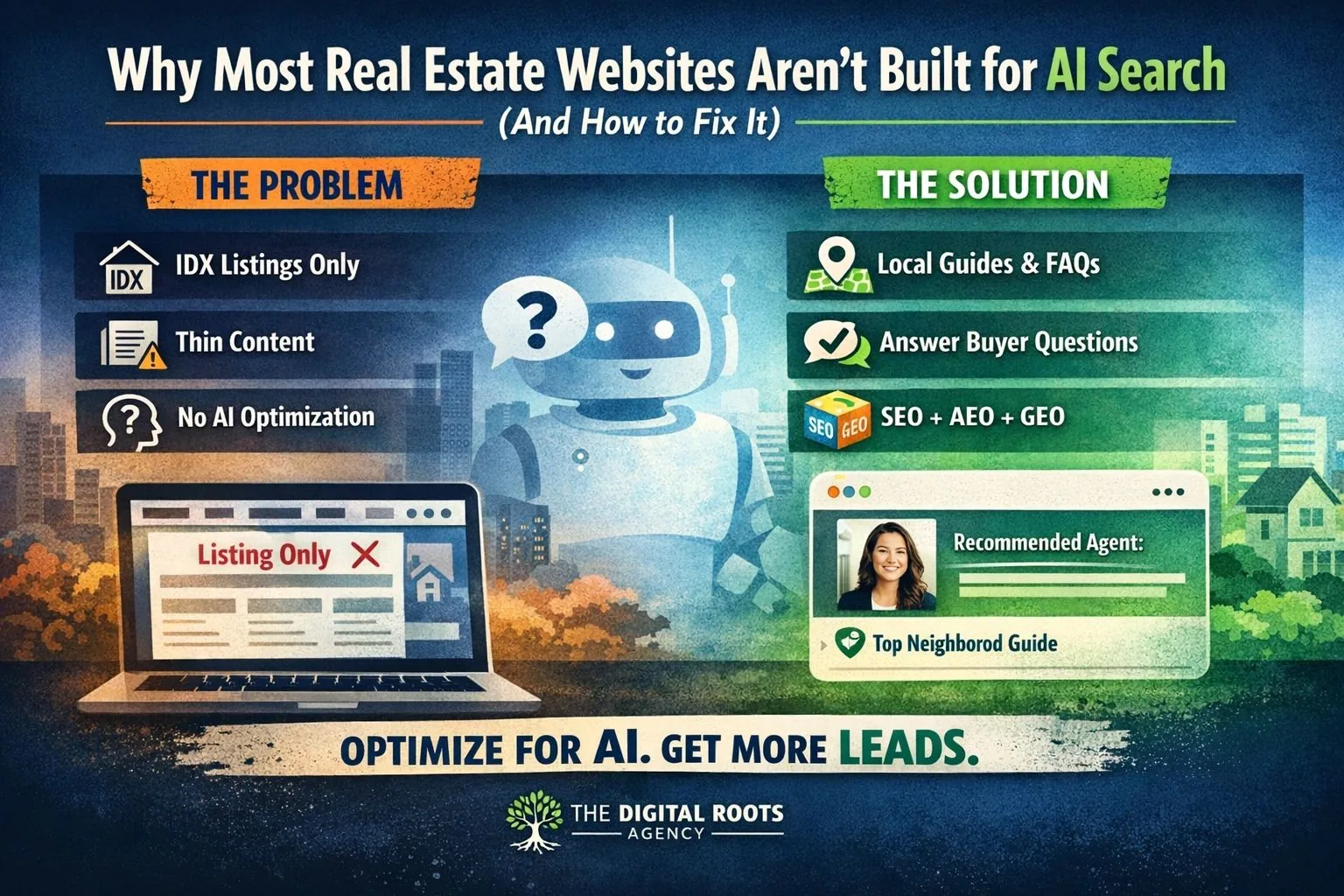
If your real estate website isn’t generating consistent inbound leads, the problem may not be your traffic, it's your visibility in modern search.
In 2026, buyers and sellers aren’t just using Google. They’re asking questions inside AI-powered tools like ChatGPT and Google’s AI search experiences and most real estate websites aren’t showing up at all.
The reason? They weren’t built for how search works today.
What’s Changed in Real Estate Search?
Traditional search used to look like this:
- User types a keyword
- Google shows a list of links
- User clicks and browses
Now, it looks like this:
- User asks a question
- AI generates a direct answer
- AI recommends businesses, agents, and resources
If your website isn’t structured to be understood and selected by AI, you’re invisible in this new environment.
The Core Problem: How Most Real Estate Websites Are Built
Most agent websites rely on:
- IDX driven listing pages
- Minimal written content
- Generic templates
- Little to no structured information
While IDX is useful for displaying listings, it creates:
- Thin, duplicated content
- Poor keyword targeting
- No clear answers for AI systems to pull from
👉 In short: your site looks fine to a human but useless to AI.
Why IDX Alone Isn’t Enough
IDX websites are designed for browsing listings, not answering questions.
AI search engines prioritize:
- Clear, structured content
- Direct answers to specific questions
- Local expertise and authority
IDX pages don’t provide that.
That’s why agents relying only on IDX:
- Don’t rank well
- Don’t get featured in answers
- Don’t get recommended by AI
The New Visibility Stack: SEO + AEO + GEO
To compete in today’s market, your website needs to be optimized for:
SEO (Search Engine Optimization) Helps your site rank in Google
AEO (Answer Engine Optimization) Helps your content get selected as a direct answer
GEO (Generative Engine Optimization) Helps your brand get recommended by AI
The agents winning today are building all three.
How to Fix Your Real Estate Website for AI Search
1. Create Location-Specific Pages
Instead of relying only on listings, build pages like:
- Best Places to Live in [City]
- Living in [Neighborhood]
- Moving to [City] Guide
These pages give AI something to understand, index, and recommend.
2. Answer Real Buyer and Seller Questions
Your content should directly answer questions like:
- How much does it cost to live in [City]?
- Is now a good time to buy?
- What are the best neighborhoods?
👉 This is AEO in action.
3. Add FAQs to Every Key Page
FAQs are one of the easiest ways to:
- Capture long-tail searches
- Get featured in AI answers
- Increase time on page
Short, direct answers win.
4. Build Internal Content Clusters
Connect your content:
- Blog → Neighborhood pages
- Neighborhood pages → Buyer guides
- Buyer guides → Contact pages
This builds authority and helps both Google and AI understand your expertise.
5. Strengthen Local Authority Signals
AI tools look for trust signals across the web.
Make sure you have:
- Optimized Google Business Profile
- Consistent business information
- Strong reviews
- Mentions across local platforms
6. Create Content Consistently
One of the biggest differentiators:
👉 Consistency
Agents who publish regularly:
- Get indexed more often
- Build authority faster
- Appear more frequently in AI results
What Happens When You Fix This?
When your website is built for AI search, you start to see:
- More inbound leads without paid ads
- Higher rankings for local keywords
- Increased visibility in AI-generated answers
- Stronger brand authority in your market
The Reality Most Agents Miss
Most real estate websites were built for:
👉 Browsing listings
Not for:
👉 Being found, trusted, and recommended
That’s why so many agents feel stuck even with a “nice-looking” site.
Want to Know If Your Website Is Optimized for AI?
If you’re not sure where you stand:
👉 Take our AI Visibility Score Quiz
Frequently Asked Questions (FAQs)
Why aren’t real estate websites showing up in AI search results? Most real estate websites lack structured, question-based content that AI tools can understand and pull from. Without clear answers and local authority signals, they are often ignored in AI-generated responses.
What is AI visibility for real estate websites? AI visibility refers to how often your website appears in AI-generated answers, recommendations, and summaries across platforms like ChatGPT and Google AI search.
Is an IDX website enough for real estate marketing? No. IDX is useful for displaying listings, but it does not provide the structured content needed to rank in search or appear in AI-generated answers.
How can I improve my real estate website for SEO and AI search? You can improve your site by creating local content, answering common questions, adding FAQs, building internal links, and strengthening your online authority.
How long does it take to see results? Most agents begin to see improvements in visibility and traffic within 30 to 90 days when consistently publishing optimized content.
Closing Thought
The agents who win in the next era of real estate won’t just have the best listings…They’ll have the most visible websites.