
Search engines don’t just crawl websites anymore.
They extract. They interpret. They synthesize.
And most dealership websites were never built for that.
If your site was designed primarily for inventory display and traditional keyword rankings, it may be technically indexed — but structurally invisible to AI systems.
Here’s why.
The Shift: From Crawling Pages to Extracting Meaning
Traditional search engines focused on:
- Can we crawl the page?
- Is it relevant?
- Does it have backlinks?
- Where should it rank?
AI-driven systems now ask:
- Can we extract a clean answer?
- Is the brand authoritative?
- Is the information structured?
- Is this source reliable enough to cite?
That’s a completely different evaluation model.
Problem #1: JavaScript-Heavy Website Architecture
Many automotive websites rely heavily on dynamic JavaScript frameworks.
Common issues:
- Content loads after initial crawl
- Inventory descriptions are thin or duplicated
- Important copy is hidden behind tabs or expandable modules
- Poor semantic HTML structure
AI systems prefer clean, structured, easily parseable content.
If your content isn’t immediately accessible in the HTML, extraction becomes harder.
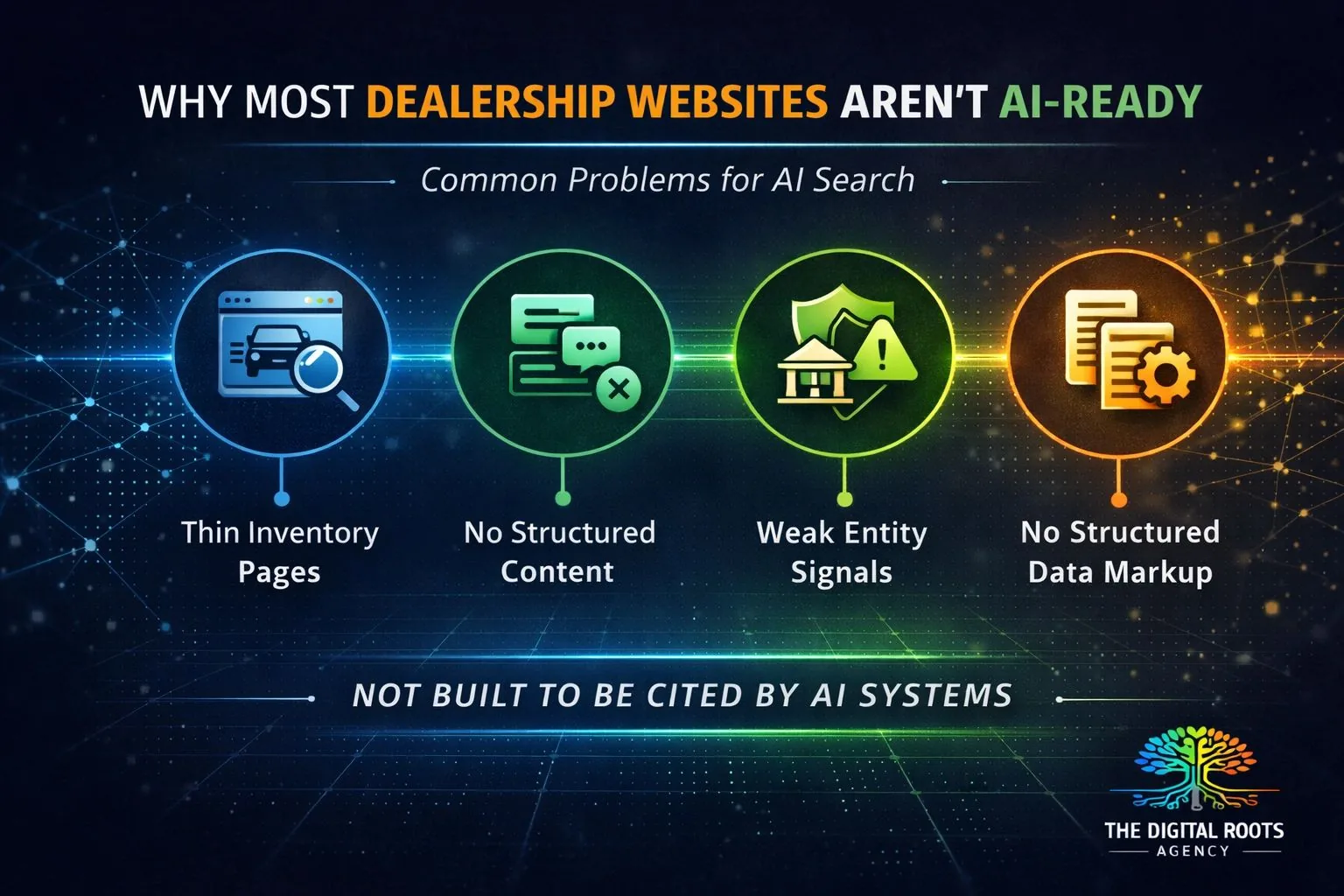
Problem #2: Thin Inventory Pages
Most VDPs (Vehicle Detail Pages) include:
- Manufacturer specs
- Standard descriptions
- Minimal unique insights
- No structured FAQ sections
AI systems rarely cite duplicate or templated content.
If every dealer has the same manufacturer description, there’s no reason to reference yours.
Authority requires differentiation.
Problem #3: No Answer-Structured Content
AI systems favor:
- Clear definitions
- Direct question-and-answer formatting
- Short, precise explanations
- Structured heading hierarchy
Most dealership blogs are written like traditional marketing copy — long paragraphs with minimal structure.
That doesn’t extract well.
Problem #4: Weak Entity Reinforcement
AI doesn’t just look at keywords.
It evaluates entities:
- Brand name consistency
- Location signals
- Industry associations
- External mentions
- Review ecosystem strength
If your dealership is not consistently referenced across trusted platforms, generative systems have less confidence citing you.
This is where Generative Engine Optimization becomes critical.
Problem #5: No FAQ Schema or Structured Data Strategy
Schema markup helps AI systems understand:
- What is a question?
- What is an answer?
- What is a service?
- What is a location?
- What is an organization?
Most dealership websites underutilize structured data beyond basic LocalBusiness schema.
That leaves extraction opportunities on the table.
What an AI-Ready Dealership Website Looks Like
An AI-optimized site includes:
- Clean semantic HTML structure
- Clear H1/H2 hierarchy
- FAQ schema blocks
- Buying guide hubs
- Model-specific answer clusters
- Unique commentary on inventory
- Strong off-site authority reinforcement
It is engineered for:
Eligibility → Extraction → Citation
The Competitive Advantage of Acting Early
AI search is still evolving.
That means authority is still being shaped.
Dealerships that restructure now will:
- Build compounding citation signals
- Increase featured snippet visibility
- Strengthen brand reinforcement across AI systems
- Reduce long-term dependency on paid ads
This is not a minor technical tweak.
It is a structural shift in digital visibility.
Final Takeaway
Most dealership websites were built to rank.
Very few were built to be referenced.
AI search rewards:
- Structure
- Authority
- Clarity
- Distributed validation
If your site is not built for extraction, it cannot compete in an answer-driven search environment.
The question is not whether AI search will grow.
The question is whether your website is engineered for it.
FAQ: AI Optimization for Dealership Websites
Why are most dealership websites not optimized for AI search?
Most dealership sites were designed for traditional SEO and inventory display, not structured answer extraction or generative AI citation models.
Does JavaScript hurt AI crawling?
Heavy JavaScript frameworks can delay or obscure content rendering, making it more difficult for crawlers and AI systems to efficiently extract structured information.
What is an AI-ready website?
An AI-ready website uses clean semantic structure, structured data, FAQ schema, clear content hierarchy, and strong off-site authority signals to improve answer extraction and citation likelihood.
Is technical SEO still important?
Yes. Technical SEO ensures crawlability and indexing, which remain foundational before answer extraction and generative referencing can occur.
How can dealerships future-proof their websites?
Dealerships should combine strong technical SEO, structured content strategy, FAQ schema implementation, and distributed authority building to compete in AI-driven search environments.