
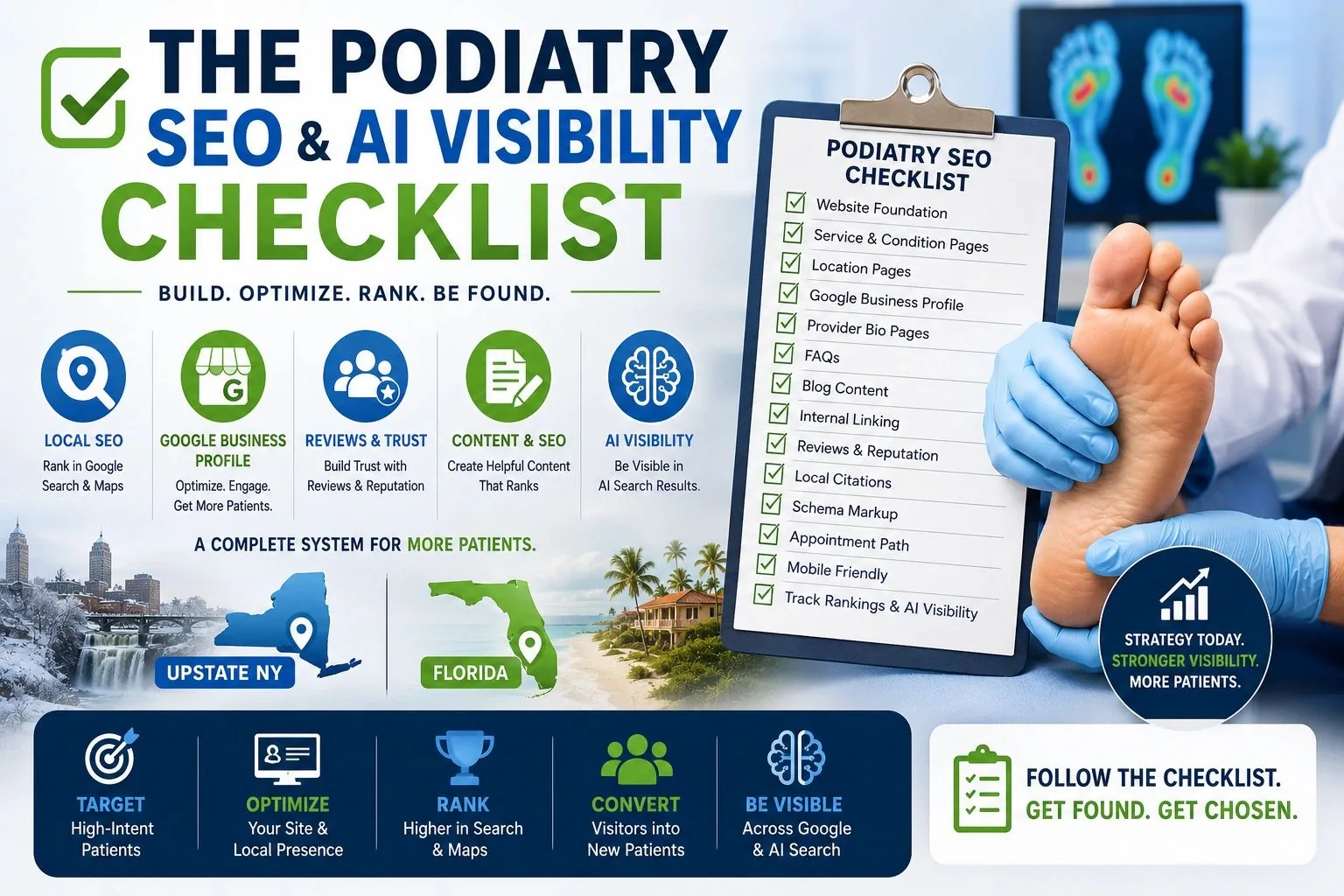
Podiatry practices are facing a new kind of search landscape.
Patients are still using Google. They are still searching “podiatrist near me” and “foot doctor near me.” They are still checking reviews, looking at Google Maps, comparing office locations, and visiting practice websites.
But now they are also asking AI tools for answers.
They are using Google AI Overviews, ChatGPT, Gemini, Perplexity, and other AI-powered platforms to understand symptoms, compare care options, and decide what kind of provider they may need.
That means a podiatry practice needs more than a website.
It needs a complete visibility system.
For practices in Upstate New York, Florida, and other competitive local healthcare markets, the goal is simple:
Be easy for patients to find.
Be easy for Google to understand.
Be easy for AI platforms to interpret.
Be easy for the right patient to choose.
This checklist brings together the major pieces of podiatry SEO and AI Visibility so foot and ankle practices can better understand what to improve, what to prioritize, and how to build a stronger digital foundation.
1. Start With a Clear Website Foundation
Your website is the center of your digital presence.
It should clearly explain who you are, where you are located, what you treat, and how patients can schedule an appointment.
A strong podiatry website should include:
- A clear homepage
- An about the practice page
- Provider biography pages
- A services overview page
- Individual service and condition pages
- Location pages for each office
- A contact page
- An appointment request page
- A frequently asked questions page
- A blog or patient resource center
- Review or trust signals where appropriate
Many podiatry practices have websites that look professional but are structurally too thin.
A homepage and one generic services page may not be enough to rank well for high-intent patient searches.
If your practice treats heel pain, plantar fasciitis, diabetic foot concerns, ingrown toenails, bunions, toenail fungus, custom orthotics, and foot injuries, your website should clearly reflect that.
Google and AI platforms need detail.
Patients need clarity.
A strong website foundation gives both.
2. Create Dedicated Service and Condition Pages
Podiatry SEO works best when your website has dedicated pages for the services and conditions patients are actually searching for.
Important pages may include:
- Heel Pain Treatment
- Plantar Fasciitis Treatment
- Diabetic Foot Care
- Ingrown Toenail Treatment
- Bunion Treatment
- Custom Orthotics
- Toenail Fungus Treatment
- Wound Care
- Neuropathy Foot Care
- Hammertoe Treatment
- Sports Foot Injuries
- Ankle Sprain Treatment
- Pediatric Foot Care
- Geriatric Foot Care
- Foot and Ankle Surgery
Each page should answer real patient questions.
A strong service page should include:
- What the condition or service is
- Common symptoms or concerns
- When a patient may want to contact a podiatrist
- What the practice may evaluate
- Care options offered by the practice
- Provider information
- Location information
- FAQs
- Internal links to related pages
- A clear appointment call-to-action
The goal is not to overcomplicate the website.
The goal is to create clear, useful pages that help patients and search platforms understand your practice.
3. Build Location Pages for Each Office
Local SEO depends heavily on geography.
A podiatry practice in Rochester should not rely on the same page to rank in Canandaigua, Victor, Pittsford, Fairport, and Webster.
A Florida podiatry group in Fort Myers should not rely on one generic contact page to rank in Naples, Cape Coral, Sarasota, Bonita Springs, and Tampa.
Each office location should have its own page.
A strong podiatry location page should include:
- Office name
- Address
- Phone number
- Hours
- Services offered at that location
- Providers at that office
- Parking or access details
- Nearby towns served
- Office photos
- Appointment CTA
- Local FAQs
- Internal links to relevant services
- Connection to the correct Google Business Profile
This helps patients understand whether your office is convenient.
It also helps Google and AI platforms connect your services to specific local markets.
Location pages are especially important for searches like:
- podiatrist Rochester NY
- foot doctor Canandaigua
- podiatrist Fort Myers
- heel pain treatment Naples
- diabetic foot care Sarasota
- ingrown toenail treatment Buffalo
- plantar fasciitis doctor Cape Coral
Local pages turn general visibility into local patient discovery.
4. Optimize Google Business Profile
Your Google Business Profile is one of the most important local SEO assets your practice owns.
For many patients, it may be the first thing they see.
A strong Google Business Profile should include:
- Accurate practice name
- Correct address
- Correct phone number
- Website link
- Appointment link
- Office hours
- Holiday hours
- Primary category
- Secondary categories when appropriate
- Services
- Photos
- Reviews
- Google Posts
- Business description
- Accessibility and location details when available
For podiatry practices, the services section is especially important.
Instead of only listing “podiatry,” the profile should clearly reflect the way patients search.
Relevant services may include:
- Heel pain treatment
- Plantar fasciitis treatment
- Diabetic foot care
- Ingrown toenail treatment
- Bunion treatment
- Custom orthotics
- Toenail fungus treatment
- Foot and ankle care
- Wound care
- Sports injury foot care
- Neuropathy foot care
Your Google Business Profile should match the services and locations shown on your website.
When your website, Google profile, reviews, and local listings all tell the same story, your practice becomes easier to understand and easier to trust.
5. Strengthen Provider Bio Pages
Provider bios are not just “about the doctor” pages.
They are trust pages.
Patients want to know who they are seeing. Search engines and AI platforms also need to understand which providers are connected to the practice and what they do.
A strong podiatrist bio page should include:
- Provider name
- Credentials
- Education
- Training
- Areas of focus
- Locations served
- Patient care philosophy
- Professional memberships when appropriate
- Internal links to relevant service pages
- Internal links to relevant location pages
- Appointment CTA
If a provider frequently sees patients for heel pain, diabetic foot care, sports injuries, wound care, bunions, or foot and ankle surgery, that should be explained naturally and accurately.
Provider bios help build confidence.
They also help create stronger entity signals for AI search.
6. Add FAQs to Important Pages
FAQs are one of the simplest ways to improve SEO and AI Visibility.
Why?
Because patients search with questions.
They ask:
- What does a podiatrist treat?
- When should I see a foot doctor?
- Can a podiatrist help with heel pain?
- Do podiatrists treat diabetic foot concerns?
- What causes foot numbness?
- Are custom orthotics worth it?
- What should I expect at my first podiatry appointment?
- Do I need a referral to see a podiatrist?
FAQ content gives Google and AI platforms clear, structured answers to common patient questions.
A strong podiatry website should have:
- A general FAQ page
- Service-specific FAQs
- Location-specific FAQs when helpful
- Blog FAQs when appropriate
For example, a heel pain page should answer heel pain questions.
A diabetic foot care page should answer diabetic foot care questions.
A location page should answer local appointment, parking, provider, and service questions.
FAQs should be helpful, accurate, and reviewed by the practice when they include clinical information.
The goal is to educate patients, not diagnose them online.
7. Publish Patient-Focused Blog Content
Blog content should not be random.
It should support your services, locations, and patient search intent.
Strong podiatry blog topics include:
- Why Does My Heel Hurt When I Wake Up?
- When Should I See a Podiatrist for Heel Pain?
- What to Expect at Your First Podiatry Appointment
- Can Custom Orthotics Help Foot Pain?
- Why Diabetic Foot Care Matters
- When Should a Patient With Diabetes See a Podiatrist?
- Do I Need a Podiatrist for an Ingrown Toenail?
- What Is the Difference Between a Podiatrist and a Foot Doctor?
- Foot Pain From Sandals: When to Call a Podiatrist
- Common Foot Problems for Runners
- How to Choose a Foot Doctor Near You
Each blog should have a purpose.
It should link to relevant service pages, provider bios, location pages, and appointment pathways.
For example, a blog about heel pain should link to:
- Heel Pain Treatment
- Plantar Fasciitis Treatment
- Custom Orthotics
- Relevant location page
- Appointment page
This turns content into a system.
A blog should not just attract traffic.
It should help patients move closer to choosing your practice.
8. Build Content Clusters Around High-Value Topics
A content cluster is a group of related pages and blogs organized around one important topic.
For podiatry practices, content clusters can help build authority around high-value searches.
A heel pain cluster may include:
- Heel Pain Treatment page
- Plantar Fasciitis Treatment page
- Custom Orthotics page
- Blog: Why Does My Heel Hurt in the Morning?
- Blog: When Should I See a Podiatrist for Heel Pain?
- FAQ: Common Heel Pain Questions
- Provider bio mentioning heel pain care
- Location page mentioning heel pain treatment
A diabetic foot care cluster may include:
- Diabetic Foot Care page
- Wound Care page
- Neuropathy Foot Care page
- Toenail Care page
- Blog: Why Diabetic Foot Care Matters
- Blog: What to Expect at a Diabetic Foot Exam
- Provider bios
- Location pages
- Appointment page
Clusters help patients find related information.
They also help search engines and AI platforms understand that your practice has depth around a topic.
This is much stronger than publishing isolated blog posts with no internal linking strategy.
9. Use Local Language Naturally
Local SEO requires local relevance.
Your content should mention the actual communities your practice serves.
For Upstate NY practices, that may include:
- Rochester
- Buffalo
- Syracuse
- Albany
- Canandaigua
- Victor
- Geneva
- Pittsford
- Fairport
- Webster
- Ithaca
- Saratoga Springs
For Florida practices, that may include:
- Fort Myers
- Naples
- Sarasota
- Cape Coral
- Bonita Springs
- Tampa
- Orlando
- Venice
- Bradenton
- St. Petersburg
- Clearwater
- Port Charlotte
The key is to use local language naturally.
Do not stuff city names into every sentence.
Instead, connect services to actual patient context.
For example:
“Our Rochester podiatry practice helps patients with heel pain, plantar fasciitis, diabetic foot care, ingrown toenails, and other foot and ankle concerns.”
Or:
“Our Fort Myers podiatry office supports patients throughout Southwest Florida with diabetic foot care, heel pain evaluations, custom orthotics, and general foot and ankle care.”
That local clarity helps patients and search platforms understand your relevance.
10. Improve Internal Linking
Internal linking is one of the most overlooked parts of podiatry SEO.
It helps patients navigate your site.
It also helps Google and AI platforms understand how your pages relate to each other.
Important internal links may include:
- Homepage to service pages
- Homepage to location pages
- Service pages to related services
- Service pages to provider bios
- Service pages to location pages
- Blog posts to service pages
- Blog posts to appointment page
- Provider bios to service pages
- Location pages to services available at that office
- FAQ page to relevant service pages
A strong website should feel connected.
No important page should feel buried or isolated.
Internal linking helps turn your website into a clear authority hub.
11. Keep Review Strategy Ethical and Consistent
Reviews help patients choose.
They also support local trust.
A strong review strategy should be:
- Ethical
- Simple
- Consistent
- Privacy-safe
- Easy for patients
- Free of incentives or pressure
- Monitored regularly
For healthcare practices, review responses should be careful.
Avoid confirming private medical details.
Instead of saying:
“We’re glad your heel pain improved after treatment.”
A safer response would be:
“Thank you for sharing your experience. We appreciate your kind words and are grateful you chose our practice.”
This keeps the response professional and protects patient privacy.
Reviews are not just a reputation tool.
They are part of the local SEO and AI Visibility ecosystem.
12. Make Directory Listings Consistent
Podiatry practices often appear across many websites.
These may include:
- Google Business Profile
- Bing Places
- Apple Maps
- Healthgrades
- WebMD
- Zocdoc, when used
- Insurance directories
- Hospital directories
- Local business directories
- Chamber of commerce pages
- Social profiles
- Provider listing sites
The practice name, address, phone number, website, provider information, and services should be consistent wherever possible.
Inconsistent listings can confuse patients.
They can also weaken the clarity that search engines and AI platforms rely on.
This is especially important for practices with multiple locations or multiple providers.
Clean information builds trust.
Confusing information creates friction.
13. Add Schema Where Appropriate
Schema markup is structured data that helps search engines better understand your website.
For podiatry practices, schema may support:
- Local business information
- Medical practice information
- Provider pages
- FAQ pages
- Blog articles
- Service pages
- Location pages
Schema does not replace good content.
It supports good content.
Think of it as an added layer of organization that helps search engines better interpret your pages.
For AI Visibility, clarity matters.
Schema can help reinforce that clarity.
14. Make the Appointment Path Easy
SEO should not just bring people to your website.
It should help them take the next step.
A podiatry website should make appointment requests simple.
Important appointment elements include:
- Clear phone number
- Appointment request button
- Contact form
- Location-specific contact options
- Office hours
- Insurance guidance when appropriate
- Referral information when needed
- Mobile-friendly design
- Click-to-call functionality
- Fast-loading pages
Patients searching for foot and ankle care may be in pain or worried.
The website should not make them work hard to schedule.
A strong appointment path turns visibility into action.
15. Track SEO and AI Visibility Over Time
Podiatry SEO is not a one-time project.
It needs to be tracked and improved over time.
Important metrics may include:
- Organic keyword rankings
- Google Maps rankings
- Google Business Profile views
- Calls from Google Business Profile
- Website traffic
- Blog performance
- Service page performance
- Appointment form submissions
- Click-through rates
- Review growth
- Local ranking movement
- AI search mentions
- Visibility in AI-generated answers
AI Visibility should be monitored with real prompts.
Examples include:
- Who is the best podiatrist near Rochester NY?
- Where can I get heel pain treatment in Fort Myers?
- What podiatrist treats diabetic foot care near Naples?
- Who treats ingrown toenails in Sarasota?
- What foot doctor near me has good reviews?
- Can a podiatrist help with plantar fasciitis?
Tracking helps identify what is working and what needs improvement.
16. Avoid Common Podiatry SEO Mistakes
Many practices struggle with visibility because their digital presence is too thin or disconnected.
Common mistakes include:
- One generic services page
- Missing location pages
- Weak provider bios
- Incomplete Google Business Profile services
- No FAQ content
- No internal linking strategy
- Thin blog posts
- Outdated website content
- Inconsistent directory listings
- Poor review response process
- No appointment CTA
- Missing schema
- No AI Visibility tracking
- Treating SEO as a one-time setup
These issues are common.
They are also fixable.
The right strategy can turn a scattered digital presence into a clear visibility system.
17. Build for Patients First, Search Engines Second
The best podiatry SEO content is written for patients first.
It should be clear, helpful, accurate, and easy to understand.
Search engines and AI platforms are more likely to understand your practice when your website clearly serves real people.
That means your content should:
- Answer real questions
- Use patient-friendly language
- Avoid unnecessary jargon
- Explain services clearly
- Include local context
- Make the next step easy
- Stay medically responsible
- Be reviewed by the practice when needed
Good healthcare content should never feel like keyword stuffing.
It should feel like guidance.
The Final Podiatry SEO and AI Visibility Checklist
Here is the simplified version:
- Clear homepage
- Dedicated service pages
- Dedicated condition pages
- Individual location pages
- Strong provider bios
- Optimized Google Business Profile
- Accurate services listed
- High-quality photos
- Ethical review strategy
- Privacy-safe review responses
- General FAQ page
- Service-specific FAQs
- Helpful blog content
- Internal linking strategy
- Local city and market references
- Consistent directory listings
- Schema markup where appropriate
- Easy appointment path
- Mobile-friendly website
- Local ranking tracking
- AI Visibility tracking
- Ongoing content updates
This is the foundation.
The practices that build this system now will be better positioned as patient search behavior continues to evolve.
Podiatry SEO Is Really About Patient Discovery
At its core, podiatry SEO is not just about rankings.
It is about patient discovery.
It is about helping someone with heel pain find the right foot doctor.
It is about helping a patient with diabetes understand when to contact a podiatrist.
It is about helping someone compare local practices with confidence.
It is about making sure Google and AI platforms can clearly understand your services, locations, providers, and trust signals.
The future of podiatry marketing will not be won by the practices that simply have a website.
It will be won by the practices that are easiest to find, easiest to understand, and easiest to trust.
Want to See How Visible Your Podiatry Practice Is?
The Digital Roots Agency helps podiatry practices improve organic SEO, Google Business Profile performance, local search visibility, website structure, content strategy, and AI Visibility across Google, Google Maps, ChatGPT, Gemini, Perplexity, and other AI-driven search experiences.
If your practice wants to rank for searches like “podiatrist near me,” “foot doctor near me,” “heel pain treatment,” “diabetic foot care,” “plantar fasciitis specialist,” “ingrown toenail treatment,” or “custom orthotics near me,” we can help build the visibility system to get you found.