
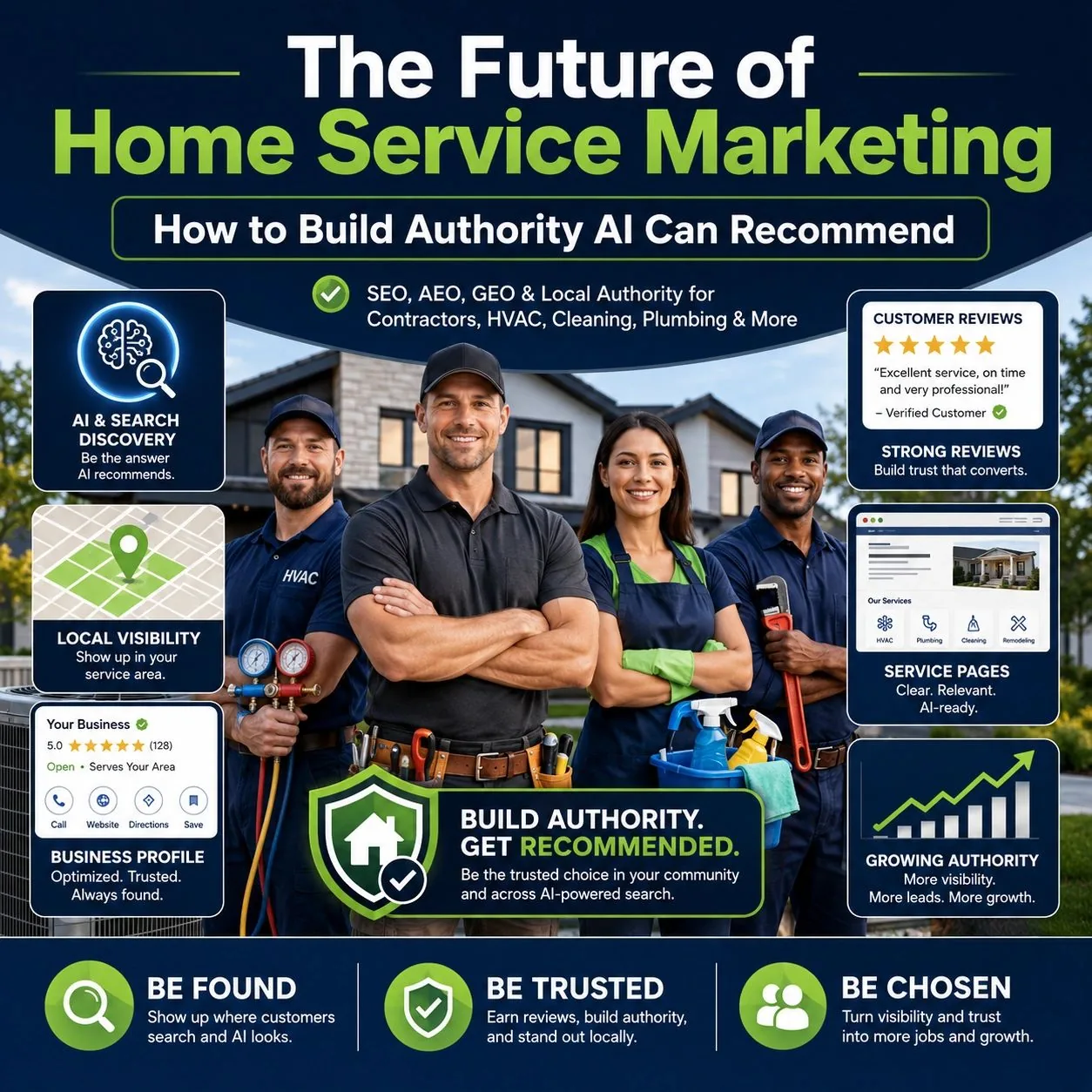
Home service marketing is entering a new era.
For years, the goal was simple.
Get found on Google.
Run some ads.
Ask for reviews.
Post on social media when there was time.
Build a website that made the business look professional.
That playbook still matters, but it is no longer enough on its own.
In 2026, homeowners are searching across more platforms, asking more detailed questions, and using AI tools to help make decisions faster.
They are not just searching for “contractor near me” or “HVAC company near me.”
They are asking who they can trust, who serves their neighborhood, who has strong reviews, who can handle their exact issue, who explains the process clearly, and who other homeowners recommend.
That means contractors, HVAC companies, cleaning businesses, plumbers, roofers, electricians, landscapers, remodelers, pest control companies, and other home service brands are not just competing for clicks anymore.
They are competing for authority.
The businesses that win will be the ones that are easiest for homeowners to trust and easiest for AI platforms to understand.
That is the future of home service marketing.
Not just visibility.
Authority.
Because if AI cannot understand your business, it cannot recommend your business.
Homeowners Are Searching Differently
The way homeowners search has changed.
A homeowner with a broken AC may still search for “AC repair near me,” but they may also ask AI whether it makes more sense to repair or replace the unit.
Someone planning a bathroom renovation may search Google, read reviews, compare contractors, watch YouTube videos, and ask ChatGPT what questions to ask before hiring.
A renter may need move out cleaning before a final walkthrough and use Google Maps to compare reviews, availability, and service areas.
A homeowner with a roof leak after a storm may want to know who responds quickly, who has strong local reviews, and who serves their town.
A business owner looking for office cleaning may want a reliable company with recurring service options and clear commercial experience.
These are not one-click decisions anymore.
They are research journeys.
Homeowners move between Google Search, Google Maps, Google Business Profile, Google AI Overviews, ChatGPT, Gemini, Perplexity, YouTube, reviews, websites, directories, and social media before deciding who to call.
That means your business needs to show up clearly across the entire journey.
Not just in one place.
Every touchpoint should reinforce the same message:
This business is real.
This business is local.
This business offers the service I need.
This business has proof.
This business can be trusted.
Authority Is The New Competitive Advantage
In the old marketing world, visibility often meant ranking for a keyword or paying for an ad.
In the new marketing world, visibility is more connected.
Google, AI platforms, and homeowners are looking for signals that help them decide who is credible.
That is where authority comes in.
Authority is not just about being known.
It is about being clearly understood and consistently trusted.
For a home service business, authority comes from the way your website, Google Business Profile, reviews, service pages, location pages, FAQs, photos, schema markup, directory listings, local content, and customer experience all work together.
An HVAC company builds authority when its website clearly explains AC repair, furnace replacement, heat pump installation, emergency HVAC service, maintenance plans, and service areas.
A cleaning company builds authority when it clearly explains recurring cleaning, move out cleaning, deep cleaning, office cleaning, post construction cleaning, and local availability.
A contractor builds authority when it clearly shows kitchen remodeling, bathroom renovation, basement finishing, additions, decks, project photos, customer reviews, and local experience.
A plumber builds authority when it has clear pages for drain cleaning, water heater replacement, leak repair, emergency plumbing, sump pumps, and fixture installation.
The more clearly your digital footprint explains who you are, what you do, where you work, and why customers trust you, the stronger your authority becomes.
That authority helps search engines.
It helps AI platforms.
Most importantly, it helps homeowners feel confident enough to call.
The Visibility Stack Has Changed
Home service businesses used to think mainly in terms of SEO.
SEO is still important.
But today, SEO is only one layer of the visibility stack.
Modern home service marketing needs SEO, AEO, GEO, local SEO, Google Business Profile optimization, reviews, content, schema, and conversion strategy working together.
SEO helps your business rank in traditional search results.
AEO, or Answer Engine Optimization, helps your content answer the questions homeowners ask before they make a decision.
GEO, or Generative Engine Optimization, helps AI platforms understand and potentially recommend your business.
Local SEO helps your business show up in Google Maps, local searches, service area searches, and “near me” results.
Google Business Profile helps homeowners see reviews, photos, services, hours, and call options quickly.
Reviews prove that real customers trust your business.
FAQs help answer real questions.
Schema markup helps search engines interpret your content more clearly.
Photos and project proof help people see the quality of your work.
Lead tracking and follow up help turn visibility into booked jobs.
No single tactic carries the whole strategy anymore.
The businesses that win are the ones that connect the pieces.
Your Website Needs To Become An Authority Hub
A home service website should not be a digital brochure.
It should be an authority hub.
That means it should do more than say who you are and list a few services.
It should clearly answer the questions homeowners ask before hiring.
It should explain what services you offer, where you offer them, what customers can expect, what problems you solve, what makes your business trustworthy, and how someone can take the next step.
For example, an HVAC website should not only say “heating and cooling services.” It should explain AC repair, furnace replacement, heat pump installation, ductless mini splits, maintenance plans, indoor air quality, emergency HVAC service, and the areas served.
A cleaning company website should not only say “residential and commercial cleaning.” It should explain recurring cleaning, move out cleaning, deep cleaning, office cleaning, post construction cleaning, Airbnb turnover cleaning, scheduling, supplies, and trust factors.
A remodeling contractor website should not only say “home improvement.” It should explain kitchen remodeling, bathroom renovation, basement finishing, additions, decks, project timelines, materials, design process, and completed work.
That kind of website helps homeowners.
It also helps Google and AI platforms understand the business in more detail.
The goal is to make your website the clearest source of truth about your company.
Dedicated Service Pages Create Clarity
One of the biggest mistakes in home service marketing is relying on one generic services page.
That approach creates a clarity problem.
Every important service should have its own dedicated page.
That does not mean creating thin pages stuffed with keywords.
It means creating useful pages that explain each service in a way homeowners can understand.
Someone searching for emergency HVAC repair has a very different need than someone comparing heat pump installation.
Someone booking move out cleaning has a different urgency than someone looking for recurring cleaning.
Someone researching bathroom renovation is making a different decision than someone trying to fix a roof leak after a storm.
Each service has its own search intent, customer questions, timeline, and trust factors.
Dedicated service pages allow your business to meet those needs directly.
They also help search engines and AI platforms understand what your business should be known for.
A strong service page should explain the service, signs the customer may need it, what is included, where it is available, common questions, trust signals, reviews, photos, and a clear call to action.
That is how service pages turn into authority assets.
Service Area Pages Prove Where You Work
Home service businesses need location clarity.
A homeowner wants to know if you serve their area.
Google wants to understand where your business is relevant.
AI platforms need enough location context to connect your company to local recommendations.
That is why service area pages matter.
A business that serves multiple towns, cities, neighborhoods, or counties should make that clear on the website.
But the pages need to be useful.
A service area page should not just swap out a city name and repeat the same content.
It should explain the services available in that area, the types of customers served, common local needs, nearby communities, reviews or project proof when possible, and how to contact the business.
For example, an HVAC company can create useful local pages around AC repair, furnace service, heat pump installation, and emergency HVAC service in the markets it wants to grow.
A cleaning company can build local pages around recurring cleaning, move out cleaning, deep cleaning, office cleaning, and post construction cleaning in its service areas.
A contractor can create local content around kitchen remodeling, bathroom renovation, basement finishing, decks, additions, and exterior projects.
The goal is simple.
Connect your services to the places where your customers are searching.
That connection supports local SEO and AI Visibility.
Google Business Profile Is Still A Core Trust Signal
Google Business Profile remains one of the most important assets in home service marketing.
For many homeowners, it is the first impression.
They may see your star rating, reviews, photos, service categories, hours, phone number, and business description before they ever visit your website.
That means your profile needs to be complete, accurate, and active.
If your Google Business Profile is thin or outdated, it can weaken trust.
If it clearly reflects your services, locations, reviews, photos, and customer experience, it can help generate more calls.
For home service businesses, the profile should support the same story as the website.
If your website says you offer emergency plumbing, drain cleaning, water heater replacement, and sump pump service, your profile should support those services.
If your website says you offer AC repair, heat pump installation, and maintenance plans, your profile should reflect that.
If your website says you offer move out cleaning, recurring cleaning, office cleaning, and post construction cleaning, your profile should reinforce it.
Alignment matters.
When your website, Google Business Profile, reviews, and directory listings all tell the same story, your digital authority becomes stronger.
Reviews Turn Authority Into Trust
Reviews are one of the most powerful trust signals for home service businesses.
They help customers feel confident.
They help Google understand reputation.
They help AI platforms interpret customer experience.
But the best reviews are specific.
A review that says “great job” is helpful.
A review that says, “They repaired our AC in Victor during a heat wave and explained the issue clearly,” is much stronger.
A review that says, “The team handled our move out cleaning in Rochester before our final walkthrough and left everything spotless,” gives more context.
A review that says, “Our bathroom renovation in Pittsford was completed on schedule and the communication was excellent,” tells a useful story.
Specific reviews connect services, locations, outcomes, and trust.
That is incredibly valuable for home service SEO and AI Visibility.
The goal is not just to get more reviews.
The goal is to build a review profile that reflects the services and markets you want to grow.
Real reviews from real customers create the kind of proof that marketing copy cannot fake.
Content Helps You Show Up Before The Customer Is Ready To Buy
Not every homeowner is ready to call right away.
Some are still researching.
They may want to know whether to repair or replace their AC system, how often to schedule professional cleaning, what questions to ask before hiring a remodeling contractor, what causes a drain to clog repeatedly, how to compare roofing estimates, or when to replace a water heater.
This is where helpful content matters.
Blog posts, FAQs, guides, service explainers, project spotlights, seasonal maintenance tips, and local resources help your business show up earlier in the decision process.
That early visibility can build trust before the homeowner is ready to contact anyone.
For example, an HVAC company can publish content around AC repair before summer, furnace maintenance before winter, and heat pump questions as more homeowners explore energy efficiency.
A cleaning company can publish content around move out cleaning checklists, deep cleaning expectations, recurring cleaning schedules, and office cleaning benefits.
A contractor can publish content around bathroom renovation timelines, kitchen remodeling planning, basement finishing ideas, and project budgeting.
This type of content supports SEO.
It supports AEO by answering questions.
It supports GEO by giving AI platforms more useful context about your expertise.
Helpful content is not filler.
It is authority building.
Schema Helps Search Engines Read The Signals
Schema markup is not the most exciting part of marketing, but it matters.
Schema is structured data that helps search engines better understand information on your website.
For home service businesses, schema can help organize details about your business, services, locations, FAQs, reviews, and contact information.
It does not replace good content.
It supports good content.
Think of it as a way to make your website easier for search engines to read.
If your website clearly explains your services and locations, schema helps label that information more effectively.
That clarity can support SEO and AI readability.
For businesses competing in crowded local markets, every clarity signal matters.
Strong content tells the story.
Schema helps organize the story.
Together, they make your website easier to understand.
Local Authority Should Extend Beyond Your Website
Your website is important, but it should not be the only place your business has authority.
Search engines and AI platforms look at broader signals across the web.
That means local authority should extend beyond your own site.
Home service businesses can build authority through local partnerships, community involvement, sponsorships, local publications, project features, directory listings, industry sites, social media, YouTube, customer stories, and review platforms.
A contractor can build authority by sharing local project stories and before and after examples.
An HVAC company can create seasonal tips for homeowners in its service area.
A cleaning company can build partnerships with real estate agents, landlords, property managers, or local offices.
A roofer can publish storm damage guidance after major weather events.
A landscaper can create seasonal content around lawn care, outdoor living, and property maintenance.
The goal is to create a distributed authority footprint.
When your business appears consistently across trusted sources, it becomes easier for Google and AI platforms to understand your credibility.
Authority is not built in one place.
It is built across the web.
Conversion Still Matters
Visibility is only valuable if it turns into action.
A business can rank, appear in maps, earn reviews, and build AI Visibility, but still lose leads if the conversion path is weak.
That is why home service websites need clear calls to action.
Phone numbers should be easy to find.
Request a quote buttons should be obvious.
Forms should be simple.
Emergency service options should be clear.
Mobile experience should be fast.
Service pages should guide homeowners toward the next step.
This matters especially for urgent services like emergency HVAC repair, plumbing leaks, roof leaks, pest control, water heater issues, garage door repair, drain cleaning, and electrical problems.
When someone needs help quickly, friction costs money.
For larger projects like remodeling, roofing, landscaping, additions, or renovations, the conversion path should make it easy to schedule a consultation or request an estimate.
The goal is not just more traffic.
The goal is more qualified calls, form submissions, appointments, estimates, and booked jobs.
AI Visibility Needs Operations Behind It
Marketing creates opportunities.
Operations converts them.
This is one of the most overlooked parts of home service growth.
A company can improve SEO, local SEO, Google Business Profile visibility, reviews, and AI Visibility, but if calls are missed or form submissions sit unanswered, the business loses revenue.
Lead follow up matters.
Call tracking matters.
CRM workflows matter.
Text follow up matters.
Appointment scheduling matters.
Speed matters.
Homeowners often contact more than one provider.
The company that responds quickly and professionally has an advantage.
This is especially true for urgent service categories, but it also applies to larger projects.
A bathroom renovation lead, roofing estimate, cleaning quote, or HVAC replacement inquiry can go cold if the follow up is slow.
The strongest home service companies connect visibility with execution.
They do not just get found.
They answer the phone.
They follow up.
They book the job.
They measure what is working.
That is how marketing turns into growth.
The Digital Roots Framework For Home Services
The future of home service marketing requires a connected system.
At The Digital Roots Agency, we think about this through three layers:
SEO, AEO, and GEO.
SEO helps home service businesses improve visibility in traditional search.
AEO helps them answer the questions homeowners are asking.
GEO helps AI platforms understand and recommend them.
For home service brands, those three layers need to be supported by local SEO, Google Business Profile optimization, reviews, service pages, location pages, FAQs, schema, content, photos, directory consistency, and lead tracking.
That is the full visibility system.
It is not about chasing one algorithm.
It is about building a digital footprint that is clear, trustworthy, and easy to understand.
When that system works, a contractor, HVAC company, cleaning business, plumber, roofer, electrician, landscaper, or remodeler becomes easier to find across Google, maps, AI search, reviews, and trusted local sources.
That is how home service companies build authority AI can recommend.
The Big Shift: From Marketing Tactics To Authority Systems
The biggest shift in home service marketing is the move from isolated tactics to connected authority systems.
A website alone is not enough.
Ads alone are not enough.
Reviews alone are not enough.
A Google Business Profile alone is not enough.
A few blog posts alone are not enough.
The businesses that win are the ones that connect all of these pieces.
They build clear service pages.
They create useful service area pages.
They optimize Google Business Profile.
They collect specific reviews.
They answer real homeowner questions.
They use schema to clarify content.
They publish helpful local content.
They show real photos and project proof.
They keep directory information consistent.
They track calls and form submissions.
They follow up quickly.
They build trust across every touchpoint.
That is what creates authority.
And authority is what helps a business stand out in both traditional search and AI search.
Final Thoughts
The future of home service marketing belongs to businesses that can be found, understood, trusted, and recommended.
For contractors, HVAC companies, cleaning businesses, plumbers, roofers, electricians, landscapers, remodelers, pest control companies, and other local service providers, this is the new standard.
Homeowners are searching differently.
AI platforms are changing discovery.
Google Business Profile still matters.
Reviews still matter.
Service pages still matter.
Local SEO still matters.
But they all need to work together.
The businesses that build digital authority now will be better positioned for the next wave of search.
They will show up more clearly.
They will answer more questions.
They will earn more trust.
They will convert more leads.
And they will become easier for AI platforms to understand and recommend.
Because in the future of home service marketing, the goal is not just to be online.
The goal is to become the obvious choice.
And if AI cannot understand your business, it cannot recommend your business.
FAQs About The Future Of Home Service Marketing
What is the future of home service marketing?
The future of home service marketing is built around SEO, AEO, GEO, local SEO, Google Business Profile optimization, reviews, service pages, location pages, content, schema markup, and AI Visibility. Home service businesses need to be easy for homeowners, search engines, and AI platforms to understand and trust.
Why is AI Visibility important for home service businesses?
AI Visibility is important because homeowners are using AI platforms and search engines to compare local service providers. If AI tools cannot clearly understand what a business does, where it works, and why customers trust it, the business may be less likely to be included in recommendations.
What does authority mean in home service marketing?
Authority means your business is clearly understood and consistently trusted across the web. It comes from strong website content, service pages, reviews, Google Business Profile, local SEO, FAQs, schema, project proof, directory consistency, and local authority signals.
How do SEO, AEO, and GEO work together for home services?
SEO helps a business rank in traditional search. AEO helps the business answer customer questions. GEO helps AI platforms understand and potentially recommend the business. Together, they create a stronger visibility system for home service companies.
Why are service pages important for home service companies?
Service pages help search engines, AI platforms, and customers understand what a business offers. Dedicated pages for services like AC repair, move out cleaning, bathroom renovation, drain cleaning, roof repair, water heater replacement, or landscaping create more clarity than one generic services page.
Why are service area pages important?
Service area pages help connect services to specific cities, towns, neighborhoods, and regions. They support local SEO and AI Visibility by making it clear where a home service business operates.
Does Google Business Profile still matter in 2026?
Yes. Google Business Profile is still one of the most important local visibility tools for home service businesses. It helps homeowners see reviews, photos, services, hours, location information, and contact options quickly.
How do reviews support AI Visibility?
Reviews help AI platforms understand customer trust, service quality, and local relevance. Reviews that mention specific services and locations provide stronger context than generic reviews.
What type of content should home service businesses create?
Home service businesses should create service pages, service area pages, FAQs, blog posts, maintenance guides, project spotlights, seasonal tips, comparison content, and customer-focused educational resources.
Is paid advertising still useful for home service businesses?
Yes. Paid advertising can help generate quick visibility and leads, especially for urgent services. However, paid ads work best when supported by strong SEO, local SEO, reviews, service pages, and AI Visibility.
How can home service businesses improve conversion?
Home service businesses can improve conversion by making phone numbers easy to find, simplifying quote forms, using clear calls to action, improving mobile experience, offering fast follow up, tracking calls and forms, and responding quickly to inquiries.
What is the biggest mistake home service businesses make online?
The biggest mistake is treating marketing as disconnected tactics instead of one authority system. A website, ads, reviews, Google Business Profile, content, and SEO should all work together to make the business easier to find, understand, trust, and recommend.
Want to know if your home service business is ready for the future of search?
The Digital Roots Agency helps contractors, HVAC companies, cleaning companies, plumbers, roofers, electricians, landscapers, remodelers, and local service brands build stronger SEO, AEO, GEO, local authority, Google Business Profile visibility, reviews, and AI Visibility across Google, ChatGPT, Gemini, and other discovery platforms.
Schedule a free AI Visibility Audit today and see where your business stands.