
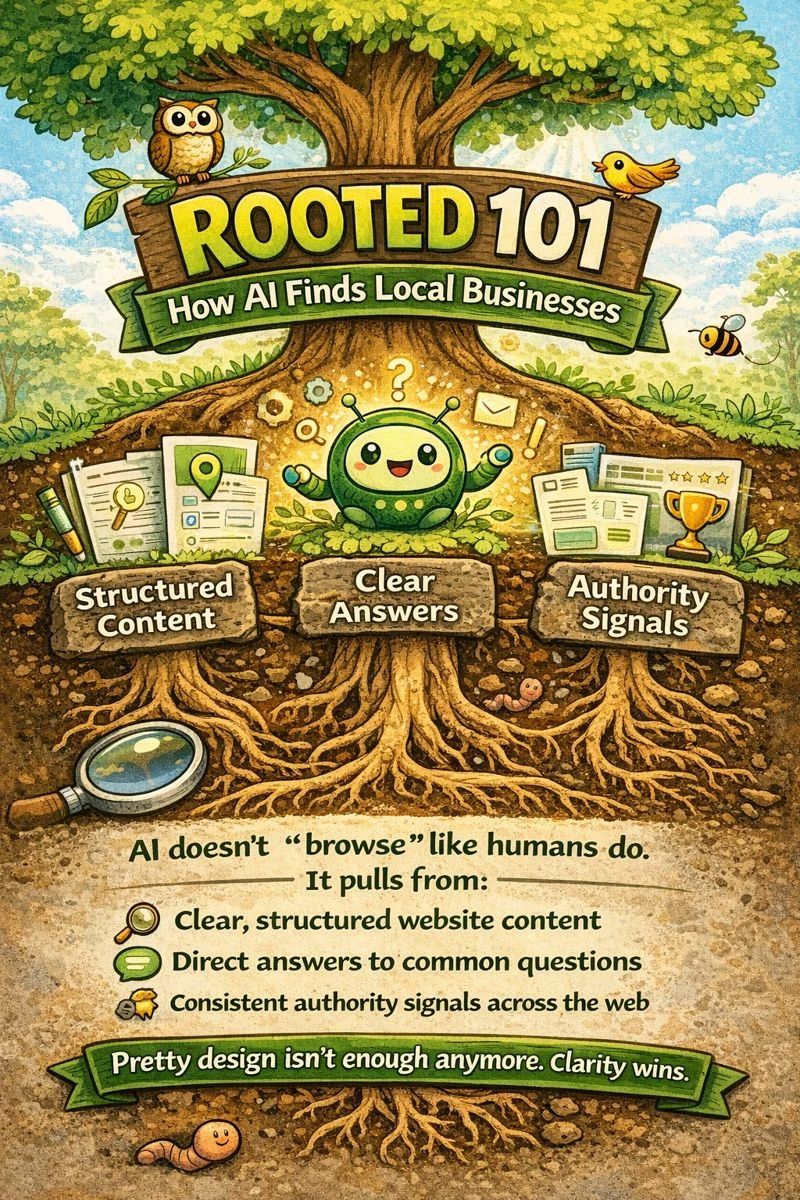
AI doesn’t search the internet the way humans do.
It doesn’t scroll websites, skim social feeds, or judge design the way people do. Instead, AI systems evaluate signals, structure, and consistency to decide which businesses to surface and which to ignore.
Understanding how AI finds local businesses is essential if you want to stay visible as search continues to evolve.
How AI Search Is Different From Traditional Search
Traditional search engines were designed to return lists of links. AI-powered search tools are designed to return answers and recommendations.
That difference changes everything.
AI is not asking:
“Which website matches this keyword?”
AI is asking:
“Which business best answers this question?”
To answer that, AI relies on clarity and trust, not aesthetics.
AI Does Not “Browse” Websites
One of the biggest misconceptions about AI search is that it behaves like a human user.
It doesn’t.
AI does not:
- Scroll through pages
- Click through menus
- Watch videos or social posts
- Appreciate branding or visual design
Instead, AI extracts meaning from content that is easy to parse and verify.
If your website or digital presence is difficult to interpret, AI moves on.
What AI Actually Pulls From
AI systems look for repeatable, structured patterns across the web. The strongest signals typically fall into three categories.
1. Clear, Structured Website Content
AI prioritizes websites that are:
- Well-organized
- Clearly labeled
- Easy to interpret semantically
This includes:
- Logical page hierarchies
- Descriptive headings
- Clear service pages
- Schema-friendly formatting
If your content lacks structure, AI may not understand what you do even if you say it clearly to humans.
2. Direct Answers to Common Questions
AI thrives on explicit answers.
Pages that include:
- FAQs
- Clear definitions
- Short, direct explanations
are far more likely to be used by AI systems.
This is where Answer Engine Optimization (AEO) plays a critical role. When your content answers real questions in plain language, AI can confidently reuse and reference it.
3. Consistent Authority Signals Across the Web
AI looks beyond your website.
It cross-checks information across:
- Business listings
- Reviews
- Local mentions
- Trusted third-party sites
Inconsistencies weaken trust. Consistency strengthens it.
If your business details, messaging, or reputation vary across platforms, AI hesitates to recommend you.
Why “Pretty” Design Isn’t Enough
A visually beautiful website does not guarantee AI visibility.
Design is for humans. Structure is for AI.
AI values:
- Clarity over creativity
- Accuracy over aesthetics
- Consistency over cleverness
A site that looks impressive but lacks clear information is often invisible to AI systems.
How AI Decides Which Local Businesses to Recommend
When AI is asked for a local recommendation, it weighs several confidence factors, including:
- Location clarity
- Relevance to the question
- Trustworthiness
- Authority within a topic or area
AI prefers businesses that can explain easily and defend confidently.
If AI cannot clearly summarize what makes your business a good recommendation, it won’t risk suggesting you.
The Role of GEO in AI Discovery
Generative Engine Optimization (GEO) focuses on recommendation readiness.
While SEO helps you be found and AEO helps you be understood, GEO helps AI decide:
“Is this the right business to suggest?”
Strong GEO signals include:
- Clear service definitions
- Local relevance
- Consistent reviews
- Topic authority
Without GEO, businesses may exist online but remain invisible in AI-driven search.
Common Reasons AI Ignores Local Businesses
Many businesses are invisible to AI not because they’re bad but because they’re unclear.
Common issues include:
- Vague service descriptions
- Unstructured content
- Missing FAQs
- Inconsistent business information
- Weak or generic reviews
AI cannot recommend what it cannot confidently understand.
Building AI-Friendly Visibility
To improve how AI finds your business, focus on:
- Clear, structured website content
- Direct answers to common customer questions
- Consistent authority signals across platforms
- Strong local relevance
This is not about gaming algorithms. It’s about removing ambiguity.
Frequently Asked Questions
How does AI find local businesses?
AI finds local businesses by analyzing structured content, direct answers, reviews, and consistent authority signals across the web.
Does AI use websites or reviews more?
AI uses both. Websites provide structure and clarity, while reviews help AI assess trust, relevance, and service focus.
Why isn’t my business showing up in AI results?
Most businesses are optimized for traditional SEO only. Without structured answers, clear messaging, and trust signals, AI systems cannot confidently recommend them.
Is social media important for AI visibility?
Social media can support authority, but AI prioritizes structured, verifiable information over social activity.
Final Thought
AI doesn’t reward noise.
It rewards clarity.
If your business isn’t easy for AI to understand, it won’t be easy for AI to recommend.
And visibility in modern search starts with building strong roots