
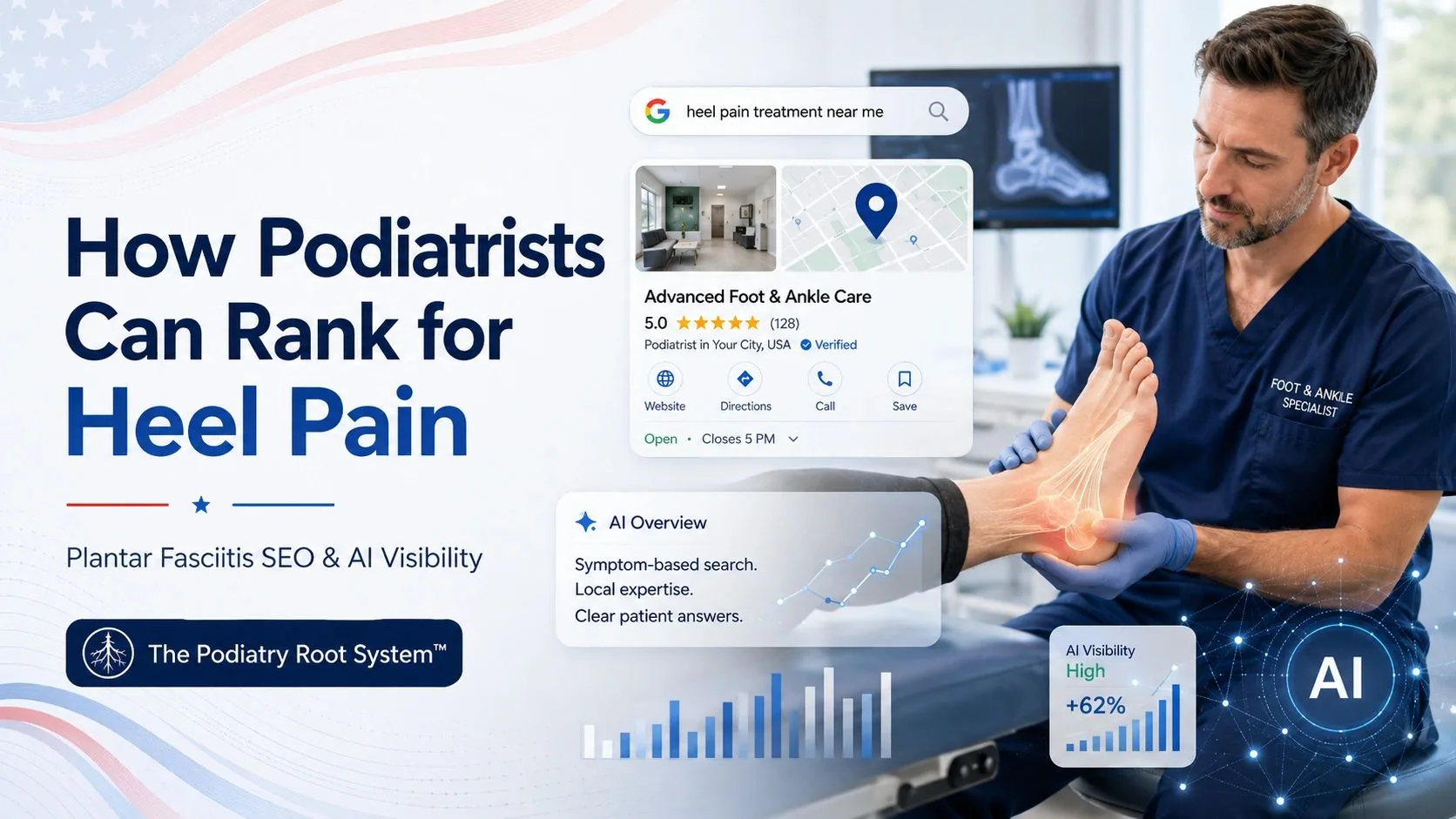
When someone searches for heel pain online, they are usually not looking for casual reading.
They are looking for answers.
They may be waking up with sharp pain in the bottom of the foot. They may be wondering if they have plantar fasciitis. They may be searching for a foot doctor nearby because walking, working, running, or standing has become uncomfortable.
For podiatry practices, this creates a major SEO and AI Visibility opportunity.
Patients often search by symptom before they search by provider. That means a person may search “why does my heel hurt when I wake up?” before they ever search “podiatrist near me.”
If your practice wants to rank for more high-intent local searches, heel pain and plantar fasciitis content should be part of your digital strategy.
For podiatrists in Upstate New York and Florida, this is especially important. Whether your practice serves Rochester, Buffalo, Syracuse, Albany, Canandaigua, Fort Myers, Naples, Sarasota, Tampa, Orlando, or Cape Coral, patients in your area are searching for answers before they choose a provider.
The question is whether your practice is showing up when they do.
Why Heel Pain Searches Matter for Podiatry SEO
Heel pain is one of the clearest examples of symptom-based search intent.
A patient may not know what is causing the pain. They may not know whether they need a podiatrist, primary care doctor, physical therapist, orthotics, imaging, or a specialist.
So they start with Google or an AI tool.
They may search:
- why does my heel hurt?
- heel pain in the morning
- pain on bottom of heel
- plantar fasciitis symptoms
- plantar fasciitis doctor near me
- heel pain treatment near me
- foot doctor for heel pain
- podiatrist for plantar fasciitis
- custom orthotics for heel pain
- best podiatrist for heel pain near me
These searches are valuable because they often come from patients who are already experiencing a problem.
For a podiatry practice, ranking for these terms can help create visibility before the patient has made a decision.
That is the real power of condition-based SEO.
You are not only trying to rank for your practice name. You are trying to become visible during the patient’s decision-making process.
Patients Search Symptoms Before Services
Many podiatry websites organize content around services.
That is a good start.
But patients often do not think in service categories.
They think in symptoms.
A podiatrist may describe a service as “plantar fasciitis treatment.” A patient may describe the same concern as:
- my heel hurts when I get out of bed
- sharp pain under my foot
- stabbing pain in my heel
- pain after standing all day
- arch and heel pain
- heel pain after running
- foot pain that gets worse after sitting
That language matters.
Strong podiatry SEO should include both clinical terminology and patient-friendly search language.
For example, a strong plantar fasciitis page should not only say “plantar fasciitis treatment.” It should also answer questions like:
- What does plantar fasciitis feel like?
- Can a podiatrist treat plantar fasciitis?
- When should I see a podiatrist for heel pain?
- What causes heel pain in the morning?
- Are custom orthotics used for heel pain?
- What happens at a podiatry appointment for heel pain?
This helps Google understand the page. It also helps AI platforms understand that your practice is relevant to the patient’s question.
Most importantly, it helps the patient feel understood.
The Role of a Dedicated Heel Pain Page
If your podiatry website does not have a dedicated heel pain or plantar fasciitis page, you may be missing a major organic search opportunity.
A single general services page usually is not enough.
A stronger structure would include a dedicated page such as:
Heel Pain Treatment or Plantar Fasciitis Treatment
That page should clearly explain:
- What heel pain is
- Common reasons patients experience heel pain
- When a patient should consider seeing a podiatrist
- What a podiatrist may evaluate during an appointment
- Treatment options the practice offers
- Whether the practice provides custom orthotics
- Where the practice is located
- How to schedule an appointment
For SEO and AI Visibility, the page should also include local context.
For example:
“Patients in Rochester, Canandaigua, and Victor who are dealing with heel pain can contact our podiatry office for an evaluation.”
Or:
“Our Fort Myers podiatry practice helps patients with heel pain, plantar fasciitis, orthotics, and foot and ankle concerns.”
Local language helps connect the condition to the geography.
That connection is critical for ranking in local search.
Blog Content Supports the Service Page
The dedicated service page is the foundation.
Blog content supports that foundation.
A heel pain service page may be designed to convert patients. A blog article can answer a specific question and bring patients into the site earlier in the search journey.
Examples of heel pain blog topics include:
- Why Does My Heel Hurt When I Wake Up?
- When Should I See a Podiatrist for Heel Pain?
- Is Heel Pain Always Plantar Fasciitis?
- Can Custom Orthotics Help With Heel Pain?
- Heel Pain After Running: When to Call a Foot Doctor
- Plantar Fasciitis vs. Heel Spur: What Patients Should Know
- What to Expect at a Podiatry Appointment for Heel Pain
- Why Heel Pain Gets Worse After Standing All Day
Each blog should naturally link back to your main heel pain or plantar fasciitis service page.
This creates topical authority.
Instead of having one isolated page, your website begins to build a content cluster around heel pain.
That cluster helps search engines and AI platforms understand that your practice has depth on the topic.
How AI Search Changes Heel Pain Visibility
AI-driven search makes condition-based content even more important.
A patient may ask ChatGPT, Gemini, Perplexity, or Google AI Overviews:
“What kind of doctor should I see for heel pain?”
Or:
“Can a podiatrist help with plantar fasciitis?”
Or:
“Where can I find heel pain treatment near Naples, Florida?”
AI tools do not simply look for one keyword. They look for context.
They need to understand:
- What your practice does
- What conditions you treat
- Where you are located
- Whether your website clearly explains the topic
- Whether your practice has local authority
- Whether your content is helpful and trustworthy
- Whether your digital presence is consistent across the web
If your podiatry website has a clear heel pain page, educational blog content, strong provider bios, optimized Google Business Profile services, and consistent local listings, AI platforms have stronger signals to work with.
If your website barely mentions heel pain, AI has very little reason to associate your practice with that search.
The same principle applies to Google.
Clarity helps visibility.
Google Business Profile Should Support Heel Pain Searches
Your Google Business Profile should also reinforce your heel pain content.
If your practice treats heel pain and plantar fasciitis, those services should be reflected in your profile where appropriate.
Important areas to review include:
- Services section
- Business description
- Photos
- Google Posts
- Appointment link
- Website link
- Review strategy
- Location accuracy
For example, your services may include:
- Heel pain treatment
- Plantar fasciitis treatment
- Custom orthotics
- Foot and ankle care
- Sports injury foot care
- Diabetic foot care
- Ankle pain treatment
You can also publish Google Business Profile posts around educational topics such as:
- When to see a podiatrist for heel pain
- Common causes of morning heel pain
- How custom orthotics may support foot comfort
- Seasonal foot care tips
- Foot pain reminders for active adults
For Florida practices, this could connect to walking, golf, tennis, beach activity, sandals, and active retirement lifestyles.
For Upstate NY practices, this could connect to running, winter footwear, long workdays on your feet, school sports, or local community activity.
The more your profile supports your website content, the stronger your local SEO foundation becomes.
Local Pages Help Connect Heel Pain to Your Market
A heel pain page can rank broadly, but local pages help you compete in specific markets.
For example, a podiatry group in Upstate NY may need individual location pages for:
- Rochester
- Canandaigua
- Victor
- Pittsford
- Fairport
- Webster
- Buffalo
- Syracuse
- Albany
A Florida podiatry practice may need location pages for:
- Fort Myers
- Naples
- Sarasota
- Cape Coral
- Bonita Springs
- Tampa
- Orlando
- Venice
- Bradenton
Each location page should mention the services available at that office, including heel pain or plantar fasciitis treatment if relevant.
This allows your site to connect service intent with local intent.
That matters because patients often search in combinations:
- heel pain doctor Rochester NY
- plantar fasciitis treatment Naples FL
- podiatrist for heel pain Fort Myers
- foot doctor for plantar fasciitis Sarasota
- heel pain treatment near Canandaigua
- podiatrist for foot pain Tampa
If your website only has a general homepage, it may struggle to rank for these more specific local searches.
A structured website gives Google and AI platforms more to work with.
Provider Bios Build Trust
Healthcare SEO is not just about keywords.
It is also about trust.
Patients want to know who will be treating them.
A strong podiatrist bio page can support SEO and patient confidence by including:
- Provider name
- Credentials
- Education
- Training
- Areas of focus
- Conditions treated
- Locations served
- Professional memberships when applicable
- Patient care philosophy
- Internal links to relevant service pages
If a provider frequently treats heel pain, plantar fasciitis, sports injuries, diabetic foot care, or custom orthotics cases, that can be reflected in the bio in a natural, accurate way.
This helps patients feel more confident.
It also helps search engines and AI platforms understand the connection between your providers, services, and locations.
FAQs Are Essential for AI Visibility
Frequently asked questions are especially valuable for heel pain SEO.
They mirror the way patients search.
They also give AI platforms clean, structured answers to common questions.
Examples of FAQs for a heel pain page include:
What causes heel pain in the morning? Heel pain in the morning can be associated with several foot and ankle conditions, including plantar fasciitis. A podiatrist can evaluate the cause and recommend appropriate next steps based on the patient’s symptoms and medical history.
Can a podiatrist treat plantar fasciitis? Yes, podiatrists commonly evaluate and treat heel pain and plantar fasciitis. Treatment recommendations depend on the patient’s symptoms, activity level, foot structure, and overall health.
When should I see a podiatrist for heel pain? Patients should consider contacting a podiatrist if heel pain is persistent, worsening, affecting daily activity, or not improving with basic changes such as rest, supportive footwear, or activity modification.
Are custom orthotics used for heel pain? Custom orthotics may be recommended for some patients depending on the cause of the heel pain, foot mechanics, and the podiatrist’s evaluation.
Is all heel pain plantar fasciitis? No. Heel pain can have multiple causes, which is why an evaluation from a qualified provider is important.
These FAQs should be reviewed by the practice for clinical accuracy before publishing.
The goal is to educate, not diagnose.
Internal Linking Helps Build Authority
Internal linking is one of the most overlooked parts of podiatry SEO.
A strong heel pain blog should link to related pages such as:
- Plantar fasciitis
- Custom orthotics
- Sports injuries
- Diabetic foot care
- Foot and ankle pain
- Provider bios
- Location pages
- Appointment page
- FAQ page
These links help patients continue learning.
They also help search engines understand the relationship between your pages.
For example, a blog called “Why Does My Heel Hurt When I Wake Up?” should link to:
- Your heel pain treatment page
- Your plantar fasciitis page
- Your custom orthotics page
- The nearest relevant location page
- The appointment page
This turns one article into part of a larger SEO system.
That is the difference between publishing content and building authority.
What Podiatry Practices Should Avoid
When writing about heel pain and plantar fasciitis, podiatry practices should avoid content that is too vague, too clinical, or too aggressive.
Common mistakes include:
- Writing only for search engines
- Overusing keywords unnaturally
- Making treatment guarantees
- Sounding too technical for patients
- Publishing thin service pages
- Forgetting local city references
- Not linking blogs to service pages
- Ignoring Google Business Profile services
- Leaving provider bios incomplete
- Failing to update content over time
- Making medical claims without provider review
Healthcare content should be helpful, accurate, and patient-centered.
It should also make the next step clear.
A patient reading about heel pain should know how to contact the practice, where the office is located, and what kind of appointment may make sense.
A Simple Heel Pain SEO Strategy for Podiatrists
A podiatry practice that wants to rank for heel pain and plantar fasciitis can start with a simple structure:
- Create a dedicated heel pain or plantar fasciitis service page
- Add FAQs to the page
- Link the page to relevant provider bios
- Link the page to relevant location pages
- Add heel pain and plantar fasciitis services to Google Business Profile
- Publish supporting blog content
- Add internal links between related pages
- Request reviews ethically and consistently
- Track rankings for heel pain and plantar fasciitis terms
- Monitor AI search visibility over time
This does not need to happen all at once.
But it does need to happen intentionally.
The practices that build these systems early will be better positioned as search continues to shift toward AI-assisted discovery.
Heel Pain Content Can Become a Patient Acquisition Asset
For podiatry practices, heel pain content is not just educational.
It can become a patient acquisition asset.
The right content can help your practice show up when someone is uncomfortable, uncertain, and looking for answers.
It can help patients understand when to contact a podiatrist.
It can help Google connect your practice to relevant local searches.
It can help AI platforms better understand what you treat and where you serve.
Most importantly, it can help the right patients find the right care faster.
That is what strong SEO and AI Visibility should do.
Want to Rank for More Podiatry Searches?
The Digital Roots Agency helps podiatry practices improve organic SEO, Google Business Profile performance, local search visibility, and AI Visibility across Google, Google Maps, ChatGPT, Gemini, Perplexity, and other AI-driven search experiences.
If your practice wants to rank for searches like “heel pain treatment near me,” “plantar fasciitis doctor,” “podiatrist near me,” “foot doctor near me,” or “custom orthotics for heel pain,” we can help build the content and visibility system to get you found.