
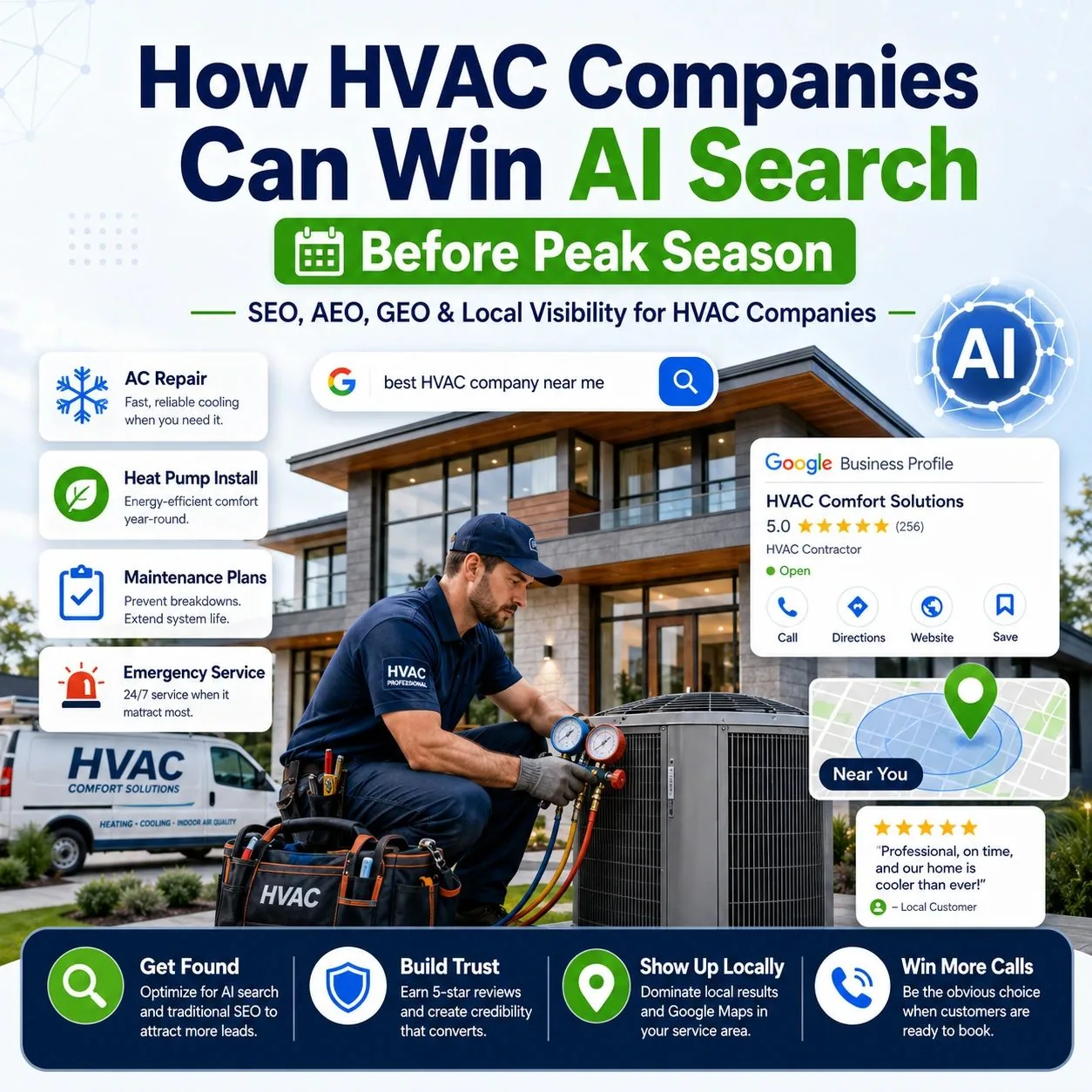
HVAC marketing is becoming more competitive.
Every year, homeowners search for AC repair, furnace replacement, heat pump installation, ductless mini splits, emergency HVAC service, indoor air quality solutions, and maintenance plans.
But in 2026, the way homeowners search is changing.
They are not only typing “HVAC company near me” into Google anymore.
They are asking more specific questions across Google, Google AI Overviews, ChatGPT, Gemini, Perplexity, YouTube, map results, review platforms, and local directories.
They want to know who is reliable, who responds quickly, who serves their neighborhood, who has strong reviews, who explains the problem clearly, and who can actually help when the temperature starts climbing or dropping.
That means HVAC companies are no longer just competing for clicks.
They are competing to become the answer.
And the companies that prepare before peak season will have a major advantage.
When homeowners are dealing with a broken AC during a heat wave or a furnace issue in the middle of winter, they are not casually browsing.
They are ready to call.
The question is whether your business is easy for Google, AI platforms, and homeowners to understand before that moment happens.
Because if AI cannot understand your HVAC business, it cannot recommend your HVAC business.
HVAC Search Is Seasonal, Urgent, And Local
HVAC is one of the clearest examples of high-intent local search.
When someone searches for AC repair near me, emergency HVAC service, furnace repair, heat pump installation, or ductless mini split service, there is usually an immediate need behind the search.
A homeowner may be uncomfortable, frustrated, worried about cost, or trying to avoid a bigger problem.
That urgency changes the way they make decisions.
They may check Google Maps, compare reviews, ask AI what to do, visit a few websites, and call the company that looks the most trustworthy.
This is why HVAC visibility needs to be built before peak season.
The best time to improve your online presence is not when every competitor is fighting for the same emergency searches.
It is before homeowners need you.
For cooling services, that means preparing before summer demand spikes.
For heating services, that means preparing before colder weather hits.
For maintenance plans, indoor air quality, heat pumps, and energy efficiency upgrades, that means creating helpful content before the homeowner starts comparing options.
HVAC marketing works best when your business is visible before the emergency.
What AI Search Means For HVAC Companies
AI search changes how homeowners discover and compare HVAC companies.
A homeowner may not simply search “AC repair Rochester NY.”
They may ask, “Who is the best HVAC company near me for emergency AC repair?”
They may ask, “Should I repair my air conditioner or replace it?”
They may ask, “What HVAC company installs heat pumps and has good reviews?”
They may ask, “Who can help with indoor air quality if my home feels dusty or humid?”
These are not just keyword searches.
They are decision-based questions.
AI platforms need context to answer them.
They need to understand what your company does, where you work, which services you offer, what customers say about you, and why your business may be a credible recommendation.
That is where AI Visibility comes in.
AI Visibility is the ability of search engines and AI platforms to understand, trust, and recommend your business.
For HVAC companies, that means your website, Google Business Profile, service pages, reviews, FAQs, location pages, photos, schema markup, and local authority signals need to work together.
The stronger those signals are, the easier it becomes for AI platforms to understand when your business should be included in the conversation.
HVAC Companies Need More Than One General Service Page
One of the biggest visibility problems in HVAC marketing is thin service content.
Many HVAC websites have one broad page that says something like “Heating and Cooling Services.”
That may be fine for a simple overview, but it is not enough for modern search.
Homeowners are searching for specific solutions.
Someone looking for emergency AC repair has a different need than someone researching heat pump installation, furnace replacement, ductless mini splits, HVAC maintenance plans, thermostat upgrades, or indoor air quality services.
Each of those services has a different search intent.
Each one has different questions.
Each one may deserve its own dedicated page.
For example, an HVAC company should clearly explain AC repair, AC installation, furnace repair, furnace replacement, heat pump installation, ductless mini split systems, indoor air quality, maintenance plans, emergency HVAC service, and commercial HVAC services if those are part of the business.
This does not mean stuffing keywords onto a page.
It means creating useful content that helps homeowners understand the service.
A strong HVAC service page should explain what the service is, when a homeowner may need it, what signs to look for, what areas the company serves, what to expect during the appointment, and how to schedule service.
That type of content helps homeowners make decisions.
It also helps Google and AI platforms understand your expertise.
AC Repair Content Should Be Built Before Summer
AC repair is one of the most competitive HVAC searches during warm weather.
When temperatures rise, homeowners move quickly.
They search for terms like AC repair near me, emergency AC repair, air conditioner not cooling, AC unit leaking water, AC blowing warm air, or HVAC technician near me.
But if your website does not already have strong AC repair content, your business may struggle to compete when demand spikes.
A good AC repair page should answer real homeowner questions.
It should explain common signs that an AC system needs repair, why the unit may be blowing warm air, when a repair makes sense, when replacement may be a better option, how emergency service works, and what areas your company serves.
The same page should also include strong calls to action, trust signals, reviews, service area context, and FAQs.
This is where many HVAC companies miss the opportunity.
They wait until peak season to think about marketing.
But SEO, AEO, GEO, and AI Visibility take time to build.
The companies that prepare early have a better chance of showing up when homeowners are ready to call.
Heat Pump And Energy Efficiency Searches Are Growing In Importance
HVAC search is not only about emergency repairs.
More homeowners are researching energy efficiency, heat pumps, smart thermostats, indoor air quality, and system upgrades.
These searches are often more educational.
A homeowner may ask whether a heat pump is worth it, how a ductless mini split works, whether a heat pump can replace a furnace, how to lower energy bills, or whether a new HVAC system will improve comfort.
This is a major opportunity for HVAC companies.
Educational content helps your business show up earlier in the decision process.
It gives homeowners useful information before they are ready to book.
It also gives AI platforms more context about your expertise.
An HVAC company that publishes helpful content around heat pump installation, ductless mini splits, indoor air quality, maintenance plans, and energy efficient HVAC systems can build authority beyond emergency repair searches.
That matters because not every lead is urgent.
Some homeowners are comparing options, planning upgrades, or trying to understand costs.
If your business can answer their questions clearly, you have a better chance of earning trust before they call.
Google Business Profile Is Critical For HVAC Companies
For HVAC companies, Google Business Profile is one of the most important parts of local SEO.
A homeowner with a broken AC or furnace may not spend much time browsing.
They may search, open Google Maps, compare reviews, and call from the profile.
That means your Google Business Profile needs to be complete, accurate, and active.
Your categories, services, service areas, hours, phone number, photos, reviews, and business description should all clearly support your HVAC services.
If you offer emergency HVAC service, AC repair, furnace repair, heat pump installation, ductless mini splits, maintenance plans, or indoor air quality solutions, your profile should reflect that.
Photos also matter.
Homeowners want to see real technicians, real equipment, service vehicles, completed installs, team photos, and proof that your company is active in the field.
Reviews matter even more.
A review that says, “They fixed our AC quickly and were professional,” is helpful.
A review that says, “They repaired our AC in Victor during the July heat and explained the whole issue clearly,” is even stronger.
Specific reviews provide service and location context.
That helps homeowners.
It also helps Google and AI platforms understand your business more clearly.
Reviews Should Mention Services And Locations Naturally
Reviews are one of the strongest trust signals for HVAC companies.
But not all reviews create the same visibility value.
A review that says “great job” is nice.
A review that mentions AC repair, furnace replacement, heat pump installation, emergency service, ductless mini split installation, or HVAC maintenance gives more context.
A review that also mentions the city, town, neighborhood, or service area is even better.
For example, a homeowner might write that your team repaired their air conditioner in Rochester, replaced a furnace in Victor, installed a heat pump in Pittsford, or handled emergency HVAC service in Brighton.
That kind of detail helps connect your company to specific services in specific areas.
You should never script fake reviews or force keywords into customer feedback.
But you can ask happy customers to share what service they received and where they are located.
That simple shift can make reviews more helpful for homeowners, search engines, and AI platforms.
Location Pages Help HVAC Companies Show Up Locally
Most HVAC companies serve more than one area.
But many websites do not clearly explain where they work.
That creates a local visibility problem.
If your company serves Rochester, Victor, Pittsford, Brighton, Fairport, Penfield, Webster, Canandaigua, or surrounding areas, your website should make that clear.
Location pages help connect your HVAC services to the towns, cities, neighborhoods, and regions you want to serve.
A strong location page should not be thin or duplicated.
It should explain what HVAC services you provide in that area, what types of homes or properties you commonly serve, what seasonal issues homeowners face, and how customers can contact you.
For example, an HVAC location page could explain AC repair and maintenance before summer, furnace repair before winter, heat pump installation for energy efficiency, and emergency HVAC service for urgent situations.
This gives search engines and AI platforms stronger local context.
It also helps homeowners quickly confirm that you serve their area.
HVAC FAQs Help With SEO, AEO, And AI Visibility
HVAC is full of questions.
Homeowners want to know why their AC is blowing warm air, how often they should service their furnace, whether heat pumps work in cold climates, how long HVAC systems last, how much repairs may cost, and when replacement makes more sense than repair.
These questions are perfect for FAQ content.
FAQs help homeowners get quick answers.
They also support AEO, or Answer Engine Optimization, because they are built around the way people ask questions online.
For HVAC companies, FAQs should be added to service pages, location pages, and relevant blog posts.
An AC repair page should answer AC repair questions.
A furnace replacement page should answer furnace replacement questions.
A heat pump installation page should answer heat pump questions.
A maintenance plan page should explain what is included and why it matters.
This structure helps Google and AI platforms understand your content more clearly.
It also gives homeowners confidence before they call.
The key is to make FAQs useful, not generic.
Answer the questions people actually ask.
Schema Markup Helps Search Engines Understand HVAC Services
Schema markup can support HVAC SEO and AI Visibility by giving search engines more structured information about your business.
For an HVAC company, schema can help clarify business details, services, locations, reviews, FAQs, and contact information.
Local Business schema can help search engines understand your company as a local provider.
Service schema can support specific HVAC offerings.
FAQ schema can help organize question and answer content.
Schema does not replace strong content.
It supports it.
Think of schema as a way to label your website more clearly for search engines.
If your content explains your AC repair services, service areas, reviews, and FAQs, schema can help organize that information in a more structured way.
For AI Visibility, clarity matters.
The easier your business is to understand, the stronger your digital footprint becomes.
HVAC Content Should Match The Customer Journey
Not every HVAC search has the same intent.
Some homeowners are ready to call immediately.
Others are researching a future replacement.
Others are trying to understand a problem before deciding what to do.
Your content should support each stage.
Emergency content should make it easy to call.
Service pages should explain what you do and where you work.
Educational blogs should answer common questions.
Comparison content should help homeowners understand options.
Maintenance content should support recurring service.
For example, someone searching “AC not cooling house” may need education and a fast path to book service.
Someone searching “heat pump vs furnace” may be early in the research process.
Someone searching “emergency HVAC repair near me” is probably ready to call now.
Strong HVAC marketing connects these moments.
It gives homeowners the right information at the right time.
It also gives search engines and AI platforms a clearer picture of your expertise.
YouTube And Video Content Can Support HVAC Authority
HVAC companies also have an opportunity to build visibility through video.
Homeowners often search YouTube or Google for explanations before making a decision.
A short video explaining why an AC unit may stop cooling, what to expect during a furnace replacement, how heat pumps work, or why regular maintenance matters can help build trust.
Video content can also support your website, Google Business Profile, social media, and AI Visibility strategy.
This does not need to be overproduced.
A technician answering common questions in a clear, helpful way can be more valuable than a generic polished ad.
The goal is to show expertise.
When your business consistently explains problems and solutions in a helpful way, it becomes easier for homeowners to trust you.
It also creates more content for search engines and AI systems to understand.
Paid Ads Work Better When HVAC SEO Is Strong
Paid ads can be extremely valuable for HVAC companies, especially during peak season.
Emergency AC repair, furnace repair, and replacement searches can be highly competitive, and ads can help generate fast visibility.
But paid ads work better when supported by strong SEO and AI Visibility.
If a homeowner clicks your ad and lands on a thin service page with weak reviews, unclear service areas, or no trust signals, they may leave.
If they click through to a strong AC repair page with clear service information, reviews, FAQs, service areas, technician photos, and a fast call option, they are more likely to convert.
That is why HVAC companies should not treat paid ads and SEO as separate strategies.
Paid ads create immediate traffic.
SEO creates long-term visibility.
AI Visibility helps your business become easier to understand and recommend.
Together, they create a stronger lead generation system.
What HVAC Companies Should Focus On Before Peak Season
HVAC companies do not need to fix everything at once.
But they should focus on the areas that create the strongest visibility signals before demand spikes.
Start with your highest-value services.
For cooling season, that may include AC repair, AC installation, emergency HVAC service, ductless mini splits, and maintenance plans.
For heating season, that may include furnace repair, furnace replacement, heat pump installation, boiler service, and winter maintenance.
Then make sure each service has a clear page.
Update your Google Business Profile so your categories, services, photos, reviews, hours, and service areas match what you want to be found for.
Review your location pages and make sure your service areas are clear.
Add FAQs to your most important pages.
Collect more specific reviews from happy customers.
Add schema markup where appropriate.
Publish helpful content before homeowners need it.
These steps help build a stronger digital foundation before peak demand arrives.
The HVAC companies that prepare early will be easier to find when homeowners are ready to call.
The Big Shift: HVAC Companies Are Competing To Be Recommended
The HVAC companies that win in 2026 will not only be the ones with the biggest ad budgets.
They will be the ones with the clearest digital authority.
They will show up in Google Maps.
They will have strong reviews.
They will explain their services clearly.
They will answer homeowner questions.
They will build service and location pages that match real search intent.
They will create content around AC repair, furnace replacement, heat pump installation, maintenance plans, indoor air quality, and emergency HVAC service before customers urgently need them.
They will make it easy for Google and AI platforms to understand who they are, what they do, where they work, and why homeowners trust them.
That is the new visibility game.
HVAC companies are no longer just competing to rank.
They are competing to be recommended.
Final Thoughts
HVAC marketing is changing because homeowners are searching differently.
They are using Google, maps, reviews, AI platforms, websites, videos, and local directories to decide who to call.
That means HVAC companies need more than a basic website and a few ads.
They need a visibility system built around SEO, AEO, GEO, local SEO, Google Business Profile optimization, reviews, service pages, FAQs, schema markup, and local authority.
The best time to build that system is before peak season.
Not when every competitor is fighting for the same emergency calls.
Not when the phone slows down.
Not after demand has already shifted.
The HVAC companies that prepare early will be in a stronger position when homeowners need help most.
Because if AI cannot understand your HVAC business, it cannot recommend your HVAC business.
FAQs About AI Visibility And SEO For HVAC Companies
What is AI Visibility for HVAC companies?
AI Visibility is the ability of search engines and AI platforms to understand, trust, and recommend an HVAC company. It includes clear service pages, strong reviews, optimized Google Business Profile information, local SEO, FAQs, schema markup, service area content, and helpful educational resources.
Why does SEO matter for HVAC companies?
SEO matters for HVAC companies because homeowners search online when they need AC repair, furnace repair, heat pump installation, emergency HVAC service, ductless mini splits, indoor air quality solutions, and maintenance plans. Strong SEO helps your company show up when those searches happen.
How can HVAC companies improve local SEO?
HVAC companies can improve local SEO by optimizing Google Business Profile, building dedicated service pages, creating location pages, collecting specific reviews, adding photos, improving directory consistency, answering FAQs, and using schema markup.
Why is Google Business Profile important for HVAC companies?
Google Business Profile is important because many homeowners use Google Maps and local search to choose HVAC providers. A complete profile with strong reviews, accurate services, photos, hours, and service areas can help generate more calls.
Should HVAC companies have separate pages for each service?
Yes. HVAC companies should have dedicated pages for major services such as AC repair, AC installation, furnace repair, furnace replacement, heat pump installation, ductless mini splits, emergency HVAC service, indoor air quality, and maintenance plans. Separate pages help homeowners, Google, and AI platforms understand each service more clearly.
What kind of reviews help HVAC companies rank better?
The most helpful reviews are specific. Reviews that mention AC repair, furnace replacement, heat pump installation, emergency service, maintenance plans, or the customer’s city or town provide stronger context than generic reviews.
How do FAQs help HVAC SEO?
FAQs help HVAC SEO by answering the questions homeowners ask before they call. They also support AEO and AI Visibility by making your website easier for search engines and AI platforms to understand.
What HVAC content should companies create before summer?
Before summer, HVAC companies should create or improve content around AC repair, emergency AC service, air conditioner installation, ductless mini splits, maintenance plans, indoor air quality, and common cooling problems such as AC blowing warm air or not turning on.
What HVAC content should companies create before winter?
Before winter, HVAC companies should focus on furnace repair, furnace replacement, heat pump service, boiler service, winter maintenance, thermostat issues, and emergency heating repair content.
Do HVAC companies need location pages?
Yes. Location pages help HVAC companies connect their services to the towns, cities, neighborhoods, and regions they serve. This supports local SEO and helps AI platforms understand where the business operates.
Can paid ads replace HVAC SEO?
No. Paid ads can help generate immediate leads, but they do not replace SEO. HVAC SEO, local SEO, reviews, and AI Visibility create long-term authority and support better conversion from paid traffic.
How can HVAC companies get ready before peak season?
HVAC companies can prepare before peak season by updating service pages, optimizing Google Business Profile, improving reviews, creating location pages, adding FAQs, using schema markup, posting helpful content, and making calls to action easy to find.
Want to know if homeowners and AI platforms can clearly understand and recommend your HVAC company?
The Digital Roots Agency helps HVAC companies and home service brands improve SEO, AEO, GEO, Google Business Profile visibility, local SEO, reviews, and AI Visibility across Google, ChatGPT, Gemini, and other search platforms.
Schedule a free AI Visibility Audit today and see where your HVAC business stands.