
A dealership event can generate excitement for one afternoon.
It can bring customers into the showroom, support a local organization, introduce a new vehicle or help the dealership reconnect with its community.
But what happens after the event ends?
In many dealerships, the answer is very little.
A few photos may be posted on social media.
An internal email may thank the employees who helped.
The dealership returns to its normal schedule, and the event disappears from the public digital record.
That is a missed opportunity.
A well-planned dealership event can become much more than a temporary promotion.
It can create:
- Local media coverage
- Community partnerships
- Website content
- Customer reviews
- Social engagement
- Video assets
- Search visibility
- Third-party mentions
- Employee recognition
- Local business relationships
- Long-term Automotive AI Visibility
The event itself may last only a few hours.
The digital authority created around it can continue working for months or years.
The difference comes down to whether the dealership treats the event as an isolated activity or as part of a complete visibility strategy.
Dealership Events Are More Than Attendance
Most event planning begins with immediate goals.
The dealership may want to:
- Increase showroom traffic
- Generate sales opportunities
- Schedule service appointments
- Promote a model launch
- Support a charity
- Strengthen customer loyalty
- Introduce new leadership
- Celebrate a milestone
- Build employee morale
- Create community awareness
These are worthwhile objectives.
But attendance should not be the only measurement of success.
An event can create value across multiple parts of the dealership’s digital presence.
For example, a community food drive may lead to:
- A partnership with a local nonprofit
- A professional press release
- Coverage from a local publication
- An event page on the dealership website
- A Google Business Profile event post
- Social media content
- Employee and customer photos
- A post-event recap article
- New customer reviews
- Mentions from community partners
- Future event invitations
- AI search evidence connecting the dealership with its local market
The strongest event strategies build both immediate engagement and long-term authority.
Why Local Authority Matters
Google explains that local results are primarily influenced by relevance, distance and prominence.
Prominence reflects how well-known a business is and can be influenced by information found across the web, including links, articles, directories and customer reviews. Google also states that review count and positive ratings can support local ranking.
A dealership cannot control its physical distance from every potential customer.
It can strengthen its relevance and prominence.
Community events can support that effort by creating legitimate reasons for:
- Local organizations to mention the dealership
- News publications to cover the business
- Customers to leave reviews
- Partners to link to the dealership
- Employees to share content
- Search engines to connect the dealership with its market
- AI platforms to find more public evidence about the dealership
The goal is not to stage events only for SEO.
The goal is to make sure real dealership activity receives the documentation and distribution it deserves.
Why Events Matter for AI Visibility
AI platforms depend on publicly available information.
They cannot attend the dealership’s charity drive.
They cannot see the employees volunteering unless the activity is documented.
They cannot know that the dealership supports a local school unless the school, dealership or another public source explains the relationship.
They cannot understand that hundreds of community members attended an event if no website, publication, video or organization mentions it.
A dealership may be highly active offline while appearing nearly invisible online.
That gap matters when customers ask questions such as:
- Which dealership is involved in the local community?
- What car dealerships support charities near me?
- Which dealership hosts family-friendly events?
- What local dealership has a strong reputation?
- Which dealer supports veterans or first responders?
- Where can I attend a vehicle launch event?
- What dealership is hosting a cars and coffee event?
- Which dealership should I trust in my community?
AI systems need public evidence to form useful answers.
Events create the real-world activity.
Digital strategy turns that activity into accessible evidence.
The Event Authority Flywheel
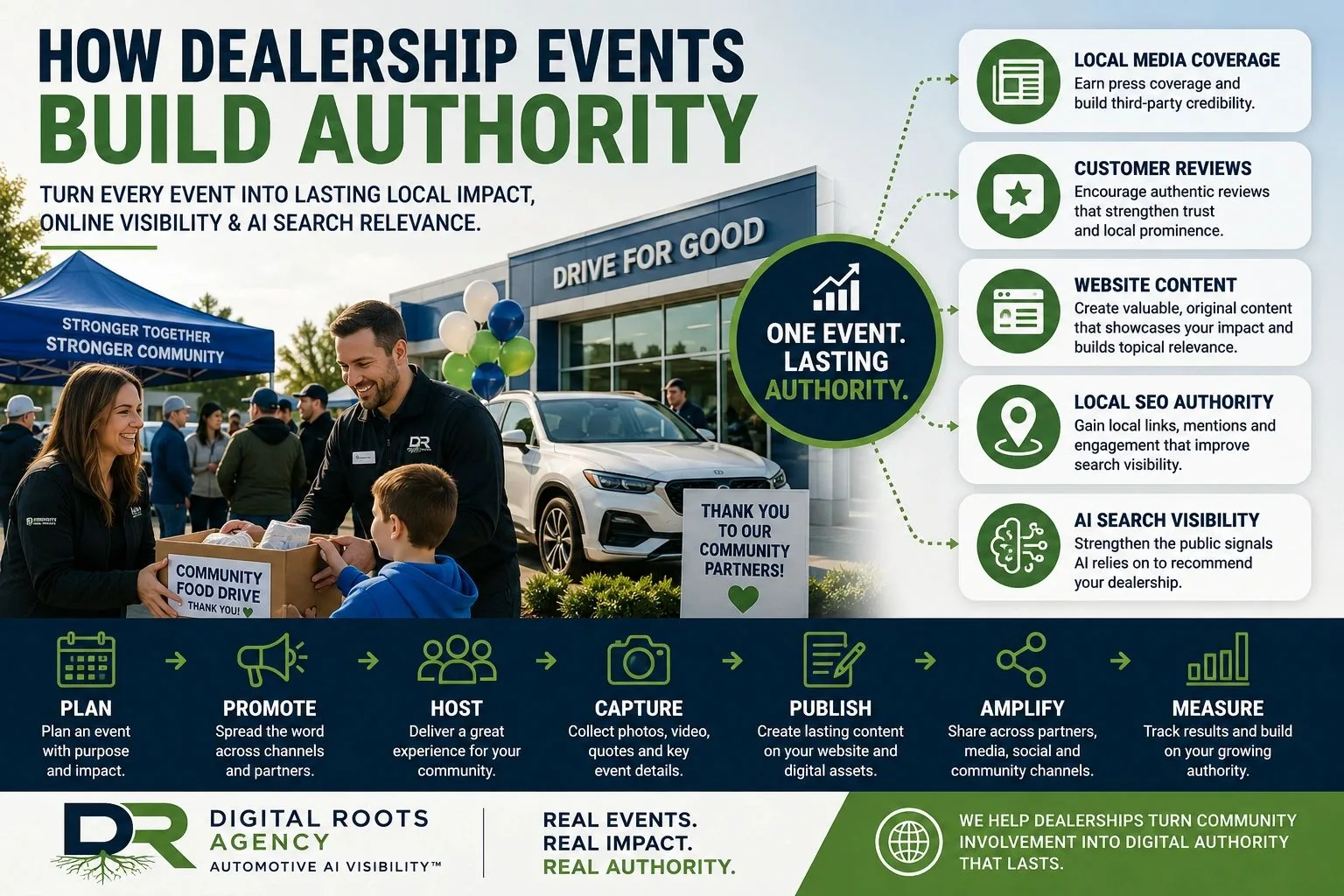
The Digital Roots Agency recommends treating every important dealership event as part of a seven-stage lifecycle:
Plan → Promote → Host → Capture → Publish → Amplify → Measure
Each stage strengthens the next.
The dealership plans an event worth discussing.
Promotion creates awareness and external participation.
The dealership hosts an experience worth documenting.
Employees capture useful media and information.
The dealership publishes permanent digital assets.
Partners and media amplify those assets.
Performance is measured so the next event becomes stronger.
This creates an Event Authority Flywheel.
Instead of starting from zero every time, each event contributes to the dealership’s growing local reputation.
Stage One: Plan an Event Worth Covering
The authority process begins before the event is announced.
A dealership should first define:
- The event’s purpose
- The target audience
- The community connection
- The dealership departments involved
- The event owner
- The budget
- The timeline
- The promotional plan
- The media opportunity
- The content opportunity
- The desired customer action
- The success metrics
The strongest dealership events usually have a clear story.
A generic sales event may be difficult for a local publication to cover.
A dealership partnering with a regional nonprofit to collect winter coats for families has a stronger community narrative.
A standard inventory showcase may receive limited attention.
An electric-vehicle education night featuring local utility representatives, charging experts and dealership product specialists provides a more useful public story.
The event should provide a reason for people outside the dealership to care.
Types of Events That Can Build Authority
Dealerships can create meaningful events across sales, service and community engagement.
Community and Charitable Events
Examples include:
- Food drives
- Coat drives
- Holiday toy collections
- Blood drives
- School-supply donations
- Veterans’ events
- First-responder appreciation
- Animal shelter partnerships
- Youth sports sponsorships
- Environmental cleanups
- Fundraisers for local families
These events can connect the dealership with nonprofit organizations, local media and community leaders.
Customer Appreciation Events
Examples include:
- Owner clinics
- Customer barbecues
- Family activity days
- Cars and coffee
- Loyalty celebrations
- Seasonal vehicle checkups
- New-owner technology workshops
- Women’s automotive education events
These programs can create stronger customer relationships and useful educational content.
Vehicle and Technology Events
Examples include:
- New-model launches
- Electric-vehicle demonstrations
- Hybrid ownership workshops
- Off-road demonstrations
- Commercial vehicle showcases
- Safety technology presentations
- Performance vehicle events
- Test-drive experiences
These events can reinforce the dealership’s product knowledge and automotive expertise.
Service Events
Examples include:
- Winter vehicle preparation
- Summer road-trip inspections
- Tire safety clinics
- Car-seat safety checks
- Battery testing events
- Technician question-and-answer sessions
- Maintenance education nights
- Recall information sessions
Service events give the fixed-operations department a stronger public voice.
Business and Networking Events
Examples include:
- Chamber of commerce meetings
- Local business showcases
- Fleet and commercial vehicle events
- Small-business networking
- Women in business events
- Young professional gatherings
- Local leadership panels
These events can build relationships beyond traditional retail customers.
Stage Two: Promote Beyond the Dealership
An event should not rely on one Facebook post and an internal email list.
Promotion should include dealership-owned channels, partner channels and external media.
Create a Permanent Event Page
Important events should have a dedicated page on the dealership website.
The page should include:
- Event title
- Date
- Start and end time
- Dealership location
- Event description
- Participating organizations
- Who should attend
- Registration information
- Parking details
- Contact information
- Photos or promotional graphics
- Relevant frequently asked questions
- Clear calls to action
The page creates a central source that every promotional channel can reference.
It also gives search engines and AI platforms a stable, publicly accessible explanation of the event.
Use Event Structured Data
Google supports Event structured data, which can make eligible events easier to discover through Google Search and other Google products.
Google recommends creating a unique page focused on the individual event, including accurate dates and location information, validating the markup and ensuring the page remains accessible to Google. Correct structured data does not guarantee a special search appearance, but it can help Google understand the event.
The structured information should match what customers can see on the page.
Important properties may include:
- Event name
- Description
- Start date
- End date
- Location
- Address
- Organizer
- Image
- Event status
- Attendance information
- Registration or offer URL
Structured data should clarify a useful page, not compensate for a weak one.
Publish a Google Business Profile Event
Google Business Profile allows businesses to publish event posts containing titles, dates, times, descriptions, photos, videos and action buttons.
These posts can appear on the dealership’s profile in Google Search and Maps, helping customers discover current announcements and events.
The post should link to the dealership’s event page whenever possible.
That creates a connected path:
Google Business Profile → Event Page → Registration or Contact Action
Activate Community Partners
Every participating organization should receive a simple promotion package.
That package can include:
- Event description
- Approved graphic
- Website link
- Social caption
- Date and time
- Hashtags
- Media contact
- Registration link
- Dealership contact
Partners may promote the event through:
- Their website
- Email newsletters
- Social accounts
- Event calendars
- Member communications
- Employee networks
- Community groups
This expands reach while creating additional public connections between the dealership and the organizations involved.
Contact Local Media
Media outreach should begin early.
Depending on the event, the dealership may contact:
- Local newspapers
- Television stations
- Radio stations
- Community newsletters
- Business publications
- Neighborhood websites
- Automotive publications
- School publications
- Chamber newsletters
- Lifestyle magazines
- Local event calendars
The pitch should explain why the event matters to the publication’s audience.
It should not simply say:
“Our dealership is hosting an event.”
A stronger pitch might explain:
- The local problem being addressed
- The nonprofit being supported
- The number of families expected to benefit
- The educational value
- The community leaders involved
- The unusual or visual elements
- The availability of interviews
- The broader local relevance
The dealership should make the story easy to understand and easy to cover.
Stage Three: Host an Experience Worth Remembering
Marketing cannot rescue a poorly organized event.
The event itself must provide a positive experience.
Important operational areas include:
- Clear signage
- Employee responsibilities
- Guest registration
- Parking
- Accessibility
- Weather planning
- Vendor coordination
- Food and refreshments
- Safety
- Customer flow
- Appointment or lead capture
- Media coordination
- Photography and video
- Partner recognition
- Follow-up responsibilities
Every employee should understand the purpose of the event.
The event should not feel like a disguised sales ambush when it has been promoted as a community program.
Sales opportunities may naturally emerge, but the customer experience should remain aligned with the public promise.
Assign an Event Content Team
Someone must be responsible for capturing the event.
Without assigned ownership, employees may assume someone else is taking photos or collecting information.
The content team should capture:
- Exterior dealership images
- Event signage
- Partner logos and displays
- Guests arriving
- Employees interacting with attendees
- Speakers and presentations
- Vehicle demonstrations
- Donation collections
- Community leaders
- Group photos
- Short interviews
- Vertical video
- Horizontal video
- Customer reactions
- Final results
The team should obtain appropriate permission when photographing or recording identifiable attendees, especially children.
Capture Information, Not Just Images
Photos are important, but the post-event story also requires facts.
Document:
- Number of attendees
- Donations collected
- Funds raised
- Appointments scheduled
- Vehicles demonstrated
- Participating organizations
- Employee volunteers
- Community leaders present
- Quotes from partners
- Quotes from dealership leadership
- Customer feedback
- Follow-up initiatives
These details turn a gallery of photos into a meaningful story.
Stage Four: Capture Genuine Customer Sentiment
Events can create natural opportunities for customers to share feedback.
The dealership should not pressure attendees or offer prohibited incentives for positive reviews.
Instead, it can make honest review opportunities visible through:
- Follow-up emails
- QR codes
- Thank-you messages
- Event recap communications
- Customer service follow-up
- Post-event surveys
Reviews should reflect the real experience.
Google states that review count and positive ratings can contribute to local prominence, but the larger benefit is that reviews provide public evidence of how customers experience the dealership.
Event-related reviews may reinforce themes such as:
- Community involvement
- Friendly employees
- Family-friendly atmosphere
- Helpful education
- Professional organization
- Welcoming dealership culture
- Strong customer relationships
These themes help future customers understand what the dealership represents.
Stage Five: Publish Permanent Digital Assets
The event should produce more than disappearing social content.
It should create durable assets on the dealership website.
Publish a Post-Event Recap
The recap article can include:
- What happened
- Why the event was held
- Organizations involved
- Results
- Quotes
- Photos
- Video
- Employee recognition
- Customer participation
- Future plans
- Links to partners
- Calls to action
The recap should be written for customers and the community, not stuffed with repetitive local keywords.
Google’s content guidance emphasizes useful, reliable, people-first information that demonstrates firsthand experience and provides genuine value.
A dealership event recap naturally contains firsthand experience.
The dealership was there.
Its employees organized the event.
Its partners participated.
Its photos and results are original.
That is precisely what makes the content difficult for competitors to copy authentically.
Create an Event Media Gallery
A gallery can organize:
- Professional photos
- Short videos
- Employee interviews
- Partner comments
- Customer reactions
- Event highlights
- Behind-the-scenes preparation
Image titles and alt text should accurately describe what appears in each image.
For example:
Image Title: Parkway Honda Boston Community Coat Drive
Alt Text: Parkway Honda of Boston employees and community partners collecting winter coats during a dealership charity event in West Roxbury
Accurate descriptions improve accessibility while helping systems understand the image context.
Publish Video Content
Video can extend the life of the event across:
- YouTube
- TikTok
- Google Business Profile
- Dealership website
One event can produce:
- A complete recap video
- Employee interviews
- Partner interviews
- Customer testimonials
- Vehicle demonstrations
- Short vertical clips
- Educational highlights
- Behind-the-scenes footage
The video title and description should clearly identify the dealership, event, location and participating organizations.
Update Relevant Website Pages
The event should also strengthen existing pages.
For example:
- Link the recap from the dealership’s About page
- Add the event to a community involvement page
- Link an EV education event from electric-vehicle pages
- Link a service clinic from relevant maintenance pages
- Feature a charitable partnership on the dealership history page
- Add upcoming events to local market pages
- Link partner organizations where appropriate
This creates a connected website rather than an isolated blog archive.
Stage Six: Amplify the Story
Publishing is not the end of the process.
The dealership should distribute the recap and supporting media through multiple relevant channels.
Social Media
Create platform-specific content rather than posting the same caption everywhere.
Possible content includes:
- Event recap
- Partner thank-you post
- Employee recognition
- Donation result
- Photo carousel
- Short video
- Customer quote
- Media coverage
- Next-event announcement
Every post should link back to the dealership website when a useful destination exists.
Google Business Profile
Publish an update featuring:
- Event result
- Professional image
- Community partner
- Link to full recap
- Relevant call to action
Google states that Business Profile posts can share announcements, updates, event details, photos and videos with customers on Search and Maps.
The purpose is not to expect an automatic ranking increase from one post.
The post helps maintain a current, useful and active public profile.
Send a follow-up email to:
- Attendees
- Invited customers
- Community partners
- Employees
- Media contacts
- Interested customers who could not attend
The message can include:
- Event results
- Photos
- Video
- Partner recognition
- Next steps
- Upcoming event information
- Relevant dealership resources
Partner Amplification
Provide partners with:
- Recap link
- Photos
- Results
- Social captions
- Video clips
- Media coverage
- Thank-you message
Partners are more likely to share content when the materials are organized and ready to use.
Their mentions add third-party context that the dealership cannot create entirely on its own.
Media Follow-Up
Journalists and community publications may be more interested after the dealership has concrete results.
A follow-up pitch can include:
- Attendance
- Donation totals
- Funds raised
- Local impact
- Strong photographs
- Quotes
- Future initiatives
A result-driven story may be more newsworthy than the initial announcement.
Stage Seven: Measure the Complete Impact
Dealerships should measure more than attendance.
The event may influence several stages of the customer journey.
Immediate Event Metrics
Track:
- Registrations
- Attendance
- Walk-in traffic
- Leads
- Appointments
- Test drives
- Service bookings
- Vehicles sold
- Donations
- Funds raised
- Partner participation
- Media attendance
Digital Engagement Metrics
Track:
- Event page visits
- Registration conversions
- Recap article traffic
- Video views
- Social reach
- Social engagement
- Email opens
- Email clicks
- Google Business Profile interactions
- Referral traffic
- Local partner traffic
Authority Metrics
Track:
- News coverage
- Partner mentions
- Backlinks
- New reviews
- Review themes
- Branded searches
- Local ranking changes
- Search impressions
- Community organization mentions
- AI recommendation visibility
- Pages cited or referenced by AI platforms
Business Metrics
Track:
- Appointments generated
- Sales opportunities
- Service retention
- Customer reactivation
- CRM activity
- New audience growth
- Cost per attendee
- Cost per appointment
- Revenue influenced
- Future partnership opportunities
Not every event should be judged exclusively by immediate sales.
A charity event may produce stronger community authority than short-term vehicle transactions.
A model launch may prioritize test drives and leads.
A customer appreciation event may prioritize retention.
The measurement plan should reflect the event’s actual purpose.
How Events Support AI Search Visibility
There is no guaranteed formula that makes an event appear in an AI-generated answer.
However, a well-documented event can strengthen the public information available about the dealership.
That public record may include:
- A dedicated event page
- A recap article
- Event structured data
- Local news coverage
- Partner mentions
- Customer reviews
- Social posts
- Videos
- Business Profile updates
- Community organization pages
- Employee profiles
- Images
- Internal links
OpenAI states that public website content can be eligible for inclusion in ChatGPT search when OAI-SearchBot is permitted to access it, although inclusion and placement are not guaranteed.
Google similarly states that the foundational practices supporting traditional SEO remain relevant to its generative AI search experiences. These include accessible pages, helpful content, accurate structured information and strong website fundamentals.
Events can support those fundamentals because they produce original, locally relevant and experience-based information.
The Difference Between an Event and an Authority Asset
An event is temporary.
An authority asset is documented, connected and reusable.
A Temporary Event
- One social post
- No website page
- No media outreach
- No partner amplification
- Few usable photos
- No recap
- No measurement
- Forgotten within days
An Authority-Building Event
- Dedicated event page
- Professional press release
- Local media outreach
- Partner promotion
- Google Business Profile event
- Original photography and video
- Customer engagement
- Post-event recap
- Third-party mentions
- Review opportunities
- Website integration
- Ongoing measurement
The event does not need to be enormous.
A smaller, well-documented service clinic may create more lasting digital value than an expensive event with no follow-up strategy.
Common Dealership Event Mistakes
Mistake One: Starting Promotion Too Late
Local publications, partners and customers need time to plan.
Major events should not be announced only a few days in advance.
Create the timeline backward from the event date.
Mistake Two: Treating Social Media as the Entire Strategy
Social media is valuable, but most posts have a limited active lifespan.
The event should also have a permanent website presence and external distribution plan.
Mistake Three: Failing to Assign Content Ownership
“Someone will take pictures” is not a content plan.
Assign specific people to photography, video, quotes, metrics and follow-up.
Mistake Four: Forgetting the Media Story
A dealership promotion is not automatically news.
Explain the local impact, educational value, charitable purpose or community relevance.
Mistake Five: Publishing Only Before the Event
Pre-event promotion drives attendance.
Post-event content builds the long-term record.
Both are necessary.
Mistake Six: Failing to Connect the Event to Relevant Services
An EV event should connect with EV inventory, charging education and service information.
A car-seat safety event should connect with family vehicle content.
A winter clinic should connect with tires, batteries and seasonal service.
The event should strengthen the wider website.
Mistake Seven: Measuring Only Sales
Sales matter, but an event may also create:
- Reviews
- Retention
- Media coverage
- Local partnerships
- Referral traffic
- Content
- Brand searches
- Future invitations
- Community trust
A complete measurement plan captures those outcomes.
A 60-Day Dealership Event Timeline
45–60 Days Before
- Define event objective
- Select event owner
- Confirm budget
- Choose community partners
- Establish success metrics
- Reserve vendors
- Create event page
- Prepare media list
- Plan photography and video
- Begin partner coordination
30–45 Days Before
- Publish event page
- Add structured data
- Distribute press release
- Begin media outreach
- Publish initial social announcement
- Create Google Business Profile event
- Send customer invitation
- Provide partner promotion package
- Confirm employee responsibilities
14–30 Days Before
- Continue social promotion
- Follow up with media
- Publish employee video
- Send reminder email
- Promote through partner channels
- Confirm registration
- Finalize signage
- Create day-of content checklist
- Confirm interview opportunities
1–14 Days Before
- Increase reminder frequency
- Confirm media attendance
- Finalize staff assignments
- Prepare QR codes
- Test registration and lead capture
- Confirm event logistics
- Review weather plan
- Prepare photography shot list
- Draft recap structure
Event Day
- Capture registration
- Photograph signage and partners
- Record vertical and horizontal video
- Collect quotes
- Track attendance
- Document results
- Recognize partners
- Monitor customer experience
- Capture dealership leadership comments
1–7 Days After
- Publish recap article
- Send thank-you emails
- Share photos and video
- Publish Google Business Profile update
- Provide materials to partners
- Follow up with media
- Request honest customer feedback
- Update community pages
- Begin performance analysis
7–30 Days After
- Publish additional video clips
- Share employee features
- Continue partner amplification
- Add internal links
- Report results
- Evaluate search and referral activity
- Update AI Visibility monitoring
- Document improvements for the next event
Frequently Asked Questions
Can dealership events improve local SEO?
Events can support local SEO when they create useful local content, customer engagement, reviews, third-party mentions, links and evidence of the dealership’s relationship with its community.
No single event guarantees a ranking increase.
The value comes from the complete authority strategy surrounding the event.
Should every dealership event have a website page?
Major public events should generally have a dedicated page containing accurate dates, location details, descriptions, participating organizations and calls to action.
Smaller recurring activities may be grouped carefully, but individual public events benefit from a clear permanent destination.
What is Event structured data?
Event structured data is machine-readable information that helps Google understand details such as an event’s name, date, location and organizer.
Eligible pages may appear in Google’s event experience, but correct markup does not guarantee special placement.
Should a dealership issue a press release for every event?
Not every small activity requires a formal release.
Press releases are most useful when the event has a meaningful public story, community impact, notable partnership, educational benefit or significant dealership milestone.
How far in advance should a dealership promote an event?
Larger events should often begin planning and outreach 45 to 60 days in advance.
Smaller events may require less time, but media organizations and community partners generally need more notice than ordinary social media followers.
How do events help Automotive AI Visibility?
Events can generate accessible public evidence about the dealership through website pages, news coverage, partner mentions, reviews, videos, structured information and community content.
These signals can help search engines and AI platforms better understand the dealership’s local relevance and public reputation.
Should dealerships use AI to write event content?
AI can help organize information, develop outlines and produce early drafts.
Final content should include accurate dealership details, firsthand quotes, original photographs, real results and human review.
The value comes from the dealership’s actual experience, not generic automated language.
Every Event Should Become a Long-Term Asset
A successful dealership event should create more than one good day.
It should generate:
- Attendance
- Customer opportunities
- Community relationships
- Useful content
- Local coverage
- Customer feedback
- Search visibility
- AI-readable evidence
- Long-term digital authority
The event creates the experience.
The marketing strategy preserves and amplifies it.
Dealerships already invest significant time, money and employee effort into events.
The next step is making sure that investment continues producing value after the tents come down, the vehicles are moved and the final guest leaves.
That is how an event becomes an authority asset.
Turn Your Next Event Into Authority
The Digital Roots Agency helps automotive dealerships plan, document and amplify events as part of a complete SEO and Automotive AI Visibility strategy.
Our approach connects:
- Event strategy
- Professional press releases
- Local media outreach
- Community partnerships
- Website content
- Event structured data
- Google Business Profile
- Social media
- Photography and video planning
- Local SEO
- Digital public relations
- AI Visibility monitoring
- Performance measurement
Your dealership is already doing meaningful work in the community.
We help make sure customers, search engines and AI platforms can see it.
Build Your Automotive Authority
If AI can’t understand your dealership, it can’t recommend it.