
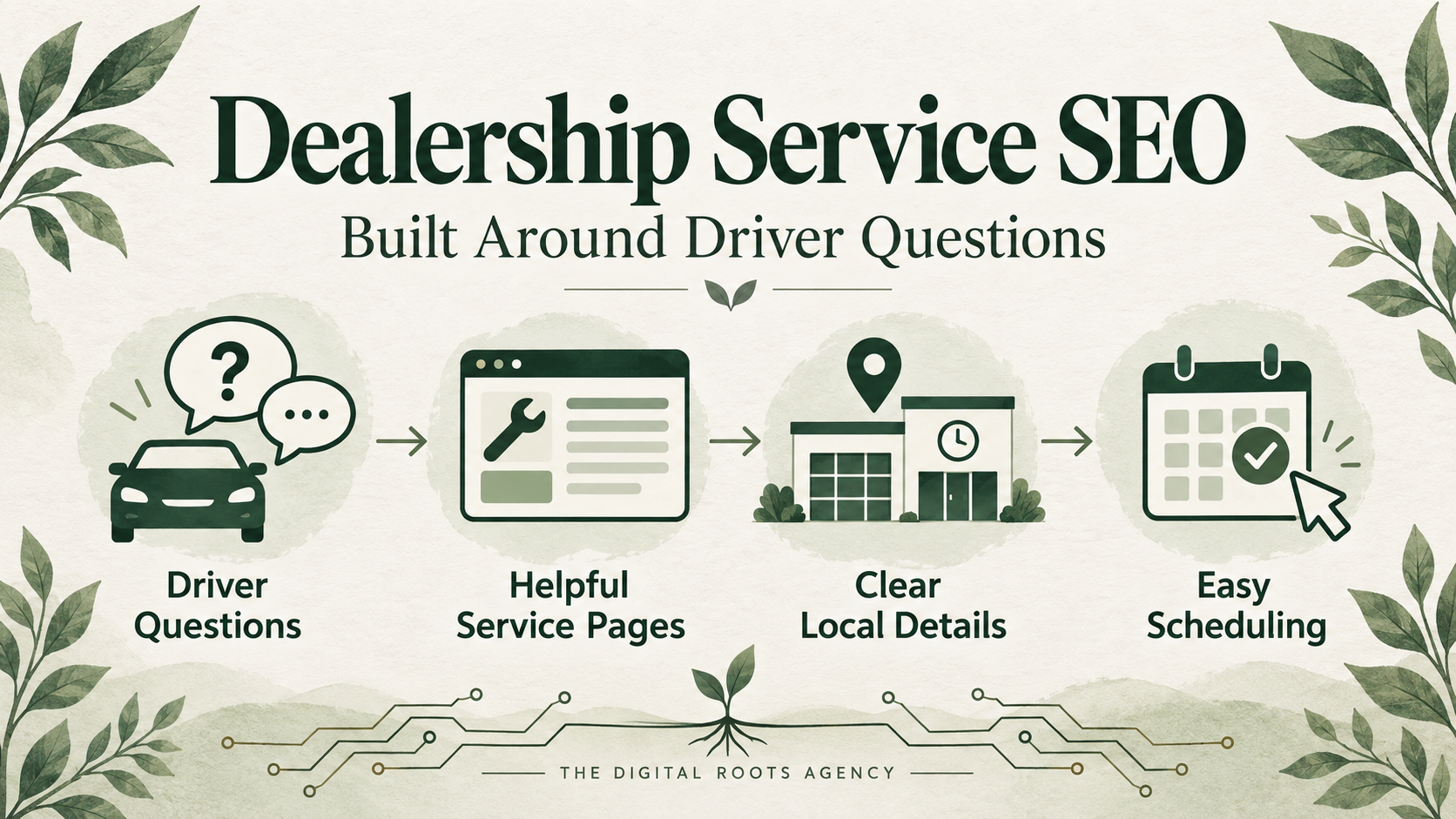
A driver does not begin every service search by choosing a dealership.
They may be trying to understand a maintenance requirement, compare service options or find an appointment that fits their week.
If your website only says “expert service at competitive prices,” it leaves much of that decision unanswered.
Dealership service SEO is the work of making your service information findable, accurate and useful for drivers researching maintenance and repair. Good content should help a person understand whether your department can meet their need and how to contact you.
Start With the Service Desk
Ask service advisors which questions come up before appointments.
Examples might include:
- Can I schedule service if I bought my vehicle somewhere else?
- Which makes and models does the department service?
- What information should I provide when booking?
- Are waiting appointments available?
- How do I confirm transportation options?
- Where do I arrive for a scheduled visit?
These are example questions, not statements about what every dealership offers.
Confirm each answer with the department. Amenities, eligibility, hours and procedures can vary, and a familiar marketing claim may no longer reflect daily operations.
Give the Main Service Page a Clear Job
The main service page should help a driver establish whether they are in the right place.
It should explain the department’s scope, location, hours, contact options and booking process. Describe relevant credentials and capabilities accurately.
Make the next step easy to identify on a phone.
A driver should not need to move through inventory promotions or a general lead form to find service scheduling.
A concise overview can link to more detailed pages where the reader needs them.
Build Detail Around Genuine Service Needs
Create dedicated service pages when there is enough useful, distinct information to justify them.
A tire-service page, for example, could explain which services the department provides, what information the team needs and how to request an appointment.
Avoid duplicating the same few paragraphs across numerous service names.
For maintenance intervals, warning indicators or vehicle-specific requirements, refer readers to appropriate manufacturer guidance and qualified staff. Have a knowledgeable reviewer check technical explanations.
A marketing article should not diagnose a vehicle from a generic symptom or imply that delaying a potentially serious issue is safe.
Separate Education From Booking
An educational guide and a scheduling page serve different purposes.
The guide can explain what to bring to a service appointment or how a department communicates inspection findings. The service page can provide the actual process for arranging a visit.
Connect them where the reader is ready to act.
A helpful link might say “review our service scheduling options.” It should take the visitor to that information, not an unrelated sales promotion.
Our broader article on AI search and dealership discovery provides context for why useful content matters beyond inventory research.
Make Local Information Specific and Accurate
Useful local details are operational: where to enter, which department to contact and when the service team is available.
Keep those details aligned with the business information shown elsewhere.
Google describes local results in terms of relevance, distance and prominence. Content does not remove distance from the equation or guarantee a particular local position.
Provide honest geographic context. Avoid creating many near-identical town pages that imply a physical presence you do not have.
If customers travel from nearby communities, explain something useful about the actual visit rather than swapping city names into a template.
Use Evidence You Can Support
“Best service in the region” tells a reader little without substantiation.
Describe the experience in concrete terms instead: how appointments are confirmed, how estimates are communicated or where a customer can ask questions.
Only mention amenities, certifications or guarantees that apply to the department.
If you reference customer experiences, use genuine material in an appropriate context and obtain permission where necessary. Do not manufacture reviews or imply that a single experience establishes a universal outcome.
Review the Entire Appointment Path
A useful article cannot fix a broken booking journey.
Test the path on a phone:
- Can the visitor find the relevant service?
- Do the contact and scheduling links work?
- Are department hours understandable?
- Does the form ask for information the team actually needs?
- Does the customer receive a clear confirmation or next-step message?
Where scheduling uses another system, review what happens when the visitor leaves the main website.
Keep the promise in the article consistent with the experience in the scheduling tool.
Measure Service Interest Separately
Track service-related content and actions separately from vehicle-shopping activity where your reporting allows it.
Useful outcomes can include completed appointment requests, qualified calls and confirmed bookings. A click on a scheduling button is an intermediate action, not proof that an appointment occurred.
Review which pages introduce service visitors and which help them act. Pair website reporting with department feedback to understand lead quality and operational follow-through.
Frequently Asked Questions
Does every dealership service need its own page?
No. Create a separate page when it provides a meaningful, distinct answer. Closely related services may be clearer together.
Should service articles target “near me” repeatedly?
Write useful location information naturally. Repeating the phrase does not substitute for an accurate business presence or a clear service page.
Can FAQs guarantee AI recommendations?
No. FAQs can help readers find answers, but the format itself does not guarantee a recommendation or citation.
Should dealerships publish repair instructions?
Only publish technical guidance appropriate to the audience and reviewed by qualified staff. Many customer needs are better served by preparation and process information.
What is the most useful conversion to track?
Confirmed appointments are closer to business value than pageviews. Use appointment requests and scheduling clicks as separate steps when complete booking data is unavailable.
Build Service Content That Helps the Driver
Your service department already answers useful questions every day.
Bringing those answers onto the website can make the path from research to an informed appointment clearer.
Sources Used
Strengthen Your Automotive Visibility
The Digital Roots Agency helps dealerships connect automotive content, local search and AI visibility. Review our automotive visibility case studies to explore examples of the agency’s work.
Strong service visibility grows from useful answers and a clear customer experience.