
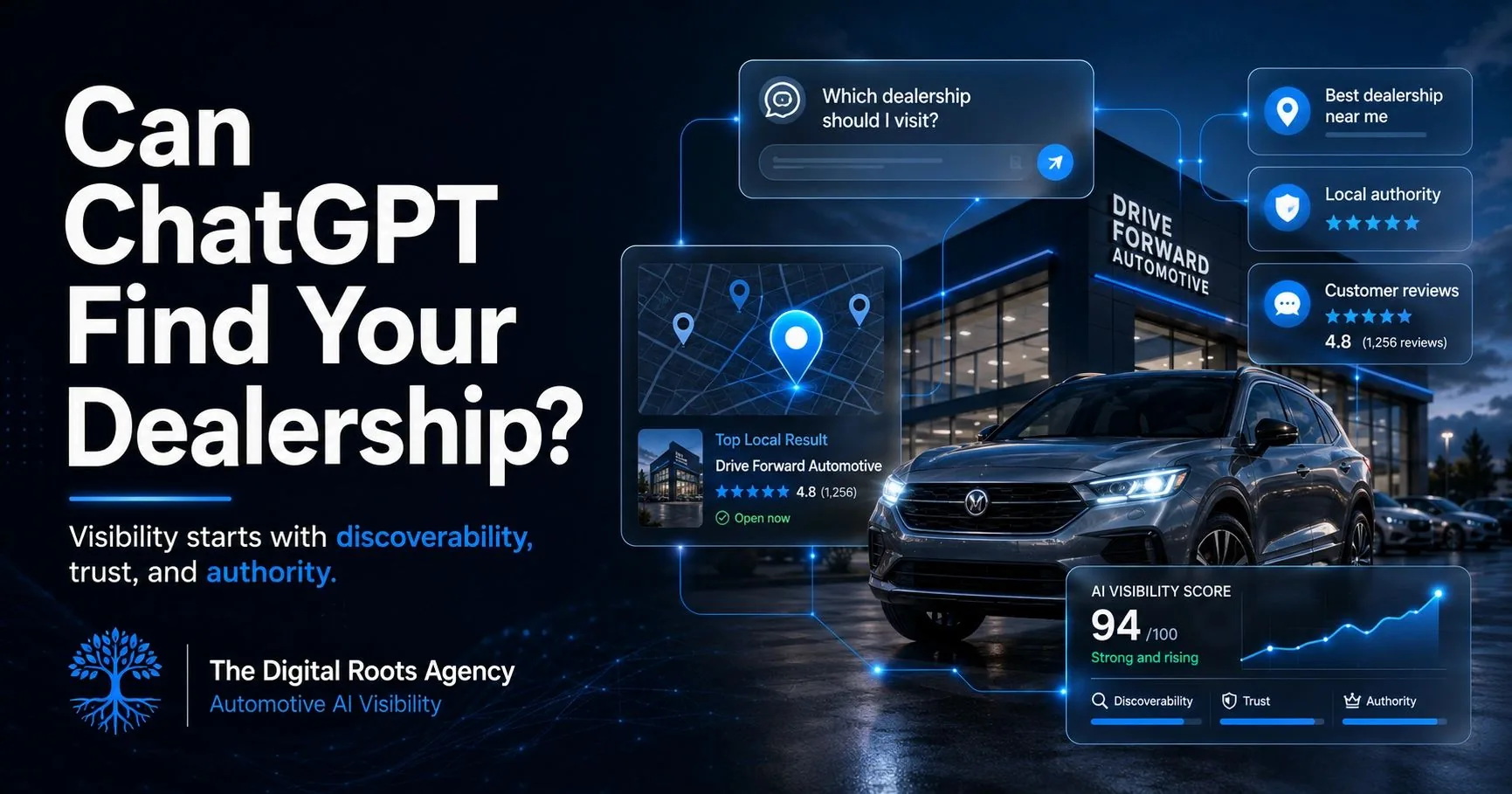
A potential customer opens ChatGPT and asks:
“What is the best Toyota dealership near Boston?”
Another shopper asks:
“Where should I buy a certified pre-owned BMW on Long Island?”
A family researching its next vehicle asks:
“Which dealership near me has the best selection of safe three-row SUVs?”
Would ChatGPT mention your dealership?
More importantly, would it have enough reliable information to explain why your dealership belongs in the answer?
This is quickly becoming one of the most important questions in automotive marketing.
Dealerships have spent years optimizing for traditional Google searches, paid advertising, third-party listing sites and lead-generation platforms. Those channels remain important, but the customer journey is expanding.
Consumers can now use conversational AI platforms to research vehicles, compare ownership options, evaluate dealerships and request local recommendations without beginning with a traditional list of search results.
That creates a new marketing challenge:
Your dealership must not only rank. It must also be understood.
This is the foundation of Automotive AI Visibility.
How ChatGPT Search Changes Automotive Research
ChatGPT can search the web and provide timely answers with links to relevant online sources. It may also turn a conversational prompt into one or more targeted web searches to gather the information needed for its response.
That distinction matters.
A traditional customer might search Google for:
Honda dealer Boston
A conversational AI user might ask:
“Which Honda dealership near Boston has a strong reputation, certified pre-owned vehicles and convenient service options for families?”
The second request contains more context, more intent and more specific expectations.
Instead of matching a short keyword, the platform must identify businesses that appear relevant to the complete question.
For dealerships, this means visibility can depend on whether publicly available information clearly communicates:
- The brands the dealership sells
- The markets and communities it serves
- Its new and pre-owned vehicle offerings
- Its service capabilities
- Its customer advantages
- Its reputation
- Its local relevance
- Its areas of expertise
- Its involvement in the community
- The reasons a shopper should choose it
A dealership website that provides only inventory and generic manufacturer content may not communicate enough of that story.
Can Any Dealership Appear in ChatGPT Search?
OpenAI states that any public website can potentially appear in ChatGPT search.
However, there is no guaranteed formula for earning a top placement. OpenAI explains that ChatGPT Search considers multiple factors intended to help users find reliable and relevant information. It also emphasizes that websites should allow OAI-SearchBot to crawl their content if they want that content to be eligible for inclusion in summaries and search results.
This creates two fundamental requirements for dealerships.
Your Information Must Be Accessible
Search and AI systems must be able to access the dealership’s public website content.
Technical restrictions, security settings, content delivery networks, robots.txt rules and bot-blocking systems can sometimes prevent crawlers from properly accessing a website.
A dealership could publish excellent content and still limit its visibility if important pages cannot be crawled.
Your Information Must Be Useful
Being accessible does not automatically make a page relevant.
The content must clearly answer the questions customers are asking and provide enough context for search and AI systems to understand the dealership.
A homepage that simply says a dealership offers “exceptional service” provides very little usable evidence.
A stronger website explains:
- Where the dealership is located
- Which surrounding communities it serves
- What makes its customer experience different
- Which vehicle categories it specializes in
- What service conveniences it offers
- How customers can buy, lease, trade or service a vehicle
- Why its experience and reputation deserve consideration
Accessibility allows the information to be found.
Clarity gives the information meaning.
ChatGPT Does Not See Your Dealership the Way a Customer Does
A customer can visit a showroom, speak with an employee and immediately begin forming an impression.
AI platforms cannot experience your dealership in that way.
They depend on digital evidence.
That evidence may include information found across:
- Your dealership website
- Vehicle and service pages
- Google Business Profile
- Customer review platforms
- Manufacturer listings
- Local directories
- News publications
- Community organizations
- Social profiles
- Third-party automotive websites
- Event pages
- Business citations
- Publicly accessible articles and videos
No single page tells the entire story.
AI Visibility is strengthened when these sources communicate a consistent identity.
For example, suppose a dealership claims to be heavily involved in its local community.
Is that involvement documented anywhere?
Does the website contain stories about local events?
Did a community publication cover the dealership’s involvement?
Did a nonprofit partner mention the dealership?
Were photos, videos and event details published?
Did the dealership share the event through its social profiles and Google Business Profile?
When meaningful activity is documented across connected public sources, the dealership’s local relevance becomes easier to verify.
Branded Searches Are Not Enough
Many dealerships test AI Visibility by entering the full name of their business.
They might ask:
“Tell me about Parkway Toyota of Boston.”
If ChatGPT provides an accurate answer, they assume their dealership has strong AI Visibility.
That is only a branded identity test.
A customer who already knows the dealership’s name is much further along in the buying process.
The greater opportunity is appearing during non-branded discovery.
These searches may include:
- Best Toyota dealership near Boston
- Honda dealer with certified pre-owned vehicles near me
- BMW dealership with good customer reviews on Long Island
- Mercedes-Benz service center near Massapequa
- Dealership offering vehicle pickup and delivery
- Best dealership for a family SUV
- Local dealership supporting community events
- Dealership with commercial van inventory
- Where to lease an electric vehicle near me
These prompts reveal whether the dealership is associated with the services, locations and customer needs it wants to own.
A dealership may perform well when its name is included but disappear when the customer asks a broader recommendation question.
That gap is exactly what Automotive AI Visibility monitoring is designed to uncover.
Location Can Change the Answer
Local dealership recommendations are especially complex because location can influence the response.
ChatGPT Search may use a person’s approximate location based on their internet connection. Users can also optionally enable device location to receive more locally relevant recommendations.
That means a dealership recommendation may differ depending on:
- Where the customer is located
- How the question is worded
- Which vehicle or service is requested
- Whether the customer provides a city or neighborhood
- Which sources are available at the time
- How clearly each dealership is connected to that market
This is why dealerships should not test only one generic prompt from one device.
A better monitoring strategy evaluates different combinations of:
- Brand
- Model
- Service
- Location
- Customer need
- Vehicle category
- Purchase intent
- Ownership stage
For example, a Toyota dealership might track:
- Toyota dealership near West Roxbury
- Best Toyota dealer in Boston
- Toyota lease deals near Boston
- Certified pre-owned Toyota dealer near me
- Toyota service center with pickup and delivery
- Best dealership for a Toyota Grand Highlander
- Family-friendly Toyota dealership near Boston
- Toyota dealership involved in the local community
Each prompt tests a different part of the dealership’s digital identity.
What Makes a Dealership Easier for AI to Understand?
OpenAI does not publish a dealership-specific ranking checklist.
No legitimate agency can guarantee that ChatGPT will recommend a particular dealership for every prompt.
However, dealerships can strengthen the public information that search and AI systems use to evaluate relevance.
The following areas should be treated as foundational elements rather than secret ranking tricks.
1. A Clear Dealership Identity
The website should make the dealership’s identity immediately understandable.
That includes:
- Official dealership name
- Physical location
- Primary phone number
- Brands represented
- Main sales and service offerings
- Geographic service area
- Connections to a larger dealer group
- Relevant awards, certifications or milestones
These details should remain consistent across the website and major external profiles.
Conflicting business names, addresses or service descriptions create unnecessary ambiguity.
2. Strong Local Market Pages
Many dealership websites mention their city only in the footer or contact page.
That is not enough to establish meaningful local relevance.
Dealerships should create useful content for the communities they genuinely serve.
A strong local page can explain:
- The dealership’s relationship to the community
- Driving distance and directions
- Popular vehicles in that market
- Available services
- Local ownership considerations
- Pickup or delivery options
- Community partnerships
- Frequently asked local questions
These pages should provide actual value.
Replacing one city name with another across dozens of nearly identical pages does not create meaningful authority.
3. Helpful Vehicle and Ownership Content
Inventory pages show which vehicles are available today.
Educational content helps establish what the dealership understands.
Dealerships can publish resources addressing questions such as:
- Which SUV is best for a growing family?
- What is the difference between leasing and financing?
- Is a hybrid worth it for local driving?
- Which vehicles perform well in winter?
- How does certified pre-owned coverage work?
- What should buyers know before purchasing an EV?
- Which truck configuration fits a specific job?
- How often should a vehicle be serviced?
This type of content gives search and AI platforms more context about the dealership’s expertise.
It also helps real customers make better decisions.
4. Service Department Expertise
Many dealerships concentrate almost all of their content on vehicle sales.
That leaves significant opportunities unexplored.
Customers regularly ask questions about:
- Maintenance schedules
- Warning lights
- Tire replacement
- Brake service
- Battery issues
- Seasonal maintenance
- Recall repairs
- Warranty coverage
- Pickup and delivery
- Express service
- Genuine parts
A service department with thin or generic website content may be difficult to distinguish from competing service centers.
Dealership-specific service resources can clarify what the department offers, who it serves and why customers should trust it.
5. Customer Reviews and Reputation
Reviews help customers evaluate whether a dealership’s promises match its actual experience.
Dealerships should not approach reviews only as a star-rating competition.
The content within reviews can also reinforce important themes such as:
- Helpful employees
- Transparent pricing
- Efficient service
- Easy communication
- Family-friendly experiences
- Successful trade-ins
- Convenient appointments
- Long-term customer relationships
Dealership teams should consistently request honest reviews and respond professionally.
The goal is not to manufacture a perfect reputation.
It is to build a credible and current record of customer experience.
6. Local News and Third-Party Mentions
A dealership’s own website is naturally self-promotional.
Third-party sources can provide additional validation.
Local authority may be strengthened through:
- Community event coverage
- Charitable partnerships
- Local sponsorships
- Business organization profiles
- Employee features
- Dealership milestones
- Local awards
- Educational interviews
- Automotive commentary
- Partnerships with schools or nonprofits
This is why local public relations should be connected to the dealership’s website, social profiles and content strategy.
A community event should not disappear after one social post.
It should become a documented piece of the dealership’s local story.
7. Technical Accessibility
Content cannot support visibility when search systems cannot properly access it.
Dealerships should evaluate:
- Robots.txt settings
- OAI-SearchBot access
- Website security rules
- Content delivery network restrictions
- Page loading performance
- Mobile usability
- JavaScript rendering
- Broken internal links
- Redirect chains
- Canonical tags
- Indexability
- Structured data
- Accessible page elements
OpenAI specifically advises website owners who want to appear in ChatGPT search not to block OAI-SearchBot. It also notes that publishers permitting access can track ChatGPT referral traffic because referral URLs include a dedicated ChatGPT source parameter.
This is an important technical checkpoint for dealership websites managed by third-party automotive platform providers.
How to Test Whether ChatGPT Can Find Your Dealership
Dealerships can perform a basic Automotive AI Visibility audit by testing several prompt categories.
Results should be documented over time rather than treated as a one-time pass-or-fail score.
Test One: Dealership Identity
Ask:
- What is [dealership name]?
- Where is [dealership name] located?
- What brands does [dealership name] sell?
- What services does [dealership name] offer?
Check whether the answers are accurate, complete and supported by appropriate sources.
Test Two: Local Discovery
Ask:
- What are the best [brand] dealerships near [city]?
- Where should I buy a [brand] near [community]?
- Which dealerships serve [city or neighborhood]?
- What dealership is close to [local landmark or area]?
Determine whether your dealership appears without its name being included in the question.
Test Three: Vehicle Expertise
Ask:
- Where should I shop for a [specific model] near [city]?
- Which dealership can help me compare [model A] and [model B]?
- What local dealership specializes in family SUVs?
- Where can I find a certified pre-owned [brand]?
These prompts test whether the dealership is associated with important inventory and expertise categories.
Test Four: Service Visibility
Ask:
- Where can I service my [brand] near [city]?
- Which local dealership offers convenient service scheduling?
- Where can I get certified [brand] repairs?
- Which dealership offers pickup and delivery for service?
Compare the answers with the services the dealership actually provides.
Test Five: Reputation and Differentiation
Ask:
- Which [brand] dealership near me has a strong reputation?
- What dealership is known for customer service in [market]?
- Which local dealership supports the community?
- What makes [dealership name] different from nearby competitors?
This is often where weak or undocumented differentiation becomes visible.
What to Do When Your Dealership Is Missing
A missing recommendation does not mean the dealership should panic.
It means the dealership has discovered a visibility gap.
Start by reviewing the answer and its sources.
Look at which competitors appeared and ask:
- What information was used to support their inclusion?
- Which websites mentioned them?
- Do they have stronger local pages?
- Are their reviews more current?
- Is their service information more complete?
- Do they have more third-party coverage?
- Is their content easier to understand?
- Are important dealership advantages missing from our site?
Do not respond by publishing dozens of rushed AI-generated articles.
Build the missing evidence carefully.
If the dealership wants to be recognized for serving a particular community, create a genuinely useful local resource.
If it wants to be known for a service convenience, document that convenience across relevant pages and profiles.
If it wants to be associated with a specific vehicle category, build useful content and inventory pathways around that category.
If it wants recognition for community involvement, connect events with local media, partner organizations, the dealership website and social channels.
Visibility improves when the dealership’s real-world strengths become clear online.
What Dealers Should Avoid
The growth of AI search will attract shortcuts and exaggerated promises.
Dealerships should be cautious of strategies built around:
- Guaranteed ChatGPT rankings
- Hundreds of low-quality AI articles
- Fake reviews
- Misleading local pages
- Repetitive city content
- Keyword stuffing
- Fabricated dealership awards
- Unverified statistics
- Hidden text
- Publishing content without expert review
- Treating one favorable AI response as proof of success
Automotive AI Visibility is not about manipulating a single platform.
It is about creating a digital presence that is clear, useful, consistent and trustworthy across the wider web.
Frequently Asked Questions
Can ChatGPT recommend a car dealership?
ChatGPT can search the web and provide answers that include relevant businesses and links to online sources. Whether a particular dealership appears can depend on the user’s question, location, available sources and the relevance and reliability of the dealership’s public information.
How do I get my dealership into ChatGPT search?
There is no guaranteed top placement. OpenAI recommends ensuring that the website is publicly accessible and that OAI-SearchBot is not blocked from crawling the content. Dealerships should also strengthen the clarity, relevance and reliability of their public information.
Does ChatGPT use location for dealership recommendations?
ChatGPT Search may use an approximate location based on the user’s internet connection. Users can also optionally share device location for more locally relevant results.
Is ranking in Google enough to appear in ChatGPT?
Traditional search visibility can support overall discoverability, but dealerships should not assume that one Google ranking guarantees inclusion in every ChatGPT answer. Conversational prompts can involve different locations, needs, sources and levels of context.
Can dealerships track traffic from ChatGPT?
OpenAI states that referral links from ChatGPT search include a source parameter that can be identified through analytics platforms such as Google Analytics.
How often should dealerships test their AI Visibility?
Dealerships should monitor important prompts consistently because website content, competitors, sources, inventory and AI search experiences can change. Testing should include branded, non-branded, local, sales and service-related questions.
Being Online Is Not the Same as Being Understood
Most dealerships already have a website, inventory feed, social profiles and listings across the automotive web.
That does not mean their complete value is easy for AI platforms to understand.
The dealerships that gain an advantage will be the ones that clearly document:
- Who they are
- Where they operate
- What they offer
- What they know
- Why customers trust them
- How they contribute locally
- What makes them different
The question is no longer simply:
“Can customers find our website?”
It is becoming:
“Can AI understand enough about our dealership to confidently include us in the conversation?”
Find Out How AI Sees Your Dealership
The Digital Roots Agency helps automotive dealerships evaluate and strengthen their visibility across traditional search and emerging AI platforms.
Our approach connects:
- Automotive SEO
- Answer Engine Optimization
- Generative Engine Optimization
- Local authority
- Content development
- Technical accessibility
- Digital public relations
- Review strategy
- Ongoing Automotive AI Visibility monitoring
We help dealerships identify where they appear, where competitors are being recommended and which digital signals need to become stronger.
Because being online is no longer enough.
Your dealership must be easy to find, understand, trust and recommend.
Get Your AI Visibility Score
If AI can’t understand your dealership, it can’t recommend it.