
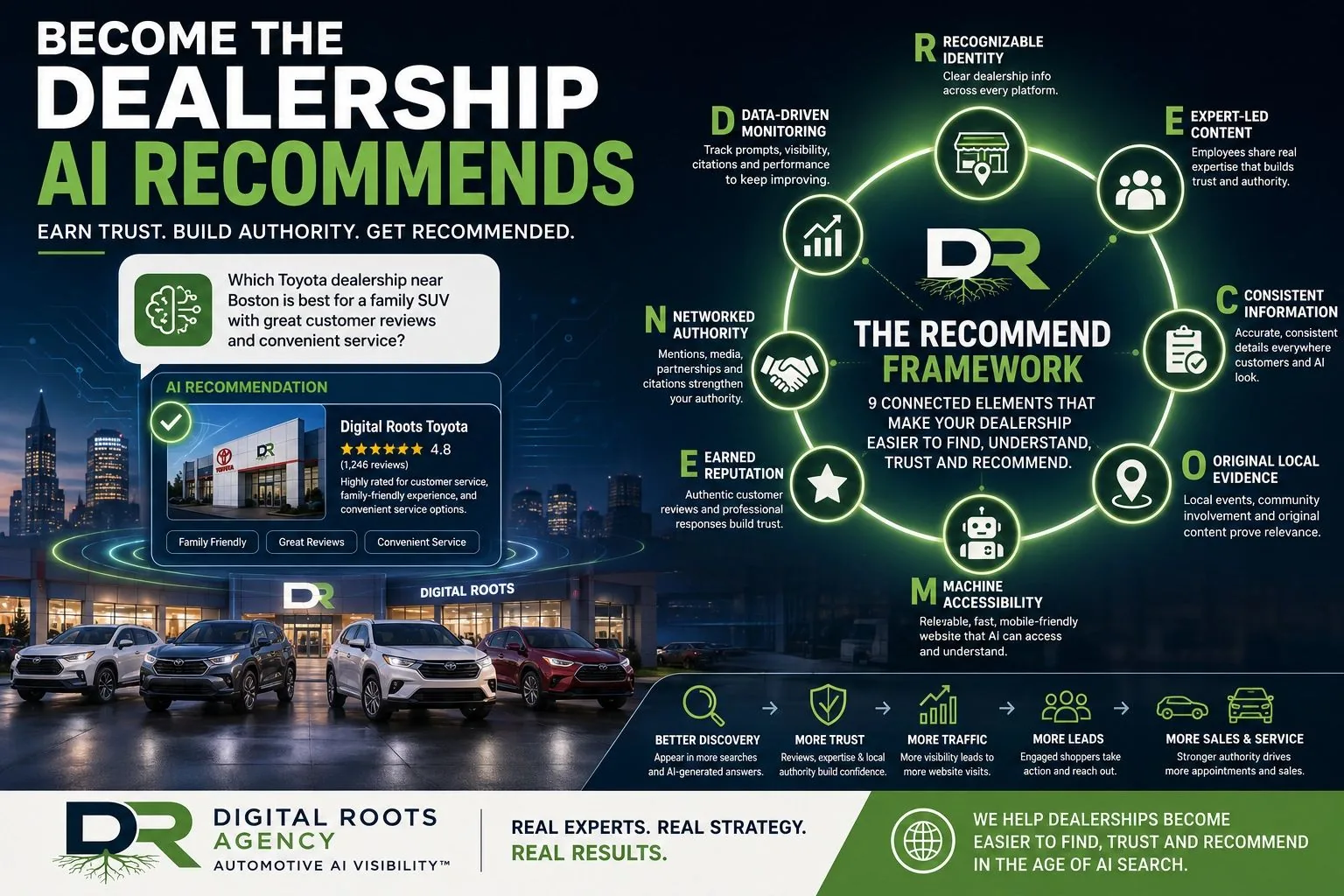
A customer asks ChatGPT:
“What is the best Toyota dealership near Boston for leasing a three-row family SUV?”
Another shopper asks Google:
“Which BMW dealership on Long Island has the strongest reputation?”
A vehicle owner asks:
“Where should I service my Mercedes-Benz near Massapequa?”
A first-time buyer asks:
“Which dealership near me will explain financing without pressuring me?”
Only a few dealerships will be included in the answer.
Will yours be one of them?
For years, automotive marketing focused primarily on helping dealerships rank, generate clicks and capture leads.
Those goals still matter.
But the customer journey is changing.
People can now use conversational AI to describe exactly what they need, ask follow-up questions, compare options and request recommendations without beginning with a traditional list of search results.
A customer may never type your dealership’s name.
They may never search the exact keyword your website was built to target.
Instead, they may describe a need:
- A trustworthy dealership
- A family-friendly SUV
- Convenient service
- Certified pre-owned inventory
- Transparent financing
- Strong customer reviews
- Local community involvement
- Electric-vehicle expertise
- Pickup and delivery
- A dealership close to home
The platform must then determine which businesses appear most relevant to that request.
That creates the defining automotive marketing question of the AI-search era:
Does the public digital evidence surrounding your dealership make it worthy of a recommendation?
Being Found Is Only the Beginning
Traditional search visibility often begins with whether a website page can rank.
Automotive AI Visibility goes further.
An AI platform may need to determine:
- Whether your dealership actually exists
- Where it is located
- Which automotive brand it represents
- Which communities it serves
- What vehicles it sells
- What services it provides
- What makes it different
- Whether customers trust it
- Whether credible sources support its claims
- Whether its information is current
- Whether its website can be accessed
- Whether it directly satisfies the customer’s request
A dealership can be indexed without being understood.
It can rank for its own name without being discovered by new customers.
It can have thousands of website pages without providing a compelling reason to be recommended.
It can use advanced artificial intelligence internally while remaining nearly invisible to the AI platforms customers use externally.
The next competitive advantage will not come from merely existing online.
It will come from becoming easier to understand than the competition.
What Does It Mean for AI to Recommend a Dealership?
An AI recommendation is not identical to a traditional search ranking.
Conversational questions may contain several layers of intent.
Consider:
“Which Honda dealership near Boston has certified pre-owned inventory, good customer reviews and convenient service for a busy family?”
That question includes:
- Automotive brand
- Geographic market
- Certified pre-owned inventory
- Reputation
- Service convenience
- Customer lifestyle
- Recommendation intent
The platform may need to gather and connect information from multiple sources before generating a useful answer.
Google explains that its generative search experiences may use a technique known as query fan-out, issuing multiple related searches across subtopics and data sources to develop a broader response. Google’s official guidance continues to emphasize the same core foundations that support traditional search: crawlable pages, helpful content, clear site structure, accurate information and strong page experiences.
ChatGPT Search can similarly search the web and return timely answers with links to relevant sources. Public websites may be eligible to appear when their content is accessible to OAI-SearchBot, although OpenAI does not guarantee inclusion or placement.
The dealership therefore needs more than one optimized page.
It needs a connected digital identity.
There Is No Guaranteed AI Recommendation Formula
No legitimate marketing agency can guarantee that ChatGPT, Google, Microsoft Copilot or another AI platform will recommend a specific dealership for every question.
Answers may vary based on:
- The wording of the question
- The customer’s location
- The platform being used
- Information available at that moment
- Sources selected by the system
- The vehicle or service requested
- Competitive changes
- Website updates
- Review activity
- Local relevance
The goal is not to manipulate a single answer.
The goal is to strengthen the dealership’s eligibility, relevance, credibility and public authority across the entire discovery ecosystem.
That requires a system.
The Digital Roots Agency RECOMMEND Framework
The Digital Roots Agency evaluates recommendation readiness through nine connected elements:
R — Recognizable Identity E — Expert-Led Content C — Consistent Information O — Original Local Evidence M — Market and Model Relevance M — Machine Accessibility E — Earned Reputation N — Networked Authority D — Data-Driven Monitoring
Together, these elements form the RECOMMEND Framework.
The framework is not a secret ranking trick.
It is a practical model for building the public evidence that helps customers, search engines and AI platforms understand what your dealership represents.
R — Recognizable Identity
Before AI can recommend the dealership, it must be able to identify it correctly.
That sounds simple.
It often is not.
Dealerships may have:
- Similar names
- Multiple locations
- Separate sales and service departments
- Multiple phone numbers
- Manufacturer branding
- Dealer-group branding
- Legacy website URLs
- Duplicate business profiles
- Recently changed leadership
- Conflicting operating hours
- Inconsistent location descriptions
A dealership’s identity should be immediately clear across its website and major public profiles.
Your Website Should Clearly State
- Official dealership name
- Automotive brand
- Physical location
- Main phone number
- Sales hours
- Service hours
- Parts hours
- Communities served
- Dealer-group relationship
- New and pre-owned offerings
- Service and parts capabilities
- Primary customer advantages
This information should not be hidden only in the footer.
It should appear naturally throughout relevant pages.
Build a Strong Dealership About Page
A useful About page can explain:
- Dealership history
- Years serving the market
- Ownership or dealer-group background
- Customer philosophy
- Communities served
- Leadership
- Brand certifications
- Community involvement
- Meaningful awards
- Dealership conveniences
- What differentiates the business
Avoid generic statements that could describe any dealership.
“Committed to exceptional customer service” provides little evidence.
A stronger page explains how that commitment appears in practice.
Clarify Department Relationships
Sales, service, parts and collision operations may have different entrances, hours, phone numbers and profiles.
Those differences should be intentionally documented.
Customers and machines should be able to understand:
- Which departments belong to the dealership
- Where each department is located
- How to contact each one
- When each is open
- Which services each provides
A recognizable identity creates the foundation for everything that follows.
E — Expert-Led Content
Inventory explains what your dealership has today.
Expert content explains what your dealership knows.
Every day, dealership employees answer questions about:
- Vehicles
- Leasing
- Financing
- Trade-ins
- Maintenance
- Technology
- Certified pre-owned programs
- Safety
- Warranties
- Electric vehicles
- Hybrid ownership
- Family transportation
- Commercial vehicles
Most of those answers disappear as soon as the conversation ends.
An expert-led content strategy captures that knowledge and turns it into permanent public resources.
Build Content Around Real Employees
Potential contributors include:
- Sales consultants
- Product specialists
- Service advisors
- Certified technicians
- Finance managers
- Parts specialists
- General managers
- Dealer principals
- Community-relations employees
Employees do not need to become professional writers.
A marketing partner can interview them, organize the information and produce polished content for review.
The expertise should come from the dealership.
Create Content Customers Actually Need
Examples include:
- Which three-row SUV is best for a growing family?
- Should I lease or finance my next vehicle?
- How does certified pre-owned coverage work?
- What should I bring when trading in a car?
- Is a hybrid worthwhile for local driving?
- What should first-time EV buyers know?
- How often should my vehicle be serviced?
- What does a dashboard warning light mean?
- How should I prepare my vehicle for winter?
- What happens during a multi-point inspection?
Google’s people-first content guidance recommends producing helpful, reliable information with clear evidence of firsthand experience and expertise rather than content created primarily to manipulate search rankings.
Identify the People Behind the Information
When appropriate, useful content should include:
- Employee name
- Professional title
- Relevant experience
- Certifications
- Department
- Contribution or review date
- Link to employee profile
Attaching a random name to an article does not create expertise.
The contributor should have a legitimate relationship with the topic.
C — Consistent Information
Your dealership’s public information should tell one coherent story.
Review the dealership’s:
- Website
- Google Business Profile
- Manufacturer directory
- Bing Places listing
- Apple Business Connect profile
- Facebook page
- Instagram profile
- LinkedIn page
- YouTube channel
- Review-platform profiles
- Local directory listings
- Chamber of commerce profile
- Local media mentions
- Community-partner pages
Look for conflicting:
- Business names
- Addresses
- Phone numbers
- Website URLs
- Hours
- Department details
- Leadership information
- Service descriptions
- Automotive brands
- Location descriptions
Inconsistency creates friction for customers.
It can also make the dealership’s public identity more difficult to interpret.
Establish an Internal Source of Truth
Maintain a current dealership information document containing:
- Approved business name
- Address
- Geographic coordinates
- Main phone number
- Department phone numbers
- Website
- Appointment URLs
- Operating hours
- Holiday hours
- Department descriptions
- Leadership
- Social links
- Service areas
- Available conveniences
- Brand certifications
Every vendor and department should work from the same information.
Support the Information With Structured Data
Structured data can help search engines understand visible information about an organization, local business, article, event, product or profile.
It does not guarantee a ranking, citation or AI recommendation.
The markup must accurately match what customers can see on the page.
Consistency reduces ambiguity.
O — Original Local Evidence
A dealership does not become locally authoritative by repeatedly inserting a city name into generic content.
It becomes locally authoritative by building a visible relationship with the market.
Original local evidence may include:
- Community events
- Charitable partnerships
- School programs
- Youth sports sponsorships
- Local business collaborations
- Customer-appreciation events
- Vehicle-safety clinics
- Electric-vehicle workshops
- Cars and coffee gatherings
- Food or toy drives
- Employee volunteering
- Local awards
- News coverage
- Original photography
- Local videos
- Community testimonials
These activities provide information competitors cannot easily copy.
Turn Offline Activity Into Online Evidence
A community event should create:
- A dedicated event page
- A professional press release
- Local media outreach
- Community-partner promotion
- Google Business Profile content
- Social promotion
- Original photography
- Video
- A post-event recap
- Internal website links
- Follow-up media outreach
- Performance reporting
The event may last one day.
The authority assets can remain discoverable for years.
Build Useful Local Market Pages
A genuine local page may include:
- The dealership’s relationship with the community
- Driving directions
- Nearby landmarks
- Popular local vehicles
- Commuting considerations
- Seasonal driving conditions
- Pickup or delivery availability
- Community events
- Customer questions
- Service conveniences
Avoid publishing dozens of pages that merely exchange one city name for another.
Local authority requires local substance.
M — Market and Model Relevance
A dealership may be geographically close to the customer but still appear less relevant than a competitor.
Relevance is built by clearly connecting the dealership with the customer’s need.
Google states that local results are primarily determined by relevance, distance and prominence. Distance cannot always be changed, but dealerships can strengthen how clearly their public information matches what customers are searching for.
Build Market Relevance
The dealership should clearly explain:
- Which communities it serves
- Which services are available
- Which conveniences are offered
- Which ownership needs it understands
- Which local events it supports
- Why customers travel from surrounding markets
Build Model Relevance
Inventory pages are essential but temporary.
They change as vehicles are sold.
Supporting model content can remain valuable across multiple inventory cycles.
Create resources around:
- Model comparisons
- Trim-level differences
- Family vehicle needs
- Cargo and passenger capacity
- Hybrid ownership
- Electric-vehicle ownership
- Performance vehicles
- Commercial vehicles
- Certified pre-owned options
- Local driving considerations
- Leasing and financing questions
- Vehicle technology
Connect Content With Inventory
A model guide should link to:
- Relevant new inventory
- Pre-owned inventory
- Certified inventory
- Current offers
- Trade-in tools
- Financing information
- Test-drive scheduling
- Employee expertise
- Related comparisons
Inventory provides immediacy.
Content provides context.
The two should reinforce one another.
M — Machine Accessibility
The best dealership content cannot support visibility when search and AI crawlers cannot access it.
Automotive websites often depend on:
- JavaScript
- Inventory feeds
- Third-party widgets
- Content delivery networks
- Security systems
- Manufacturer tools
- Website-platform rules
- Tracking scripts
- Digital retailing integrations
Every additional system can introduce technical complications.
Review Crawler Access
Check:
- Robots.txt
- Noindex tags
- Canonical tags
- XML sitemaps
- Firewall settings
- Bot-protection rules
- Content delivery network settings
- JavaScript rendering
- Redirects
- Broken links
- Mobile usability
- Page speed
- HTTPS
- Internal linking
OpenAI states that website owners who want their content eligible for ChatGPT Search should allow OAI-SearchBot to access it. Inclusion and placement are still not guaranteed.
Google similarly requires pages to be crawlable and indexable before they can become eligible for its traditional or generative search experiences.
Make Important Information Visible
Critical dealership information should not depend entirely on:
- An image
- A hidden tab
- A chatbot
- An inventory widget
- A PDF
- A script that fails to load
- A popup
- An employee-only portal
Customers and crawlers should be able to access important content through stable public URLs.
Protect Performance
Conversion technology can become counterproductive when it causes:
- Slow loading
- Layout shifts
- Intrusive popups
- Broken navigation
- Overlapping chat tools
- Repeated consent banners
- Poor mobile usability
- Confusing calls to action
Technology should support the customer journey rather than obstruct it.
E — Earned Reputation
Your dealership can claim to be trustworthy.
Customers determine whether that claim is believable.
Reviews create public evidence of:
- Employee knowledge
- Communication
- Transparency
- Convenience
- Problem resolution
- Sales experience
- Service experience
- Long-term relationships
- Customer satisfaction
A strong review strategy is not about manufacturing a flawless score.
It is about earning consistent, authentic feedback.
Build Review Activity Across the Ownership Journey
Request honest feedback after:
- Vehicle purchases
- Lease transactions
- Test drives
- Trade-in experiences
- Service appointments
- Parts purchases
- Pickup and delivery
- Customer events
- Problem resolution
Sales and service should both be represented.
Focus on Review Quality, Not Only Quantity
Detailed reviews may naturally mention:
- Employee names
- Vehicle models
- Services completed
- Customer concerns
- Communities
- Dealership conveniences
- Reasons for choosing the store
- Problems resolved
Do not tell customers what to write.
Create an experience specific enough to be worth describing.
Respond Professionally
Responses should:
- Thank the customer
- Reference the actual experience
- Recognize employees appropriately
- Remain professional
- Protect private information
- Offer a next step when needed
- Avoid repetitive keyword stuffing
Review responses are visible to future customers.
They demonstrate how the dealership communicates when praised and when challenged.
N — Networked Authority
Your dealership website cannot create complete authority by itself.
It is naturally a self-controlled source.
External validation can strengthen the dealership’s public identity.
Networked authority comes from legitimate relationships with:
- Local publications
- Television stations
- Radio stations
- Community newsletters
- Chambers of commerce
- Schools
- Charities
- Youth sports organizations
- Local businesses
- Automotive publications
- Manufacturer websites
- Event calendars
- Professional associations
- Community leaders
Build Relationships Before You Need Coverage
Do not contact local media only when the dealership wants free promotion.
Provide useful stories throughout the year.
Possible topics include:
- Seasonal driving safety
- New vehicle technology
- EV ownership education
- Holiday travel preparation
- Vehicle theft prevention
- Car-seat safety
- Community fundraising
- Employee milestones
- Automotive employment
- Technician education
- Local economic activity
The dealership should become a useful automotive resource.
Connect Every Authority Asset
Suppose the dealership hosts an EV education night.
The network can include:
- Dealership event page
- Local utility partner
- Charging provider
- Local newspaper
- Chamber calendar
- Employee videos
- EV inventory
- EV ownership article
- Google Business Profile
- Customer email
- Social media
- Post-event recap
No single source tells the whole story.
The network creates stronger context.
D — Data-Driven Monitoring
A dealership cannot improve what it does not measure.
Automotive AI Visibility should be monitored over time rather than treated as a one-time experiment.
Track Branded Prompts
Examples include:
- What is [dealership name]?
- Where is [dealership name] located?
- What services does [dealership name] provide?
- Is [dealership name] trustworthy?
- What makes [dealership name] different?
These prompts test identity and accuracy.
Track Non-Branded Prompts
Examples include:
- Best Toyota dealership near Boston
- BMW dealership on Long Island
- Honda dealer near West Roxbury
- Mercedes-Benz service near Massapequa
- Dealership with certified pre-owned SUVs
- Best dealership for a family vehicle
- Local dealership offering service pickup and delivery
- Dealership with strong customer reviews
These prompts test discovery.
Track Customer-Need Prompts
Examples include:
- Which SUV has the most usable third row?
- Where should I lease a hybrid SUV?
- Which dealership can explain EV ownership?
- Where can I service my vehicle without losing an entire day?
- Which dealership is best for a first-time buyer?
- What dealership supports the local community?
These prompts test whether the dealership is connected to specific needs.
Document More Than Position
Track:
- Whether the dealership appears
- Which competitors appear
- Why each business is mentioned
- Which sources are cited
- Whether information is accurate
- Which dealership strengths are missing
- Which pages are referenced
- How answers change
- Whether visibility produces traffic or leads
Track AI Referral Traffic
OpenAI states that ChatGPT Search referral URLs include utm_source=chatgpt.com, allowing website owners to identify traffic from ChatGPT through analytics platforms.
AI referrals may represent only part of the customer journey.
A customer may discover the dealership through AI and later return through:
- A branded Google search
- Google Maps
- Direct website traffic
- A phone call
- Social media
- A different device
AI Visibility should therefore be evaluated alongside broader business outcomes.
Use Emerging AI Reporting
Microsoft launched an AI Performance report in Bing Webmaster Tools in February 2026.
The report can show citation totals, cited pages, grounding queries and citation trends across supported Microsoft AI experiences. Microsoft also cautions that a citation does not automatically indicate ranking, authority or placement within a specific answer.
This is an important distinction.
A dealership needs both platform data and business interpretation.
The Recommendation Chain
Dealership discovery can be viewed as a six-stage chain:
Question → Discovery → Verification → Confidence → Recommendation → Action
1. Question
The customer describes a need.
2. Discovery
The platform identifies potentially relevant businesses and information.
3. Verification
It looks for public evidence supporting each dealership’s relevance.
4. Confidence
Consistent, credible and useful information reduces uncertainty.
5. Recommendation
The dealership may be included in the answer.
6. Action
The customer visits the website, checks reviews, calls, requests directions, schedules service or submits a lead.
Weakness at any stage can cost the dealership the opportunity.
When Discovery Fails
The dealership may not have enough relevant content.
When Verification Fails
Claims may not be supported by reviews, outside mentions or consistent information.
When Confidence Fails
The website may be outdated, inaccessible or contradictory.
When Action Fails
The website may be slow, confusing or difficult to use.
Automotive AI Visibility is therefore not a single marketing tactic.
It is the result of an interconnected dealership system.
The Recommendation Gap
Most dealerships already have:
- A website
- Inventory
- A CRM
- Paid advertising
- Social media
- Customer reviews
- A Google Business Profile
- Manufacturer content
- Lead forms
- Service scheduling
Why are some still difficult to recommend?
Because owning the components does not mean they are connected.
A dealership may have reviews that are never analyzed.
It may host events that are never documented.
It may employ experts who never appear online.
It may create content that is blocked from crawlers.
It may serve several communities without explaining those relationships.
It may offer valuable conveniences that appear only in an advertisement.
It may invest heavily in conversion technology while neglecting discovery.
The gap between what the dealership does and what the internet can verify is the recommendation gap.
Closing that gap is the purpose of Automotive AI Visibility.
What Recommendation-Worthy Dealerships Do Differently
They Document Real Strengths
They do not invent differentiation.
They make existing strengths visible.
They Answer Real Questions
Their content comes from customer conversations, CRM insights, reviews, service departments and employees.
They Connect Every Department
Sales, service, parts, marketing and leadership contribute to the public dealership identity.
They Build Local Relationships
Community activity creates legitimate external evidence.
They Make Employees Visible
Expertise is associated with real people.
They Maintain Accurate Information
Public profiles are treated as important dealership assets.
They Invest in Discovery and Conversion
They understand that conversion tools cannot convert customers who never find the dealership.
They Measure Competitors
They track which dealerships are being recommended and why.
They Improve Continuously
They treat Automotive AI Visibility as an ongoing operating discipline.
What Dealerships Should Stop Doing
Stop Treating AI as a Software Purchase
Buying another platform does not create a complete strategy.
Stop Publishing Generic Content at Scale
More pages do not automatically produce more authority.
Stop Hiding Expertise Inside the Showroom
Customer knowledge should become public content.
Stop Letting Events Disappear
Every meaningful event should become a documented authority asset.
Stop Treating Reviews as a Star-Rating Contest
Customer language contains valuable operational and marketing insight.
Stop Building Thin City Pages
Local pages should demonstrate real relevance.
Stop Assuming the Website Provider Handles Everything
Dealership leadership must verify technical accessibility, information quality and measurement.
Stop Measuring Only Leads
Visibility, authority, reviews, citations, branded demand and customer actions all matter.
A 90-Day Recommendation Readiness Plan
Days 1–30: Become Understandable
Audit:
- Dealership identity
- Business information
- Google Business Profile
- Manufacturer listings
- Department details
- Technical crawler access
- Website indexability
- Homepage clarity
- About page
- Service information
- Employee profiles
- Branded AI prompts
Correct inaccurate or conflicting information first.
Days 31–60: Become Relevant
Develop:
- Local market content
- Model comparisons
- Service education
- Customer FAQs
- Employee interviews
- Vehicle videos
- Review processes
- Internal links
- Clear dealership differentiators
- Structured information
- Non-branded prompt tracking
Prioritize useful assets rather than content volume.
Days 61–90: Become Authoritative
Launch:
- Community partnerships
- Local media outreach
- Professional press releases
- Event documentation
- Employee expert series
- Review analysis
- Partner amplification
- Competitive monitoring
- AI referral tracking
- Performance reporting
At the end of 90 days, repeat the audit.
Compare:
- Visibility
- Accuracy
- Sources
- Competitors
- Website engagement
- Reviews
- Local mentions
- Leads
- Appointments
- Sales and service outcomes
The Dealer Principal and GM Scorecard
Dealership leaders should be able to answer these questions.
Identity
- Can customers immediately understand who we are?
- Is our information consistent across the web?
- Are sales, service and parts clearly connected?
Expertise
- Who are our visible experts?
- What real customer questions are we answering?
- Does our website demonstrate firsthand knowledge?
Local Authority
- Which communities are we genuinely connected to?
- What local organizations mention us?
- Are our events becoming permanent assets?
Reputation
- Are reviews current?
- Do sales and service both earn feedback?
- What themes appear repeatedly?
- Are we responding professionally?
Technical Foundation
- Can important crawlers access our website?
- Are important pages indexed?
- Is critical information visible without relying on a widget?
Discovery
- Do we appear without our dealership name in the prompt?
- Which competitors are recommended?
- What evidence supports their inclusion?
Measurement
- Are we monitoring important prompts?
- Can we identify AI referral traffic?
- Are we connecting visibility with business results?
If leadership cannot answer these questions, the dealership does not yet have a complete Automotive AI Visibility strategy.
Frequently Asked Questions
Can a dealership guarantee that ChatGPT will recommend it?
No.
OpenAI does not provide guaranteed placement in ChatGPT Search. Public website content may be eligible when it is accessible to OAI-SearchBot, but inclusion and ranking are not guaranteed.
Is Automotive AI Visibility different from SEO?
Automotive AI Visibility builds on SEO.
It also evaluates how well the dealership is understood across conversational prompts, local recommendations, cited sources, public profiles, reviews, third-party mentions and AI-generated answers.
Strong SEO remains part of the foundation.
Does Google require special AI markup?
Google states that businesses do not need special AI files or unique schema specifically for its generative search features.
Existing SEO foundations, useful content, crawlability and accurate structured data remain important.
How long does Automotive AI Visibility take to improve?
The timeline depends on the dealership’s starting point.
Technical corrections and business-information updates may happen quickly.
Building meaningful content, reviews, local authority and third-party validation requires ongoing work.
This is a compounding strategy rather than a one-time campaign.
Do more customer reviews guarantee an AI recommendation?
No.
Reviews can strengthen reputation and public evidence, but recommendation answers may consider multiple factors and sources.
The quality, recency and themes within reviews may be as important strategically as the visible total.
Should dealerships create content with AI?
AI can help dealerships organize research, structure interviews, draft content and repurpose existing material.
The final information should be accurate, dealership-specific, professionally reviewed and strengthened by real employee expertise.
Can inventory pages create AI Visibility?
Inventory pages are important because they show current availability.
They rarely communicate the dealership’s complete identity, expertise, service capabilities, local relevance or customer reputation by themselves.
Inventory should be connected to broader dealership content.
How often should dealerships monitor AI prompts?
Important branded, non-branded, sales, service and local prompts should be monitored consistently.
More frequent monitoring may be appropriate in highly competitive markets or after significant website and content changes.
What should a dealership do when a competitor is recommended instead?
Study the evidence.
Review:
- Sources used
- Competitor content
- Reviews
- Local pages
- Community mentions
- Website clarity
- Service information
- Model relevance
- Technical accessibility
Do not copy the competitor blindly.
Identify what public evidence they possess that your dealership is currently missing.
Can a dealership improve AI Visibility without replacing its website?
Often, yes.
Many improvements can be made through content, technical corrections, internal linking, structured information, local authority, reviews and public relations.
The existing platform must still allow important changes and provide appropriate technical accessibility.
Who should own Automotive AI Visibility inside the dealership?
The strategy should have one accountable leader, but it requires participation from:
- General management
- Marketing
- Sales
- Service
- Parts
- Customer experience
- Website vendors
- CRM vendors
- Community partners
- Employees
Automotive AI Visibility is too interconnected to remain isolated within one department.
The Dealership AI Can Recommend Is Built, Not Hacked
There is no magic prompt.
There is no single schema tag.
There is no guaranteed directory.
There is no AI tool that can replace a weak reputation.
There is no volume of generic content that can manufacture genuine local authority.
The dealerships that become easier to recommend will be the ones that consistently make their real strengths visible.
They will clearly document:
- Who they are
- Where they operate
- What they offer
- What they know
- Who their experts are
- Why customers trust them
- How they serve the community
- What makes them different
- Which sources validate their claims
They will connect operations, conversion and discovery.
They will use technology without confusing technology adoption with authority.
They will turn employees into experts, events into assets, reviews into insights and community relationships into public evidence.
They will not simply ask whether they are using AI.
They will ask whether AI can understand enough about the dealership to recommend it confidently.
That is the next standard for automotive visibility.
Become the Dealership AI Recommends
The Digital Roots Agency helps automotive dealerships build the public digital authority required for modern discovery.
Our Automotive AI Visibility strategy connects:
- Automotive SEO
- Local SEO
- Answer Engine Optimization
- Generative Engine Optimization
- Dealership content
- Employee expertise
- Review development
- Local public relations
- Community authority
- Technical accessibility
- Entity consistency
- AI prompt monitoring
- Competitive intelligence
- Performance measurement
We identify where your dealership appears, where competitors are being recommended and which signals need to become stronger.
Because the dealership with the most AI tools will not automatically win.
The dealership that is easiest to find, understand, trust and recommend will.
Become the Dealer AI Recommends
If AI can’t understand your dealership, it can’t recommend it.