
For years, automotive marketing has revolved around inventory.
More vehicles. More VDPs. More pages.
Dealerships invested heavily in building massive inventory libraries under the assumption that more pages = more visibility.
In today’s AI-driven search environment, that assumption no longer holds.
The Inventory First Mindset in Automotive Marketing
Inventory pages have traditionally been the backbone of dealership websites.
They were designed to:
- Capture long-tail searches
- Rank for specific vehicle queries
- Drive traffic directly to VDPs
And they still matter.
But inventory pages were built for search engines, not decision engines.
AI-powered search evaluates dealerships very differently.
How AI Views Inventory Pages
AI does not evaluate inventory the same way shoppers do.
It does not:
- Browse dozens of VDPs
- Compare trims visually
- Scroll photo galleries
Instead, AI asks:
“What kind of dealership is this?”
Inventory alone does not answer that question.
Why Inventory Pages Are Not Authority Signals
Inventory pages are transactional by nature.
They change constantly, expire quickly, and often share:
- Similar language
- Repetitive structures
- Thin or duplicated content
From an AI perspective, inventory pages rarely establish:
- Trust
- Expertise
- Long-term relevance
AI doesn’t recommend vehicles. AI recommends dealerships.
What AI Needs Beyond Inventory
To confidently recommend a dealership, AI looks for broader signals that explain the full ownership experience.
1. Clear Dealership Identity
AI needs to understand:
- Who you are
- Which brands you represent
- What differentiates your dealership
This is especially important for multi-brand groups representing manufacturers like Toyota, Honda, BMW, Mercedes-Benz, and MINI.
Without clarity, AI treats dealerships as interchangeable.
2. Service Department Authority
AI heavily weighs service credibility.
It looks for:
- Clear service offerings
- Maintenance expertise
- Long-term ownership support
Dealerships with strong service visibility often outperform inventory heavy competitors in AI recommendations.
3. Reviews That Explain the Experience
Inventory pages don’t create trust — reviews do.
AI uses reviews to understand:
- Buying experience
- Service quality
- Honesty and transparency
If reviews reinforce expertise and consistency, AI gains confidence in recommending the dealership.
4. Educational and Support Content
AI values content that answers questions such as:
- What happens after the sale?
- How is service handled?
- What kind of experience should a buyer expect?
Inventory alone doesn’t provide that context.
Why Inventory Still Matters (But Differently)
Inventory pages still play an important role — just not the role many dealerships expect.
They help:
- Capture high-intent vehicle searches
- Support SEO breadth
- Serve shoppers who already chose the dealership
But they are supporting actors, not the main signal AI uses for recommendations.
The New Dealership Visibility Equation
Modern visibility requires balance.
- Inventory pages = transactional support
- Service pages = authority signals
- Reviews = trust reinforcement
- Structured content = AI understanding
Dealerships that rely on inventory alone often struggle to appear in AI-driven results, even with thousands of pages indexed.
Common Inventory Related Visibility Mistakes
Dealerships often lose visibility because:
- Inventory pages dominate the site structure
- Service and ownership content is thin
- Messaging is generic across brands
- Authority content is missing
AI cannot infer expertise without context.
How Dealerships Should Rebalance Their Strategy
To improve AI-driven visibility, dealerships should:
- Strengthen service and ownership content
- Clarify brand and dealership identity
- Use inventory pages as support, not strategy
- Align content around the full customer journey
This creates a digital footprint AI can understand and trust.
Frequently Asked Questions
Do inventory pages help dealership SEO?
Yes. Inventory pages support traditional SEO, but they are not enough to drive AI-based recommendations.
Why doesn’t my inventory rank well in AI search?
AI focuses on dealership authority and trust, not individual vehicle listings.
What content matters more than inventory pages?
Service pages, dealership identity content, reviews, and structured educational content play a larger role in AI visibility.
Should dealerships reduce inventory pages?
No. Inventory pages should support a broader visibility strategy, not replace it.
Final Thought
Inventory sells cars.
Authority sells dealerships.
If AI can’t understand who you are beyond your listings, it won’t recommend you — no matter how many vehicles you have.
Modern automotive visibility isn’t about having more pages. It’s about having the right ones.
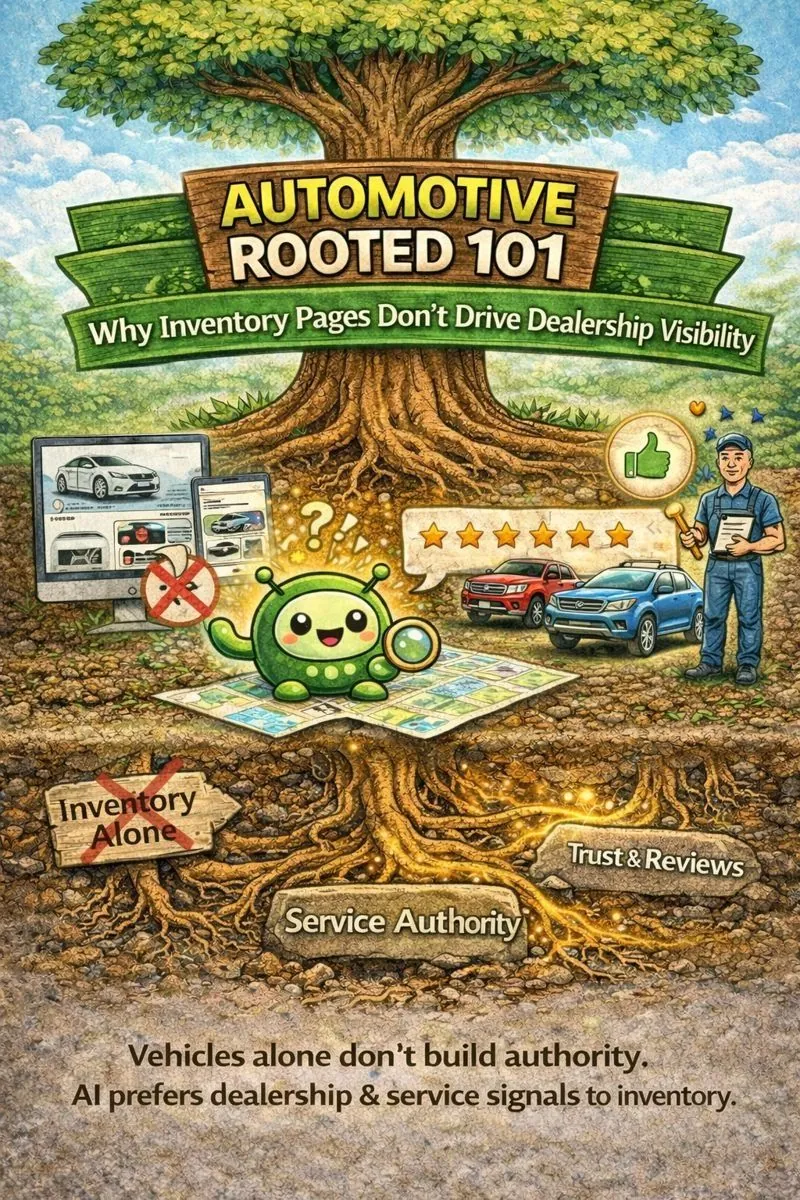
And strong dealerships, like strong roots, grow deeper before they grow wider