
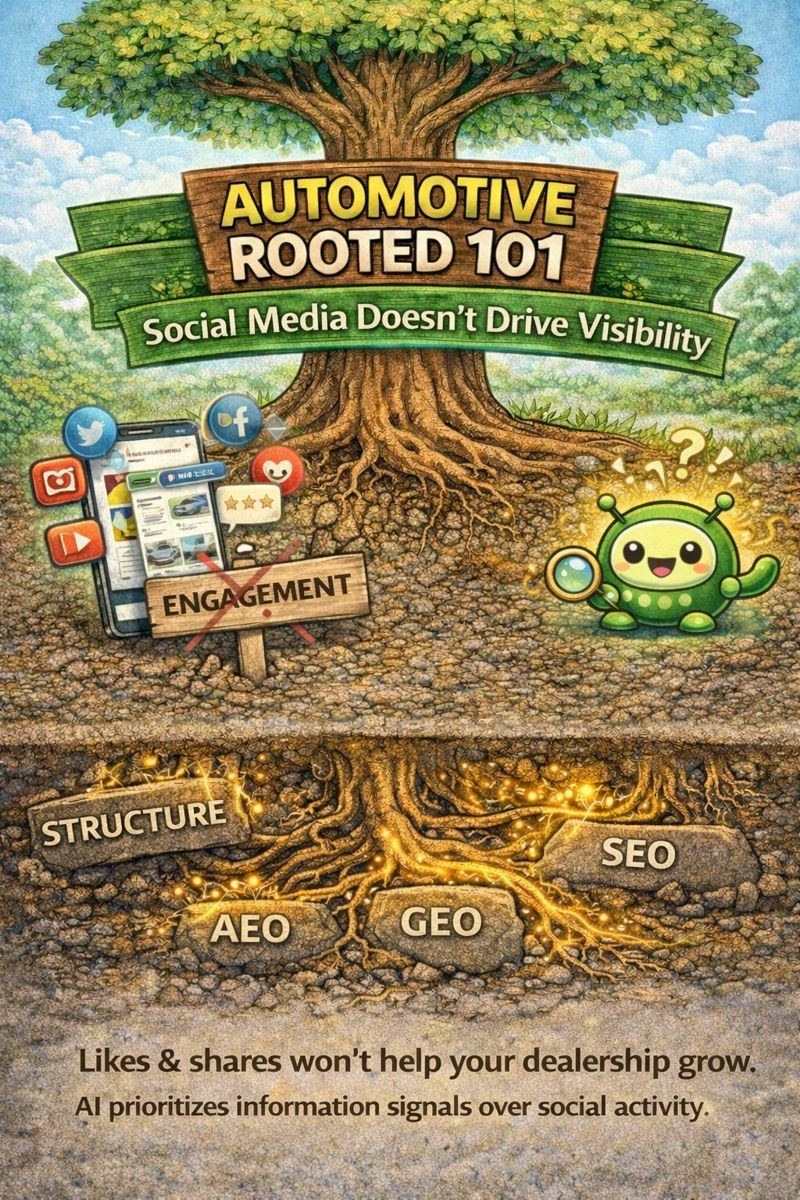
Posting consistently on social media does not guarantee visibility.
This is one of the most misunderstood ideas in automotive marketing. Dealerships invest time, energy, and budget into social posts yet still struggle to appear in search results, maps, and AI recommendations.
The reason is simple:
Social activity is not the same thing as search visibility.
Why Dealerships Rely on Social Media
Social media feels productive.
It provides:
- Likes and comments
- Brand awareness
- Community engagement
- A sense of momentum
And social platforms absolutely have value. They help reinforce brand personality and customer connection.
But social media was never designed to explain your dealership to search engines or AI systems.
How AI Views Social Media Content
AI does not interpret social media the way humans do.
It does not:
- Scroll feeds
- Watch short-form videos for context
- Infer expertise from engagement metrics
Instead, AI looks for structured, verifiable information.
A viral post does not tell AI:
- What your dealership specializes in
- What services you offer
- Why you should be recommended
Without structure, social content becomes noise.
Visibility Requires Structure, Not Activity
AI-powered search engines prioritize:
- Clear answers
- Organized pages
- Topic authority
- Local relevance
Social posts are:
- Ephemeral
- Unstructured
- Context-light
They are excellent for people but unreliable for AI interpretation.
Why Social Media Rarely Builds Authority
Authority is built through depth and consistency, not frequency.
AI learns authority from:
- Dedicated service pages
- Clear dealership explanations
- Educational content
- Reviews and ownership signals
Social posts often:
- Change topics quickly
- Lack permanence
- Duplicate messaging
This makes it difficult for AI to form a stable understanding of your dealership.
The Difference Between Engagement and Visibility
Engagement answers:
“Do people interact with this content?”
Visibility answers:
“Can AI confidently recommend this dealership?”
A post can perform well socially and still contribute nothing to search visibility.
That disconnect is where many dealerships get stuck.
How Social Media Should Be Used
Social media works best as a supporting signal, not a foundation.
It should:
- Reinforce messaging already established on your website
- Echo service and ownership themes
- Support review generation
- Drive traffic to structured content
When social content aligns with your website structure, it strengthens not replaces visibility.
Common Social Media Mistakes That Hurt Visibility
Dealerships often struggle because:
- Social replaces structured content
- Posts lack clear intent
- Messaging changes too frequently
- No connection exists between social and site content
AI cannot connect dots that don’t exist.
The Visibility Stack Revisited
Modern automotive visibility requires alignment:
- SEO ensures your dealership can be found
- AEO ensures AI understands your content
- GEO ensures AI can recommend you
Social media supports the stack but it cannot replace it.
Frequently Asked Questions
Does social media help dealership SEO?
Indirectly. Social media can support awareness and traffic, but it does not replace structured website content needed for search visibility.
Why doesn’t posting more improve search rankings?
Because AI prioritizes clarity, authority, and structure—not posting frequency.
Should dealerships stop using social media?
No. Social media should support a broader visibility strategy, not serve as the strategy itself.
What matters more than social posts?
Service pages, dealership explanations, reviews, FAQs, and structured content matter more for AI-driven visibility.
Final Thought
Social media creates activity.
Visibility creates opportunity.
If AI cannot clearly understand your dealership, it will not recommend you no matter how often you post.
In modern automotive search, visibility is built through structure, clarity, and trust, not likes and impressions.
And strong visibility, like strong roots, grows below the surface