
Most car dealerships have access to similar technology.
Competing dealerships may use:
- Similar website platforms
- The same manufacturer content
- Comparable CRM systems
- Similar inventory feeds
- The same advertising channels
- Related digital retailing tools
- Comparable AI automation
- Similar vehicle incentives
Technology can improve efficiency, but it does not always create meaningful differentiation.
Your people can.
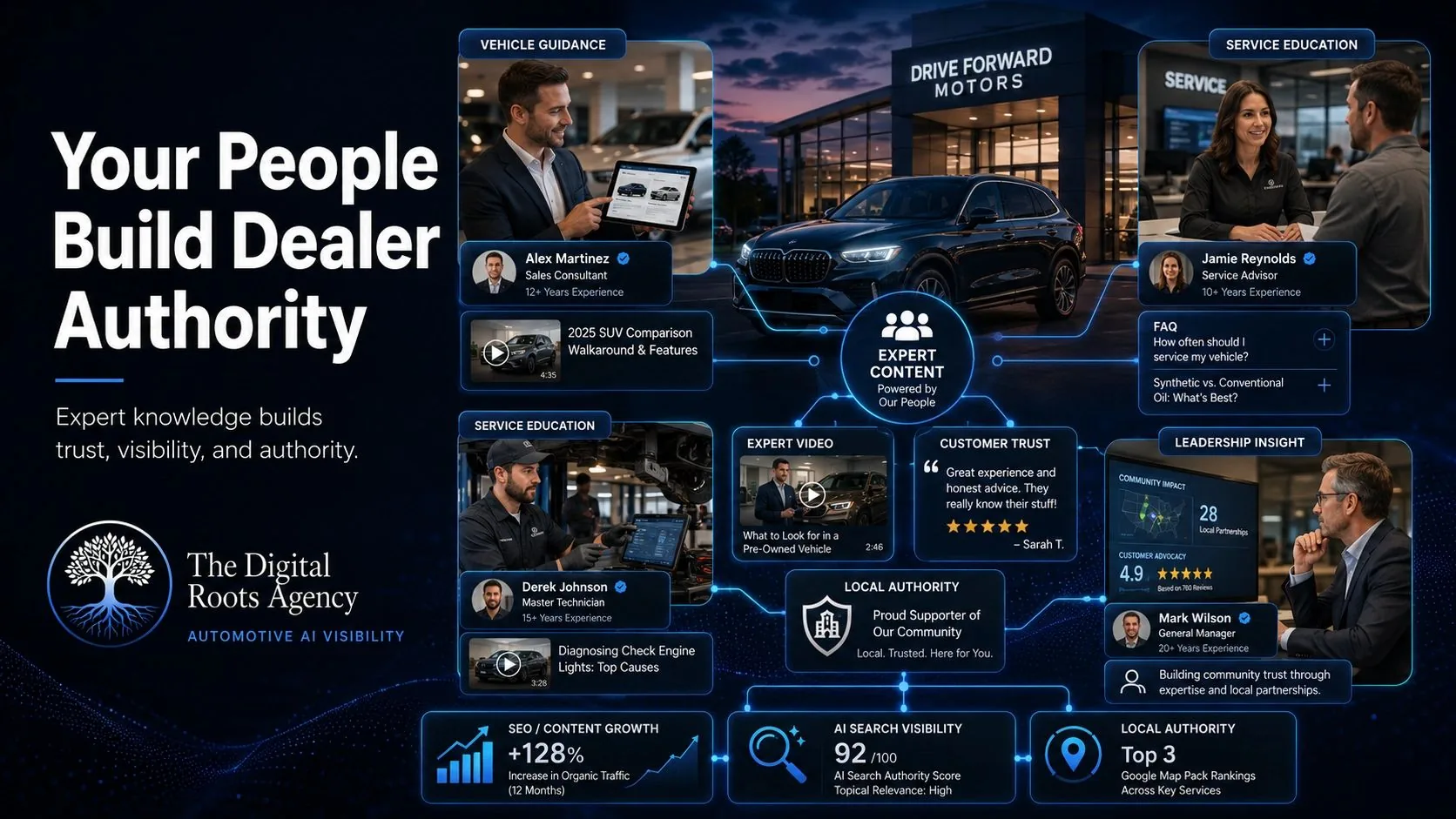
A salesperson who has helped hundreds of families choose the right SUV possesses knowledge a generic vehicle page does not.
A service advisor who answers maintenance questions every day understands the concerns real owners have.
A certified technician can explain vehicle systems, warning lights and repair decisions with a level of firsthand experience that generic AI-generated content cannot authentically reproduce.
A general manager can speak about the dealership’s history, community relationships and customer philosophy.
These employees are not only operational resources.
They are potential authority assets.
When their knowledge is properly documented and published, dealership employees can help strengthen:
- Customer trust
- Website content
- Local relevance
- Employee recognition
- Search visibility
- Video performance
- Review credibility
- Community authority
- Automotive AI Visibility
The dealership’s strongest competitive content may already exist inside the building.
The challenge is capturing it.
Your Dealership Knows More Than Its Website Shows
Most dealership employees answer customer questions throughout the day.
Salespeople explain:
- Vehicle differences
- Trim levels
- Leasing
- Financing
- Trade-ins
- Technology
- Safety features
- Fuel economy
- Electric and hybrid ownership
- Family vehicle needs
Service advisors explain:
- Maintenance schedules
- Repair timelines
- Warning lights
- Tire replacement
- Brake service
- Recall work
- Warranty coverage
- Seasonal maintenance
- Pickup and delivery
- Appointment preparation
Technicians understand:
- Common mechanical problems
- Diagnostic processes
- Preventive maintenance
- Brand-specific systems
- Repair procedures
- Vehicle technology
- Genuine parts
- Safety concerns
- Service recommendations
Managers understand:
- The local market
- Customer expectations
- Dealership history
- Community partnerships
- Employee development
- Operational improvements
- Customer experience
- Automotive trends
Yet much of that knowledge disappears as soon as the conversation ends.
The question is answered once.
The customer leaves.
The employee moves on to the next task.
Meanwhile, the dealership website may contain thin manufacturer descriptions, generic service language and repetitive pages that provide little evidence of the real expertise available inside the store.
That creates a major visibility gap.
Expert-Led Content Is Becoming More Valuable
Search and AI platforms need useful information that goes beyond material repeated across thousands of websites.
Google’s current guidance for generative AI search encourages businesses to create original, non-commodity and expert-led content that provides value beyond commonly available information. Google also continues to recommend clear evidence of firsthand experience and information about the people responsible for creating content.
That is an important opportunity for dealerships.
A generic article called “Five Reasons to Buy an SUV” can be produced by nearly anyone.
An article featuring a dealership employee explaining which SUV features local families consistently ask about is more specific.
A generic maintenance article may repeat the manufacturer schedule.
A video featuring a dealership technician explaining how local weather affects batteries, tires or brakes adds firsthand context.
The dealership’s advantage is not simply publishing more.
It is publishing information competitors cannot authentically duplicate.
Employee Expertise Creates Originality
A dealership may struggle to determine what “original content” means in an industry where every store sells similar vehicles.
Originality does not require discovering a new fact about automobiles.
It can come from:
- Firsthand customer experience
- Local market knowledge
- Employee explanations
- Dealership-specific processes
- Original photographs
- Original video
- Real customer questions
- Community involvement
- Service department observations
- Vehicle demonstrations
- Employee stories
- Local driving considerations
For example, two Toyota dealerships may sell the same Grand Highlander.
One dealership publishes the manufacturer description.
The other asks an experienced product specialist to explain:
- Which seating configuration families prefer
- How the cargo space works with the third row raised
- Which trim offers the most useful family features
- How the hybrid system fits different driving patterns
- What buyers regularly compare it against
- Which questions customers ask during test drives
- What local owners should consider before choosing a trim
The second dealership is not changing the vehicle.
It is adding useful human perspective.
That perspective builds authority.
The People-to-Authority Framework
The Digital Roots Agency recommends a six-stage process for turning dealership expertise into public authority:
Identify → Capture → Create → Connect → Amplify → Measure
Identify
Find employees with useful knowledge, strong communication skills and customer credibility.
Capture
Document the questions they answer, the experiences they have and the insights they can contribute.
Create
Turn that knowledge into profiles, articles, videos, FAQs and useful website resources.
Connect
Link each employee’s expertise with relevant vehicle, service, local and dealership pages.
Amplify
Share the content through search, social media, YouTube, Google Business Profile, email and local media.
Measure
Track whether the content improves engagement, visibility, employee recognition and customer action.
This process does not require every employee to become a full-time content creator.
It requires the dealership to develop a system for capturing valuable knowledge without disrupting the store.
Stage One: Identify Your Internal Experts
Every dealership contains different types of expertise.
The first step is determining which employees can contribute to specific topics.
Sales Consultants
Sales consultants can speak about:
- Vehicle comparisons
- Trim levels
- Family vehicle needs
- Technology demonstrations
- Leasing questions
- Financing preparation
- Test-drive advice
- Trade-in preparation
- New-owner guidance
- Customer decision factors
A salesperson does not need to be a professional presenter.
They need to explain useful information clearly and accurately.
Product Specialists
Product specialists may be particularly valuable for:
- Model walkarounds
- Technology tutorials
- Infotainment demonstrations
- Driver-assistance features
- Electric vehicles
- Hybrid systems
- Performance vehicles
- New-model launches
- Feature comparisons
These employees can make complex technology easier for customers to understand.
Service Advisors
Service advisors hear recurring ownership questions every day.
They can contribute to content involving:
- Service scheduling
- Maintenance intervals
- Seasonal preparation
- Repair communication
- Warranty questions
- Recall support
- Tire care
- Brake service
- Battery replacement
- Appointment preparation
- Service pickup and delivery
Their insights can help the dealership create content based on genuine customer concerns.
Technicians
Technicians provide technical credibility.
Their expertise can support:
- Maintenance education
- Diagnostic explanations
- Vehicle inspections
- Warning-light content
- Tire safety
- Brake systems
- Battery care
- Hybrid and EV service
- Genuine parts
- Seasonal vehicle preparation
Technician content should be educational rather than personalized repair advice.
Customers should still be encouraged to have their individual vehicles properly inspected.
Finance Managers
Finance employees can answer common questions about:
- Leasing versus financing
- Credit applications
- Down payments
- Loan terms
- Protection products
- Payment calculations
- Trade-in equity
- Required documents
- First-time buyers
- End-of-lease options
Financial content should remain clear, accurate and appropriately reviewed.
It should educate customers without promising terms or outcomes that depend on individual circumstances.
General Managers and Dealer Principals
Leadership can communicate:
- Dealership history
- Customer philosophy
- Community involvement
- Employee development
- Long-term market commitment
- Charitable partnerships
- Business milestones
- Customer service standards
- Industry perspective
- Future dealership initiatives
Leadership content can help humanize the business and explain what the dealership stands for.
Employees With Community Connections
Some employees may also have meaningful connections to:
- Schools
- Youth sports
- Charities
- Business organizations
- Veterans’ groups
- Cultural organizations
- Local events
- Volunteer programs
Those relationships can support authentic dealership involvement and local storytelling.
Stage Two: Capture the Knowledge
Most dealerships do not need to invent content topics.
Employees already provide them during customer conversations.
The dealership needs a repeatable process for capturing those questions.
Build a Question Bank
Ask employees to document questions they repeatedly hear.
Sales questions might include:
- Which SUV has the most usable third-row space?
- Should I lease or finance?
- Is the hybrid worth the additional cost?
- Which trim level is right for my family?
- What should I bring when trading in my vehicle?
- Can I trade in a vehicle with an existing loan?
- Which safety features are standard?
- How long does ordering a vehicle take?
Service questions might include:
- Why is my tire-pressure light on?
- How often should I replace my battery?
- Do I need an appointment for service?
- What does this dashboard warning light mean?
- When should I replace my brakes?
- Is pickup and delivery available?
- How long will this repair take?
- What maintenance is due at my mileage?
These questions should be organized by:
- Department
- Vehicle model
- Customer stage
- Topic
- Urgency
- Local relevance
- Content format
A question repeatedly asked in the showroom is probably worth answering online.
Conduct Short Employee Interviews
Content interviews do not need to take hours.
A marketing partner can ask an employee:
- What question do customers ask you most?
- What do buyers misunderstand about this vehicle?
- What should customers know before a test drive?
- What mistake do owners commonly make?
- Which feature surprises customers?
- What should a service customer bring to an appointment?
- What local driving concern comes up frequently?
- What makes your dealership process different?
A 15-minute conversation can produce:
- One article
- Several FAQs
- Multiple social posts
- A short video
- An employee quote
- An email topic
- Google Business Profile content
The employee provides the expertise.
The marketing team organizes, edits and distributes it.
Review CRM and Search Data
Employee insight should also be compared with:
- CRM notes
- Website search activity
- Google Search Console queries
- Call recordings
- Chat transcripts
- Review themes
- Lead objections
- Service appointment questions
- Social media comments
- AI search prompts
This helps the dealership identify where internal expertise and customer demand overlap.
Capture Video During Normal Activity
Content does not always need a formal studio.
Useful video can be recorded during:
- Vehicle walkarounds
- New-model arrivals
- Service inspections
- Technology demonstrations
- Community events
- Employee introductions
- Seasonal maintenance checks
- Customer clinics
- Dealership milestones
The content should still have:
- Clear audio
- Stable framing
- Appropriate lighting
- Accurate information
- Customer privacy
- Brand compliance
- A defined purpose
Authentic does not have to mean careless.
Stage Three: Create Employee Authority Assets
The captured expertise should become permanent, organized dealership assets.
Employee Profile Pages
Many dealership websites contain staff pages with only:
- A headshot
- A name
- A title
- A phone number
- An email address
That is a missed opportunity.
A strong employee profile may include:
- Full name
- Professional title
- Department
- Years of automotive experience
- Brand experience
- Certifications
- Languages spoken
- Areas of expertise
- Communities served
- Personal customer-service philosophy
- Links to articles and videos
- Customer review mentions
- Professional photograph
- Contact options
The profile should focus on information relevant to customers.
It should not expose unnecessary personal details.
Google supports ProfilePage structured data for pages primarily focused on a person or organization affiliated with the website. When appropriate and accurately implemented, this markup can help Google better understand the subject of the profile page.
Structured data is not a ranking guarantee.
It should clarify information already visible on a useful page.
Expert Articles
Employees can contribute to articles such as:
- How to Choose the Right Three-Row SUV
- What to Know Before Leasing Your First Vehicle
- How Certified Pre-Owned Coverage Works
- What to Bring When Trading In Your Car
- Five Signs Your Vehicle May Need Brake Service
- How New England Winters Affect Car Batteries
- What First-Time EV Buyers Should Know
- How to Prepare Your Vehicle for a Florida Road Trip
The employee does not need to personally write every word.
The article can be created from an interview and professionally edited.
The final page should identify the contributor and explain their relevant experience.
Google’s people-first content guidance specifically encourages clear background about the author or expert responsible for the information, particularly when that context helps readers understand why the content should be trusted.
Vehicle Walkaround Videos
Walkarounds should do more than list every feature shown in the brochure.
A stronger video answers a specific customer need.
Examples include:
- Is the Third Row Actually Comfortable?
- Which Trim Is Best for Families?
- How Much Cargo Space Is Available?
- What Comes Standard on This Model?
- How Does the Hybrid System Work?
- What Technology Should New Owners Learn First?
- Which Features Make This Vehicle Good for Commuting?
- What Should Buyers Compare During a Test Drive?
The employee should speak naturally and focus on the customer question.
Service Education Videos
Service content can include:
- How to Check Tire Tread
- What a Dashboard Warning Light Means
- When to Replace a Battery
- How to Prepare for Winter Driving
- What Happens During a Multi-Point Inspection
- Why Wheel Alignment Matters
- How Brake Wear Is Evaluated
- What Customers Should Bring to a Service Visit
These videos can make the service department feel more accessible while demonstrating real expertise.
Frequently Asked Questions
Employee interviews can create dealership-specific FAQs.
Instead of generic answers copied from another site, the dealership can explain:
- Its appointment process
- Pickup and delivery availability
- Trade-in requirements
- Financing preparation
- Service timelines
- EV charging assistance
- Certified pre-owned inspections
- Vehicle ordering
- Local delivery areas
- Customer support process
The answers should be direct, accurate and written in language customers understand.
Employee Features
Dealerships can also publish stories about:
- Employee anniversaries
- Certifications
- Promotions
- Community volunteering
- Industry awards
- Training achievements
- Customer recognition
- Career paths
- Specialized expertise
These stories support recruiting, culture and local authority.
They also show that the dealership is made up of real people with long-term connections to the business.
Stage Four: Connect the Expertise Across the Website
Employee authority should not remain isolated on a staff page.
It should connect with the broader dealership website.
Link Employees to Relevant Models
A product specialist’s profile might link to:
- Model walkarounds
- Inventory
- Comparison articles
- Technology guides
- New-model pages
- Electric or hybrid resources
The model content can also link back to the employee’s profile.
Connect Service Experts to Ownership Content
A technician or service advisor may be featured on:
- Maintenance pages
- Seasonal service articles
- Brake-service resources
- Battery information
- Tire pages
- Recall content
- Service FAQs
This creates a clearer relationship between the content and the dealership expertise behind it.
Add Contributors to Articles
Articles should identify the employee or expert who contributed to the content when appropriate.
That can include:
- Name
- Title
- Relevant experience
- Link to profile
- Date reviewed
- Department
The goal is not to attach a random name to every page.
The contributor should have a legitimate connection to the topic.
Link Community Stories to Leadership
When dealership leadership participates in an event or partnership, the recap can link to:
- Leadership profiles
- Community involvement pages
- Partner websites
- Local market pages
- Related dealership history
- Future events
This helps connect the people, activity and local story.
Use Clear Article Information
Google’s Article structured-data guidance allows publishers to identify information including authors, dates, headlines and images so Google can better understand article pages. The visible content and markup should remain accurate and consistent.
Again, structured data supports understanding.
It does not replace strong content or guarantee a special search result.
Stage Five: Amplify Employee Expertise
Publishing a profile or video is only the beginning.
The content should be distributed through appropriate channels.
YouTube
Dealership videos should include:
- A specific title
- Clear description
- Dealership name
- Employee name and role
- Vehicle or service topic
- Location where relevant
- Link to the related website page
- Useful chapters for longer videos
- Accurate thumbnail
- Captions
Google’s video guidance recommends indexable video pages, stable video and thumbnail URLs, and dedicated watch pages when video is the primary content.
A dealership can publish the video on YouTube and embed it on a useful page containing:
- A written summary
- Key takeaways
- Employee information
- Related inventory or services
- Frequently asked questions
- A clear next action
Social Media
Employee content can be adapted for:
- TikTok
- YouTube Shorts
- Google Business Profile
A single interview can produce:
- One long-form video
- Three short clips
- One article
- Several quotes
- A photo post
- A customer FAQ
- An employee spotlight
The message should be adjusted for each platform rather than copied without context.
Google Business Profile
Dealerships can use Google Business Profile updates to highlight:
- Employee expertise
- New-model demonstrations
- Service education
- Certifications
- Community participation
- Customer events
- Helpful dealership resources
The post should link to a relevant website destination when one exists.
Employee expertise can support:
- Sales follow-up
- Service reminders
- New-model announcements
- Ownership education
- Customer newsletters
- Event invitations
- Employee introductions
For example, an email promoting winter service could include a technician’s short explanation of battery or tire concerns.
Local Public Relations
Employees can also serve as expert sources for:
- Local news articles
- Seasonal driving stories
- Vehicle safety features
- Electric-vehicle education
- Automotive theft prevention
- Holiday travel preparation
- Community events
- Local business coverage
A dealership technician may provide better local media value than a generic corporate statement.
The employee has direct, relevant experience.
Reviews Can Reinforce Employee Authority
Customer reviews often mention employees by name.
Repeated praise can reveal which employees customers already view as trusted experts.
Common themes may include:
- Clear explanations
- Product knowledge
- Honest communication
- Patience
- Responsiveness
- Service expertise
- Problem-solving
- Long-term relationships
Those insights can help the dealership identify:
- Content contributors
- Employee spotlights
- Training opportunities
- Website differentiators
- Leadership potential
- Customer-experience strengths
The dealership should never fabricate or manipulate employee mentions.
Authentic customer recognition is valuable because it provides independent public validation.
How Employees Support Automotive AI Visibility
An AI platform cannot walk into the dealership and interview the team.
It depends on information available publicly.
Employee-driven content can create accessible evidence about:
- The dealership’s expertise
- Vehicle knowledge
- Service capabilities
- Local experience
- Customer support
- Community connections
- Brand specialization
- Staff longevity
- Dealership culture
A dealership that publishes useful, expert-led content may provide more context than a competitor relying almost entirely on inventory and manufacturer text.
OpenAI states that public website content can potentially appear in ChatGPT search when it is accessible to OAI-SearchBot, although inclusion and placement are not guaranteed.
Making employee expertise public does not guarantee an AI recommendation.
It gives search and AI systems more accurate information to work with.
Employee Expertise and Non-Branded Discovery
Consider a customer asking:
“What should I know before buying my first electric vehicle?”
A dealership might become relevant through an employee-led EV guide.
Another customer might ask:
“Which three-row SUV is easiest for families?”
A salesperson’s detailed comparison could support discovery.
A service customer might ask:
“How do I know if my brakes need to be replaced?”
A technician-led article or video could provide a useful answer and introduce the dealership’s service expertise.
These customers may not know the dealership’s name yet.
Expert content gives the dealership an opportunity to enter the conversation before a branded search begins.
The Human Advantage Over Generic AI Content
AI can help dealerships:
- Organize interview notes
- Develop outlines
- Repurpose video transcripts
- Draft social captions
- Create FAQ structures
- Summarize technical explanations
- Improve readability
But AI should not invent the expertise.
The employee provides:
- Experience
- Judgment
- Examples
- Customer understanding
- Local context
- Brand knowledge
- Firsthand observations
- Personal credibility
The technology helps organize and distribute that knowledge.
The strongest process combines human expertise with efficient production.
Common Employee Content Mistakes
Mistake One: Publishing Only a Headshot
A headshot and job title provide very little evidence of expertise.
Build useful profiles that help customers understand why the employee can help them.
Mistake Two: Forcing Every Employee on Camera
Some employees will be comfortable presenting.
Others may contribute more effectively through interviews, written articles or behind-the-scenes expertise.
Choose the format that fits the person.
Mistake Three: Using Scripted Corporate Language
Customers can recognize unnatural content.
Employees should sound professional but human.
A useful outline is often better than a rigid script.
Mistake Four: Failing to Review Technical Information
Vehicle, service and financial information should be reviewed for accuracy.
Content must remain aligned with:
- Manufacturer guidance
- Dealership policies
- Brand compliance
- Legal requirements
- Current vehicle specifications
Mistake Five: Publishing Content Without Employee Permission
Employees should understand:
- Where content will appear
- How their name and image will be used
- Whether the content may be reused
- How updates will be handled
- What happens if they leave the dealership
The dealership should establish a clear content and consent process.
Mistake Six: Deleting Valuable Content When an Employee Leaves
When an employee leaves, the dealership should review affected content.
Possible actions include:
- Updating the contributor
- Retaining factual content with a revised editorial note
- Redirecting the profile page
- Re-recording important videos
- Removing outdated contact details
- Preserving useful URLs when appropriate
Automatically deleting every page can erase valuable content and create broken links.
Mistake Seven: Making One Employee the Entire Brand
Employee authority should strengthen the dealership brand, not replace it.
Build a team of contributors across:
- Sales
- Service
- Parts
- Finance
- Leadership
- Community involvement
That creates a more durable system.
Protect Customer Privacy
Employee content must not expose customer information.
Avoid sharing:
- Customer names without permission
- Financial information
- Credit details
- Service records
- License plates
- Personal phone numbers
- Addresses
- Private conversations
- Identifiable customer stories without consent
Employees can discuss common themes and anonymized examples.
The lesson should be public.
The customer’s private information should remain private.
A 90-Day Employee Authority Plan
Days 1–30: Identify the Experts
Select employees from:
- Sales
- Service
- Parts
- Finance
- Leadership
Document:
- Experience
- Certifications
- Topic expertise
- Languages
- Customer review mentions
- Video comfort
- Community involvement
- Common questions answered
Create a list of 25 real customer questions.
Days 31–60: Build the Assets
Produce:
- Five improved employee profiles
- Two expert articles
- Two vehicle videos
- Two service videos
- Ten dealership-specific FAQs
- One leadership story
- One employee recognition post
- Internal links to relevant pages
Use original photographs whenever possible.
Days 61–90: Amplify and Measure
Distribute through:
- Website
- YouTube
- Social media
- Google Business Profile
- Local media outreach
- Sales and service follow-up
Track:
- Page views
- Video engagement
- Organic impressions
- Employee-name searches
- Calls
- Appointment requests
- Review mentions
- AI recommendation prompts
- Local media interest
- Customer feedback
Use the results to determine which employees and topics should become recurring content series.
Questions Dealership Leaders Should Ask
- Which employees do customers consistently praise?
- Who explains complex topics particularly well?
- What questions are answered every day but missing from the website?
- Which employees possess certifications or specialized experience?
- Does our website explain who created or reviewed important content?
- Are staff profiles useful or merely contact listings?
- Are we capturing employee expertise before it disappears?
- Do our videos answer real customer questions?
- Are our service experts visible online?
- Do local media outlets know whom to contact for automotive insight?
- Are employees comfortable with how their names and images are used?
- Are we measuring the business impact of expert-led content?
Frequently Asked Questions
Can dealership employees improve SEO?
Employees can contribute original, expert-led information that makes dealership content more useful and trustworthy.
Their expertise can support articles, videos, local pages, service resources and vehicle comparisons.
SEO performance still depends on content quality, technical accessibility, competition and other factors.
Should every dealership employee have a profile page?
Not every employee necessarily needs a detailed public profile.
Customer-facing employees, leadership and expert contributors are often the strongest candidates.
Profiles should be useful, current and relevant.
What should an employee profile include?
A profile may include the employee’s name, role, department, experience, certifications, languages, areas of expertise, content contributions and professional contact options.
Avoid unnecessary personal information.
Can employee videos help dealerships appear in search?
Videos can support search visibility when they are useful, accessible and published with clear titles, descriptions, thumbnails and supporting website content.
Google recommends dedicated watch pages when video is the main content and stable URLs so video assets can be properly indexed.
Does employee expertise improve AI Visibility?
Employee-led content can give AI systems more public information about the dealership’s knowledge, services and customer experience.
It does not guarantee inclusion in AI answers, but it can strengthen the accessible evidence available about the dealership.
Can AI write content for dealership employees?
AI can assist with drafting and organization.
Employees or qualified reviewers should provide the underlying expertise, verify accuracy and add dealership-specific experience.
What happens when an employee leaves?
Update the profile and contact information promptly.
Review any articles and videos associated with the employee, preserve valuable content where appropriate and remove or revise information that is no longer accurate.
Should dealership technicians appear in content?
Technicians can be excellent contributors for maintenance and vehicle-ownership education.
Content should remain accurate, clearly presented and avoid diagnosing individual customer vehicles without inspection.
How often should dealerships publish employee-led content?
Consistency matters more than producing a large volume.
A dealership could begin with one expert article and two short videos each month, then expand based on performance and available resources.
Your Competitors Cannot Copy Your People
Competitors may use the same website provider.
They may advertise on the same platforms.
They may sell the same models.
They may use similar AI tools.
They cannot authentically duplicate:
- Your employees’ experience
- Your customer relationships
- Your dealership history
- Your local knowledge
- Your community involvement
- Your service expertise
- Your team culture
- Your firsthand stories
Those qualities create differentiation.
The dealership’s job is to make them visible.
Your employees already answer the questions customers care about.
They already create trust during sales and service conversations.
They already shape customer reviews.
They already represent the dealership in the community.
An effective content strategy captures that value and gives it a longer life.
One employee conversation can help one customer.
One well-built authority asset can help thousands.
Turn Your Team Into an Authority Engine
The Digital Roots Agency helps automotive dealerships capture employee expertise and transform it into useful content that supports search, local authority and Automotive AI Visibility.
Our approach includes:
- Employee authority strategy
- Professional profile development
- Expert interviews
- Automotive content creation
- Vehicle walkaround planning
- Service education content
- Video optimization
- Local SEO
- Review analysis
- Digital public relations
- Structured information
- AI Visibility monitoring
- Performance measurement
Your dealership’s greatest source of original content is already inside the building.
We help bring that expertise online.
Build Your Dealer Authority
If AI can’t understand your dealership, it can’t recommend it.