
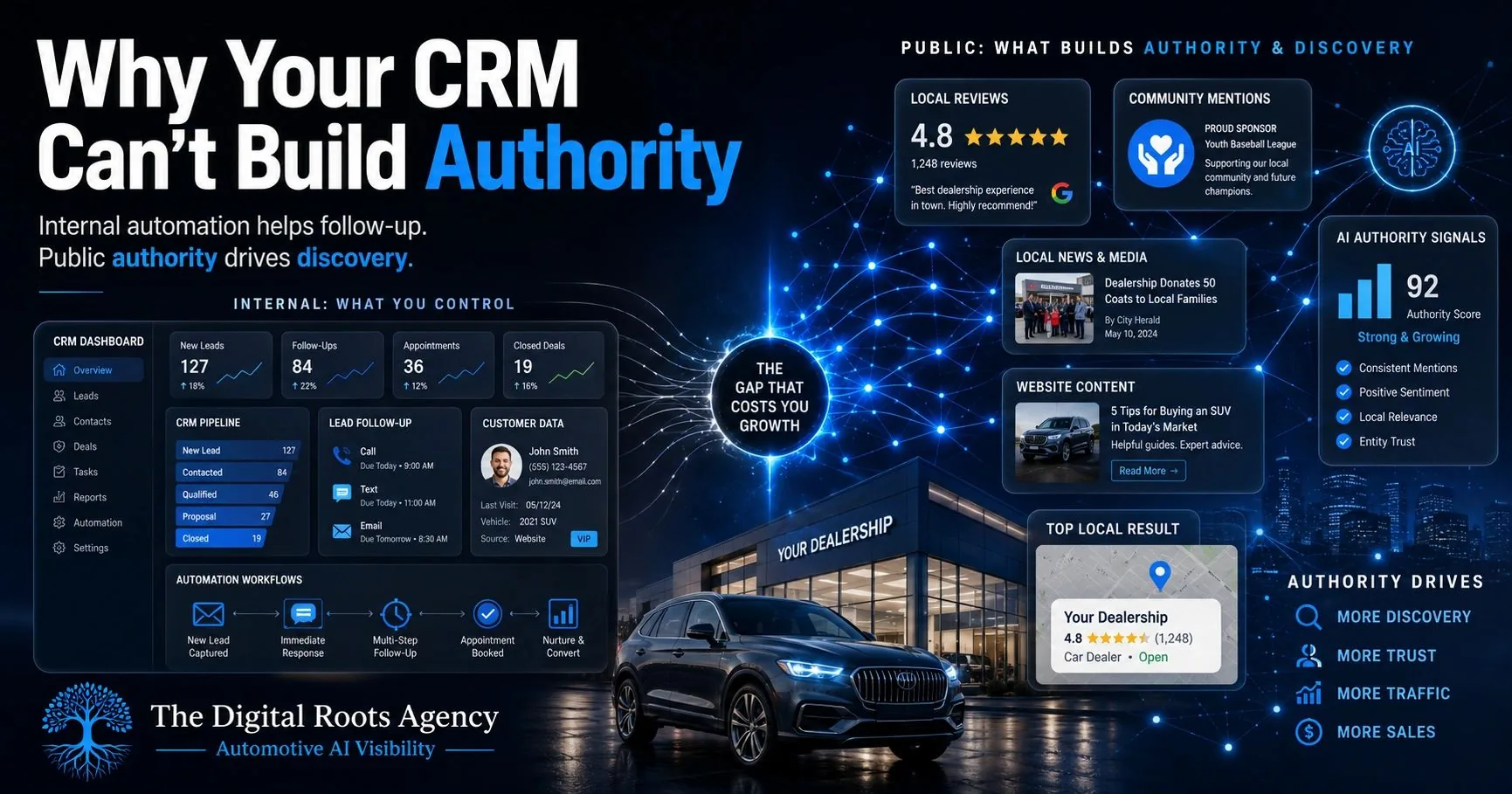
Your dealership CRM may be one of the most important systems inside the store.
It helps organize leads, track customer communication, schedule follow-up, support sales processes and maintain relationships after the initial purchase.
Modern platforms may also use artificial intelligence to:
- Prioritize opportunities
- Automate customer messages
- Recommend next actions
- Reengage older leads
- Personalize outreach
- Identify service opportunities
- Improve reporting
- Support customer retention
These capabilities can make a dealership more responsive and efficient.
But there is one major problem a CRM cannot solve by itself:
It cannot create local authority.
A CRM becomes valuable after a customer enters the dealership’s ecosystem.
Local authority influences whether that customer discovers the dealership in the first place.
That distinction is becoming increasingly important as car shoppers use Google, ChatGPT and other AI-powered platforms to ask questions such as:
- What is the best Toyota dealership near Boston?
- Which BMW dealer on Long Island has the strongest reputation?
- Where should I service my Mercedes-Benz near Massapequa?
- Which local dealership is best for buying a family SUV?
- What dealership near me is active in the community?
- Who offers the most convenient automotive service experience?
Your CRM may help manage the customer once the lead is generated.
It does not determine whether your dealership is included in the answer.
What Your Dealership CRM Does Well
A CRM is primarily an internal operating and communication system.
It helps dealership teams manage information about:
- Prospective customers
- Existing owners
- Website leads
- Phone inquiries
- Vehicle interests
- Appointments
- Follow-up activity
- Trade-ins
- Service history
- Marketing campaigns
- Customer communication
- Sales opportunities
When properly configured and consistently used, it can help reduce missed opportunities.
A CRM can remind a salesperson to follow up with a customer who viewed a vehicle.
It can trigger a message after a test drive.
It can identify an owner who may be approaching the end of a lease.
It can support service reminders and customer retention campaigns.
It can help dealership leadership understand what happened after a customer submitted a form, called the store or entered the showroom.
All of that matters.
But the CRM primarily operates within a defined audience:
People the dealership already knows about.
Local authority helps the dealership reach people who have not yet decided which business to contact.
The Difference Between Managing Demand and Creating Demand
Dealerships often evaluate technology based on how effectively it manages leads.
That is understandable. Leads, appointments and sales are measurable outcomes.
However, every lead begins with an earlier discovery moment.
Before a customer submits a form, they may:
- Search for a dealership
- Research a vehicle
- Compare local businesses
- Read customer reviews
- Ask an AI platform for a recommendation
- Watch a video
- Read a local article
- Review a dealership’s community involvement
- Compare service conveniences
- Visit multiple dealership websites
These activities occur before the customer becomes a recognizable record inside the CRM.
Your dealership’s public digital presence influences those decisions.
That public presence includes:
- Website content
- Search visibility
- Google Business Profile
- Customer reviews
- Local media coverage
- Community partnerships
- Business directory information
- Social content
- Videos
- Manufacturer listings
- Third-party automotive mentions
- Event pages
- Structured business information
The CRM may eventually capture the customer.
It does not create most of the evidence that convinced the customer to choose the dealership.
What Is Local Authority?
Local authority is the collection of public signals that help customers, search engines and AI platforms understand a business’s relationship with its market.
For a dealership, local authority can help establish:
- Where the dealership operates
- Which communities it serves
- How long it has served the area
- Which automotive brand it represents
- What services it provides
- Whether customers trust it
- Whether it participates in the community
- Whether credible organizations mention it
- What makes it different from nearby competitors
Google explains that local search results are primarily influenced by relevance, distance and prominence.
Prominence reflects how well-known a business is and can be influenced by information from across the web, including links, articles, directories and customer reviews. Google also notes that review volume and positive ratings can support local ranking.
That is important because most of those signals exist outside the dealership CRM.
They are public, connected and verifiable.
Your CRM Contains Data, Not Public Evidence
A dealership CRM may contain thousands of valuable customer records.
It may show:
- High customer satisfaction
- Strong appointment conversion
- Repeat service visits
- Customers traveling from surrounding communities
- Successful local events
- Popular vehicle categories
- Frequently asked questions
- Positive employee feedback
- Strong retention
- Common service needs
But search engines and AI platforms generally cannot see that private information.
The information remains inside the dealership’s internal system unless the dealership turns it into something useful and public.
For example, the CRM may show that hundreds of customers travel from a nearby community to purchase vehicles.
That data does not automatically establish local relevance.
The dealership could use the insight to create:
- A helpful service-area page
- Customer transportation information
- Pickup and delivery details
- Community-specific ownership resources
- Local event partnerships
- Driving directions
- Relevant customer FAQs
The CRM identifies the opportunity.
The public marketing strategy builds authority.
Why AI Search Raises the Stakes
Traditional dealership marketing often focused on getting a website page to rank for a particular keyword.
AI-powered discovery creates more complex questions.
A shopper might ask:
“Which Honda dealership near Boston has strong reviews, certified pre-owned inventory and a convenient service department?”
To answer that question, a platform may need to understand several different dealership attributes:
- Brand relevance
- Geographic relevance
- Inventory offerings
- Customer reputation
- Service capabilities
- Convenience
- Trustworthiness
The CRM may contain information about all of those areas.
But unless the dealership clearly communicates them through accessible public sources, the information may not help the dealership get discovered.
Google’s current guidance for its generative AI search experiences emphasizes many of the same fundamentals that support traditional SEO: accessible pages, clear technical structure, valuable content and useful information that goes beyond generic or widely repeated material.
OpenAI similarly explains that public website content must be accessible to OAI-SearchBot to be eligible for inclusion in ChatGPT search experiences. Inclusion and placement are not guaranteed.
The common thread is clear:
Private dealership technology cannot replace a strong public digital presence.
Seven Things Your CRM Cannot Build Alone
Your CRM can support the process, but it cannot independently create the public authority signals that influence discovery.
1. Original Local Website Content
Your CRM does not automatically create a useful explanation of why your dealership is relevant to a particular city, neighborhood or customer group.
A strong local page should provide information such as:
- The communities the dealership serves
- Driving directions
- Nearby landmarks
- Pickup and delivery availability
- Popular vehicles in the market
- Local driving considerations
- Dealership events
- Community partnerships
- Frequently asked local questions
A thin page that simply replaces one city name with another is not meaningful local content.
The page should demonstrate a genuine relationship with the community.
CRM data can help determine which communities deserve attention.
The content itself still requires strategy, expertise and editorial review.
2. Credible Third-Party Mentions
Your CRM cannot make a newspaper cover your dealership.
It cannot independently earn a chamber of commerce profile, a community organization mention or an event listing.
These opportunities require real activity and outreach.
Examples include:
- Hosting a community event
- Supporting a local charity
- Sponsoring youth sports
- Partnering with a school
- Participating in a food or toy drive
- Celebrating an employee milestone
- Sharing automotive safety expertise
- Supporting a local business organization
- Launching a customer education initiative
When these activities are documented by credible outside sources, they strengthen the dealership’s public story.
The goal is not to manufacture mentions.
Google specifically advises businesses not to chase inauthentic mentions as a shortcut for generative AI visibility. Its systems remain focused on high-quality content and spam prevention.
The goal is to create legitimate activity worth discussing.
3. A Trusted Customer Reputation
A CRM can help identify which customers should receive a review request.
It may automate the timing of that request.
It cannot guarantee what customers will say.
A credible reputation must be earned through:
- Transparent communication
- Professional employees
- Reliable follow-up
- Fair treatment
- Efficient service
- Clear expectations
- Problem resolution
- Consistent customer care
Reviews provide public evidence of the experience customers actually received.
They may also reinforce themes such as:
- Easy purchasing
- Helpful salespeople
- Convenient service
- Fair pricing
- Strong communication
- Family-friendly experiences
- Long-term customer relationships
The CRM can support review generation.
The dealership experience creates the reputation.
4. Community Relevance
Your CRM may contain customer ZIP codes and location data.
That does not automatically make the dealership locally relevant.
Community relevance is built through participation.
That can include:
- Hosting dealership events
- Supporting charities
- Joining business organizations
- Working with local media
- Sponsoring community programs
- Collaborating with other businesses
- Volunteering
- Providing educational resources
- Celebrating local customers and employees
The dealership must then document and amplify that involvement.
An event that appears only in an internal calendar creates little lasting digital value.
An event connected to the website, social profiles, local publications, partner organizations, photography and video can become a long-term authority asset.
5. Expert Automotive Content
A CRM may reveal the questions customers ask most frequently.
It does not automatically turn those questions into authoritative dealership content.
Dealership employees possess valuable knowledge about:
- Leasing
- Financing
- Trade-ins
- Vehicle technology
- Electric vehicles
- Hybrid ownership
- Certified pre-owned programs
- Service schedules
- Warning lights
- Warranty coverage
- Family vehicles
- Commercial vehicles
- Seasonal maintenance
That expertise should be captured and published.
Useful dealership content can answer questions such as:
- Should I lease or finance my next vehicle?
- Which three-row SUV is right for my family?
- How does certified pre-owned coverage work?
- What should I bring when trading in my car?
- Is a hybrid worth it for local driving?
- How often should my vehicle be serviced?
- What does this dashboard warning light mean?
- Can I trade in a vehicle with an existing loan?
Google recommends producing original, helpful and people-first content rather than publishing large quantities of automated material without meaningful added value.
Your dealership’s real experience is what makes the content valuable.
6. Consistent Public Business Information
A CRM may contain the correct dealership name, address and phone numbers.
That does not guarantee the same information appears correctly across the web.
Dealership information should be reviewed across:
- Dealership website
- Google Business Profile
- Manufacturer directory
- Bing Places
- Apple Business Connect
- Social profiles
- Review platforms
- Business directories
- Local organizations
- Press coverage
- Sales, service and parts listings
Inconsistencies may include:
- Old phone numbers
- Incorrect department hours
- Outdated leadership
- Conflicting dealership names
- Duplicate profiles
- Incorrect URLs
- Missing service information
- Confusion between locations
Structured data can help search engines better understand information about an organization, including its name, address, contact information and other identifying details. The markup must accurately reflect the information visible to customers.
The CRM can serve as an internal source of truth.
The public information still has to be updated separately.
7. Long-Term Digital Authority
A CRM is designed to support active customer relationships and sales processes.
Local authority compounds over time.
A useful dealership article can continue attracting traffic months after publication.
A local news feature may continue validating the dealership.
A community partnership can produce repeated mentions and events.
A strong review profile can influence thousands of future shoppers.
An employee video can establish expertise.
A well-built local page can strengthen relevance for an entire market.
These assets continue working before, during and after individual CRM campaigns.
That is the difference between renting attention and building authority.
Your CRM Still Has an Important Role
The lesson is not that dealership CRMs are unimportant.
The CRM should become an intelligence source for the dealership’s public marketing strategy.
It contains clues about:
- What customers want
- Which questions cause confusion
- Which vehicles generate interest
- Which communities produce leads
- Why opportunities are lost
- What customers praise
- Which services drive retention
- Which dealership advantages matter
- Where communication breaks down
The mistake is allowing those insights to remain trapped inside the system.
The CRM-to-Authority Framework
The Digital Roots Agency recommends connecting CRM insights to a five-stage authority process:
Learn → Create → Publish → Validate → Measure
Stage One: Learn
Use CRM and customer data to identify:
- Common questions
- Lead objections
- Popular vehicle categories
- High-value service areas
- Customer locations
- Reasons for lost sales
- Successful employee conversations
- Positive review themes
- Recurring service concerns
This creates an evidence-based content and authority strategy.
Stage Two: Create
Turn those insights into useful public assets:
- Local market pages
- Model comparisons
- Financing guides
- Service FAQs
- Employee videos
- Community stories
- Customer education articles
- Event resources
- Review campaigns
- Website improvements
The content should reflect actual dealership experience.
Stage Three: Publish
Connect the information across appropriate channels:
- Dealership website
- Google Business Profile
- Social platforms
- YouTube
- Local event calendars
- Partner websites
- Press releases
- Local media
- Manufacturer opportunities
Not every piece of content belongs everywhere.
Distribution should match the customer need and the strength of the story.
Stage Four: Validate
Support the dealership’s claims with external evidence.
If the dealership says it supports the community, partner organizations should be able to confirm that activity.
If it promotes exceptional service, customer reviews should reinforce that experience.
If it claims local expertise, the website should contain useful market-specific resources.
If it specializes in a vehicle category, its inventory, content and employee expertise should support the claim.
Authority grows when multiple credible sources tell a consistent story.
Stage Five: Measure
Track whether the work improves:
- Organic search visibility
- Local rankings
- AI recommendation prompts
- Website engagement
- Referral traffic
- Review activity
- Third-party mentions
- Branded searches
- Lead quality
- CRM conversion
The CRM becomes one measurement tool within a broader visibility system.
How to Use CRM Data Without Violating Customer Trust
Customer information should never be carelessly copied into public content.
Dealerships should use aggregated trends rather than exposing private details.
For example:
Instead of publishing information about a specific customer, the dealership might say:
“Many local families ask us how the Toyota Grand Highlander compares with other three-row SUVs.”
Instead of revealing individual service records, the dealership might publish:
“Battery concerns become more common during cold New England weather. Here are the warning signs drivers should watch for.”
The insight comes from dealership experience.
The content remains educational and respectful of customer privacy.
A 90-Day CRM-to-Authority Action Plan
Dealerships can begin connecting internal intelligence with public authority through a focused 90-day process.
Days 1–30: Identify the Gaps
Review CRM activity and customer conversations to identify:
- Ten frequently asked sales questions
- Ten frequently asked service questions
- Five common objections
- Five high-value surrounding communities
- Three important vehicle categories
- Recurring positive review themes
- Recurring customer complaints
- Upcoming dealership or community events
Compare those findings with the website.
Determine which topics and advantages are missing.
Days 31–60: Build the Assets
Create or improve:
- One dealership differentiation page
- Two local market pages
- Two sales education articles
- Two service resources
- One employee expertise feature
- One community partnership page
- Review request and response processes
- Internal links between relevant pages
Quality matters more than volume.
Days 61–90: Expand the Authority
Focus on:
- Local media outreach
- Community partner promotion
- Event coverage
- Customer review growth
- Social amplification
- Google Business Profile updates
- Video content
- AI Visibility prompt monitoring
- Competitor comparisons
- Analytics and CRM attribution
At the end of 90 days, evaluate whether the dealership is appearing more consistently for non-branded searches and recommendation prompts.
Questions Dealership Leaders Should Ask
When evaluating the relationship between CRM technology and Automotive AI Visibility, dealership leadership should ask:
- What happens before a customer enters our CRM?
- Which public sources influence the customer’s decision?
- Can AI platforms understand what makes us different?
- Are our best customer insights being turned into useful content?
- Are our community efforts properly documented?
- Do customer reviews support our positioning?
- Are local publications and organizations mentioning us?
- Is our website accessible to search and AI crawlers?
- Do our business details remain consistent across the web?
- Are we measuring branded and non-branded AI visibility?
These questions move the dealership beyond software adoption and toward a complete discovery strategy.
Frequently Asked Questions
Can a dealership CRM improve SEO?
A CRM can provide valuable insights into customer questions, behavior, locations and interests. Those insights can inform SEO strategy, but the CRM does not automatically create rankings, website authority or local relevance.
Can a CRM improve AI Visibility?
A CRM can support AI Visibility by identifying useful topics, customer needs and market opportunities.
The dealership must still turn those insights into accessible website content, accurate public information, reviews, local authority and credible third-party mentions.
What is the difference between CRM automation and Automotive AI Visibility?
CRM automation helps manage and communicate with known customers and leads.
Automotive AI Visibility helps the dealership get discovered, understood and considered before a customer submits a lead.
Do customer reviews affect local dealership visibility?
Google states that review volume and positive ratings can contribute to local ranking. Reviews also help potential customers evaluate the dealership’s public reputation.
Can AI-generated content build dealership authority?
AI can assist with research, organization and drafting.
Authority comes from original dealership knowledge, useful information, accurate local context, credible sources and real customer value.
Publishing large volumes of generic automated content without adding meaningful value can create more risk than authority.
Does structured data create local authority?
Structured data can help search engines understand information on a page, but it does not create reputation, community relevance or customer trust by itself.
It should support accurate visible content rather than replace it.
Should a CRM replace the dealership’s marketing agency?
A CRM and a marketing strategy perform different roles.
The CRM helps organize customer relationships and sales activity.
An effective automotive marketing partner should help the dealership create demand, build public authority, improve discovery and connect those efforts with measurable dealership outcomes.
The Best Technology Cannot Replace Public Trust
Your dealership CRM can help you respond faster.
It can organize leads, automate communication and improve customer retention.
It can make your team more efficient.
But it cannot independently convince Google, ChatGPT or a potential customer that your dealership deserves to be recommended.
That requires public evidence.
It requires:
- Useful content
- Consistent business information
- Strong customer reviews
- Local relevance
- Community involvement
- Credible third-party mentions
- Technical accessibility
- Ongoing measurement
The dealership that connects its CRM intelligence with a public authority strategy gains the real advantage.
It does not simply manage demand more effectively.
It becomes easier to discover before the demand ever reaches the CRM.
Turn Your Dealership Data Into Authority
The Digital Roots Agency helps automotive dealerships connect customer insights, SEO, local authority and AI Visibility into one complete growth strategy.
Our approach includes:
- Automotive SEO
- Automotive AI Visibility monitoring
- Local market content
- Answer Engine Optimization
- Generative Engine Optimization
- Review strategy
- Community authority building
- Digital public relations
- Technical accessibility
- Competitive analysis
Your CRM should help you understand your customers.
Your digital strategy should help those customers find you.
Get Your AI Visibility Score
If AI can’t understand your dealership, it can’t recommend it.