
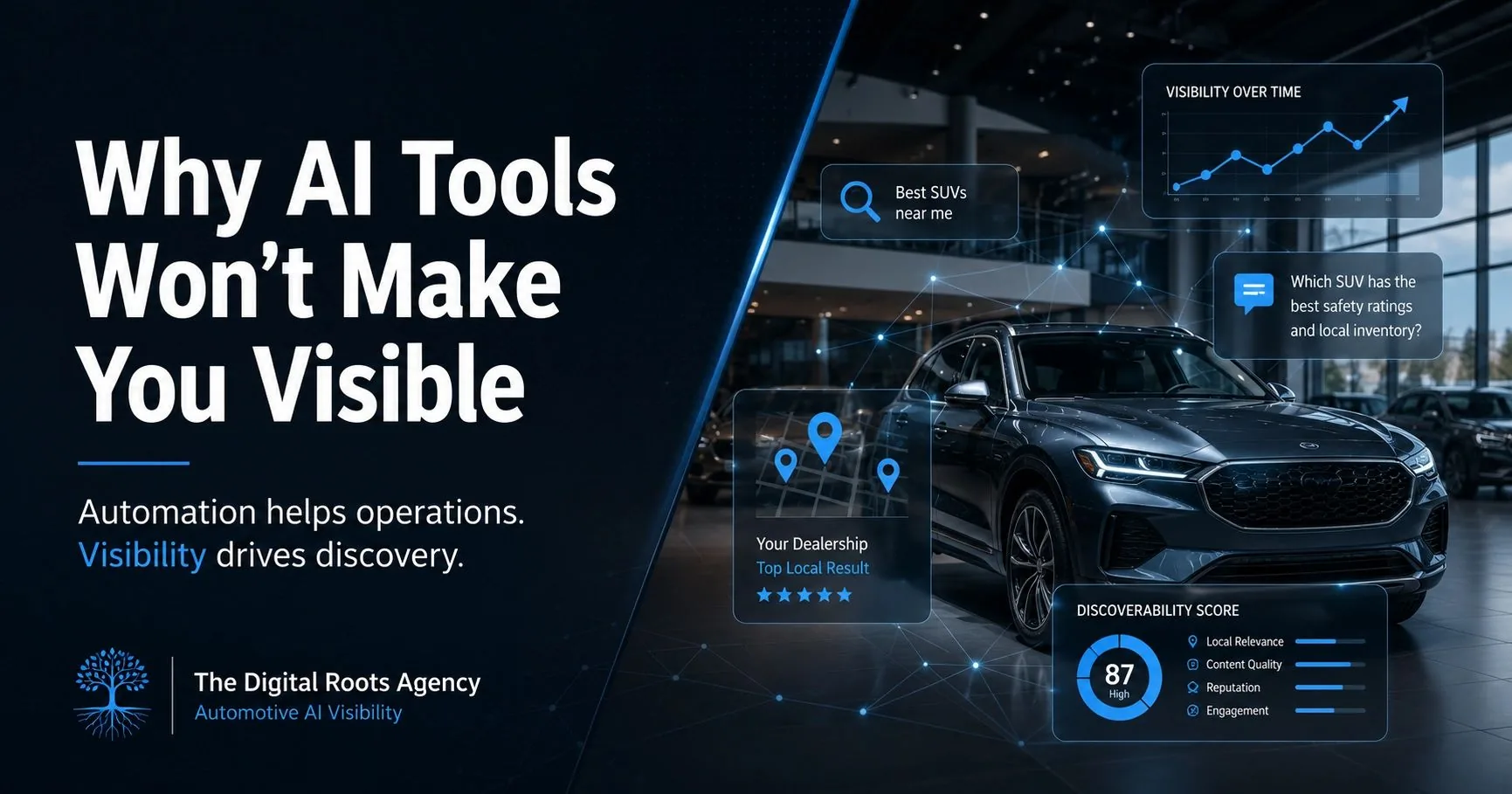
Artificial intelligence is quickly becoming part of nearly every department inside the modern car dealership.
Dealers are using AI to answer leads, schedule appointments, personalize customer communication, improve digital advertising, merchandise inventory and even inspect vehicles.
These tools can make a dealership faster, more responsive and more efficient.
But there is an important distinction that many automotive retailers are overlooking:
Using AI inside your dealership does not automatically help customers find your dealership through AI.
A dealership can have an advanced CRM, an automated BDC assistant, personalized advertising and AI-powered inventory merchandising while still being nearly invisible when a customer asks ChatGPT, Google Gemini, Perplexity or another AI platform where they should buy their next vehicle.
That is the difference between dealership AI automation and Automotive AI Visibility.
Dealers will increasingly need both.
How Car Dealerships Are Already Using AI
Automotive AI is no longer a future concept. Dealerships are already using it across sales, service, marketing, merchandising and operations.
The specific technology may differ by dealership, but most automotive AI tools fall into several major categories.
AI Lead Response and Customer Engagement
One of the most common uses of AI in automotive retail is automated customer communication.
These systems can help dealerships:
- Respond to internet leads
- Answer common vehicle questions
- Follow up with unsold customers
- Reengage older opportunities
- Schedule test drives
- Communicate outside normal business hours
- Personalize messages based on customer activity
Platforms such as Impel position their technology around AI-powered customer lifecycle management, including sales, service, chat, marketing and merchandising capabilities. The goal is to help dealerships manage customer interactions more consistently throughout the ownership journey.
This can dramatically improve how quickly a dealership responds after a shopper enters its digital ecosystem.
However, the customer still has to discover the dealership first.
AI Marketing and Customer Data Activation
Dealerships collect enormous amounts of information through their websites, CRMs, DMS platforms, service departments, advertising campaigns and third-party lead providers.
AI can help organize and activate that information.
Fullpath, for example, describes its platform as an AI ecosystem that unifies dealership data, automates outreach and supports marketing activation. Its technology is designed to give dealers a more unified foundation for using customer data across their operations.
AI-powered marketing platforms may help dealerships:
- Build customer audiences
- Personalize advertising
- Prioritize leads
- Automate email and text campaigns
- Adjust advertising bids and budgets
- Match customers with relevant vehicles
- Identify sales and service opportunities
This is an important part of the modern dealership technology stack.
But customer data activation generally begins after the dealership has already generated awareness, traffic or a lead.
It does not replace the need to become visible during the customer’s original research process.
AI Voice Assistants and Service Scheduling
AI is also helping dealerships manage phone calls and service appointments.
STELLA Automotive AI focuses on conversational voice technology for dealerships, including answering calls, handling customer questions and booking service appointments. These systems can provide coverage during busy periods and outside normal operating hours.
For service departments, this can help reduce:
- Missed calls
- Long hold times
- Scheduling friction
- Repetitive administrative work
- Lost after-hours opportunities
A customer who already knows which dealership they want to call may receive a faster and more convenient experience.
The visibility question comes one step earlier:
How did that customer decide which dealership to contact?
AI Vehicle Merchandising and Inspections
Artificial intelligence is also changing how dealerships photograph, inspect and present their inventory.
AI-assisted merchandising can help create:
- Vehicle walkaround experiences
- Inventory videos
- Feature descriptions
- Enhanced vehicle images
- Consistent listing content
- More engaging vehicle detail pages
Other systems focus on physical vehicle inspection. UVeye, for example, uses AI-powered inspection technology to identify and document vehicle conditions for dealerships, fleets and other automotive operators.
These technologies can improve efficiency, transparency and the quality of the customer experience.
Still, even the best inventory presentation will have a limited impact when the dealership’s website, local authority and digital presence are not strong enough to be discovered.
Dealership AI and Automotive AI Visibility Are Not the Same
Most dealership AI tools are designed to improve what happens after a customer enters the dealership’s ecosystem.
They help dealerships operate, communicate and convert.
Automotive AI Visibility focuses on whether the dealership is discovered and recommended in the first place.
It helps answer questions such as:
- Can AI platforms clearly identify the dealership?
- Do they understand which communities it serves?
- Can they determine which brands, vehicles and services it specializes in?
- Does the dealership have enough supporting evidence to be considered credible?
- Is its information consistent across its website and external platforms?
- Is the dealership being mentioned by trusted local and automotive sources?
- Does its website directly answer the questions customers are asking?
A dealership could use several sophisticated AI platforms and still have weak answers to every one of these questions.
That is the Automotive AI Visibility gap.
What Happens When a Customer Asks AI for a Dealership Recommendation?
Customers are no longer conducting all of their automotive research through a traditional list of blue links.
They are increasingly asking conversational questions such as:
- What is the best Toyota dealership near Boston?
- Where should I buy a certified pre-owned BMW on Long Island?
- Which Honda dealer near me has the best reputation?
- What dealership offers pickup and delivery for service?
- Where can I find a family-friendly three-row SUV?
- Which dealership supports events in my community?
These are not simply keyword searches.
They are recommendation requests.
To confidently recommend a dealership, an AI platform needs to understand more than the dealership’s name and inventory feed. It needs clear, consistent and credible information that explains why the business is relevant to the customer’s request.
That information may be supported by:
- Strong dealership and service pages
- Local market content
- Helpful model and ownership resources
- Accurate business information
- Customer reviews
- Structured website data
- Local news coverage
- Community partnerships
- Third-party automotive mentions
- Consistent social and website activity
- Clearly documented dealership advantages
This is why an inventory feed by itself is not an Automotive AI Visibility strategy.
Inventory shows what a dealership currently has.
Authority explains why the dealership should be trusted and recommended.
The Three Layers of a Modern Automotive AI Strategy
Dealerships should think about their AI strategy in three connected layers.
Layer One: Operate
The first layer includes tools that help the dealership run more efficiently.
Examples include:
- CRM automation
- AI lead response
- Voice assistants
- Service scheduling
- Internal reporting
- Customer lifecycle communication
- Vehicle inspection technology
These tools help dealership teams save time and manage customer activity.
Layer Two: Convert
The second layer helps the dealership turn attention into action.
Examples include:
- Personalized advertising
- Website personalization
- Inventory merchandising
- Automated follow-up
- Retargeting
- Lead scoring
- Offer personalization
These tools can improve the experience after a customer sees an advertisement, visits the website or submits a lead.
Layer Three: Get Discovered
The third layer helps customers and AI platforms find, understand and trust the dealership.
This includes:
- Search engine optimization
- Answer engine optimization
- Generative engine optimization
- Local SEO
- Google Business Profile management
- Review strategy
- Content development
- Technical website optimization
- Structured data
- Local public relations
- Community authority building
- AI Visibility monitoring
This is the layer many dealerships are still missing.
A dealership may have strong tools for operating and converting but lack the digital authority required to consistently get discovered.
Why More AI Tools Are Not Always the Answer
Dealerships are frequently presented with new platforms promising faster responses, better leads, improved advertising or increased efficiency.
Some of these tools can produce meaningful value.
The problem begins when dealerships treat the purchase of another AI product as a complete AI strategy.
Technology should support a clear business objective. It should not create another disconnected system, another dashboard or another source of conflicting information.
Before adding a new AI tool, dealership leadership should ask:
- What specific problem will this solve?
- Does it integrate with our existing systems?
- Who will be responsible for managing it?
- How will success be measured?
- Does it improve the customer experience?
- Does it strengthen our dealership’s discoverability?
- Does it help create information that search engines and AI platforms can understand?
The best dealership AI strategy is not necessarily the one with the most tools.
It is the one in which the tools, website, content, data and local authority work together.
The Role of SEO in an AI-Driven Automotive Market
AI is not eliminating SEO.
It is increasing the importance of doing SEO correctly.
Search engines and AI platforms still need accessible, organized and trustworthy information. Dealership websites need clear page structures, relevant local content, accurate business details and useful answers to real customer questions.
Traditional SEO creates much of the foundation.
Answer Engine Optimization helps dealership content respond clearly to specific customer questions.
Generative Engine Optimization helps increase the likelihood that a dealership’s information can be understood, cited or incorporated into AI-generated answers.
Together, SEO, AEO and GEO help dealerships prepare for a search environment in which customers may receive a recommendation before they ever visit a traditional search results page.
Local Authority Will Become a Major Dealership Advantage
Automotive AI Visibility is not built entirely on the dealership’s own website.
Third-party validation matters.
A dealership that participates in community events but never documents them online is missing an opportunity. The same is true for charitable partnerships, local sponsorships, dealership milestones, employee expertise and customer success stories.
When a dealership holds a local event, the marketing strategy should connect:
- The dealership website
- Local news and community publications
- Social media accounts
- Google Business Profile updates
- Event photography and video
- Partner organizations
- Relevant internal pages
- Follow-up content
This turns a one-day event into a lasting collection of digital authority signals.
The event creates the story.
The connected digital strategy helps search engines, AI platforms and local customers understand its significance.
What Dealers Should Do Next
Dealerships do not need to abandon the AI tools they are already using.
They need to make sure those tools are part of a more complete strategy.
Start by evaluating three areas.
1. Your Dealership Technology
Identify where AI is currently being used across sales, service, marketing and operations.
Determine whether each platform is producing a measurable outcome or simply adding another layer of complexity.
2. Your Digital Foundation
Review whether your website clearly explains:
- Who you are
- Where you operate
- What makes your dealership different
- Which vehicles and services you specialize in
- Which communities you serve
- Why customers should trust you
3. Your Automotive AI Visibility
Test whether your dealership appears for the questions customers are asking across Google and emerging AI platforms.
Do not look only for your dealership’s name.
Track non-branded recommendation prompts connected to your brand, location, inventory, services and customer advantages.
Frequently Asked Questions
What AI tools are car dealerships using?
Car dealerships are using AI for lead response, customer follow-up, service scheduling, voice assistance, advertising, customer data activation, inventory merchandising, vehicle inspections and internal reporting.
Will an AI tool improve my dealership’s SEO?
An AI tool may help create content, organize data or automate certain marketing activities, but simply purchasing an AI platform will not automatically improve dealership SEO. Search visibility still depends on website quality, technical performance, local relevance, content, reviews and authority.
What is Automotive AI Visibility?
Automotive AI Visibility is the ability of search engines and AI platforms to find, understand, trust and potentially recommend a dealership when customers ask automotive questions.
Is Automotive AI Visibility different from dealership automation?
Yes. Dealership automation improves internal processes and customer communication. Automotive AI Visibility focuses on whether the dealership is discoverable and understandable before the customer contacts it.
How can a dealership improve its visibility in AI search?
Dealerships can improve AI Visibility by strengthening their SEO foundation, publishing useful local and automotive content, improving structured information, earning trustworthy mentions, managing reviews and monitoring the questions customers ask AI platforms.
The Dealerships That Connect Everything Will Win
AI tools can help dealerships respond faster, market more efficiently and provide better customer experiences.
But automation alone will not determine which dealerships customers discover.
The next competitive advantage will belong to dealerships that connect their technology with strong SEO, local authority, trusted content and a deliberate Automotive AI Visibility strategy.
The dealership with the most AI tools will not necessarily win.
The dealership that is easiest for customers and machines to find, understand, trust and recommend will.
Is Your Dealership Visible to AI?
The Digital Roots Agency helps automotive dealerships strengthen the digital foundation that supports visibility across traditional search and emerging AI platforms.
Our approach connects SEO, Answer Engine Optimization, Generative Engine Optimization, local authority, content strategy and ongoing AI Visibility monitoring.
Because using AI is only part of the opportunity.
Your dealership also needs to be found by it.
Get your AI Visibility Score Today
If AI can’t understand your dealership, it can’t recommend it.