
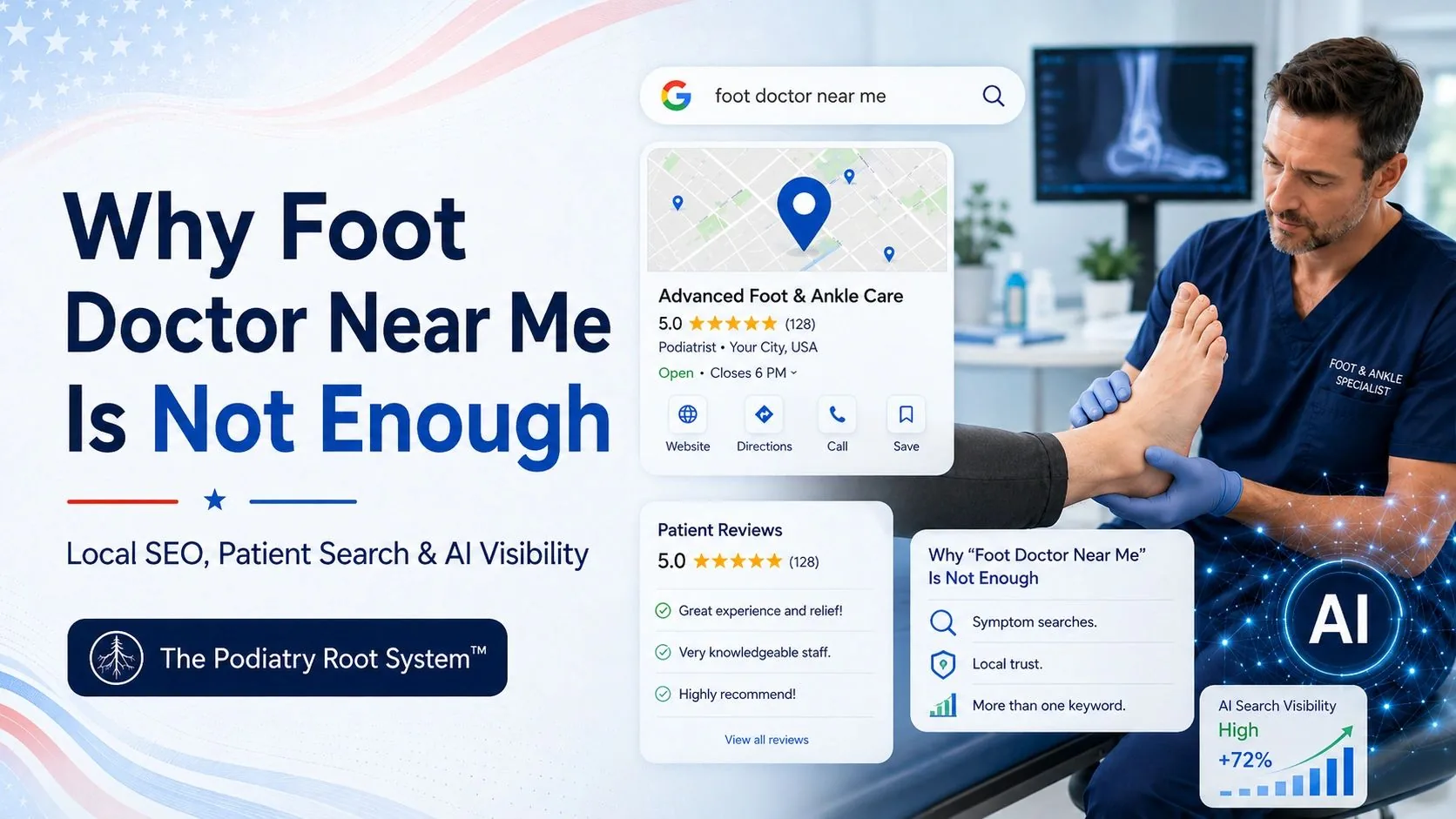
Every podiatry practice wants to show up when a patient searches “foot doctor near me.”
And for good reason.
That search usually means someone is actively looking for care. They may be dealing with heel pain, an ingrown toenail, diabetic foot concerns, bunions, foot numbness, ankle pain, or another issue that has finally pushed them to look for a provider nearby.
But here is the problem:
Ranking for “foot doctor near me” is not enough anymore.
Patients do not all search the same way. Some start with a symptom. Some search by condition. Some search by location. Some ask Google. Some check Maps. Some ask ChatGPT, Gemini, Perplexity, or another AI search tool. Some compare reviews before they ever click your website.
That means podiatry practices need a more complete search strategy.
For foot and ankle practices in Upstate New York and Florida, the opportunity is not just to rank for one phrase. The real opportunity is to become visible across the entire patient search journey.
That is where podiatry SEO, local SEO, and AI Visibility come together.
Why “Foot Doctor Near Me” Matters
“Foot doctor near me” is a high-intent local search.
When someone types it into Google, they are usually not looking for a general education article. They are looking for a podiatrist, foot and ankle specialist, or local practice they can contact.
This type of search often triggers local map results, Google Business Profiles, reviews, directions, phone numbers, and nearby provider options.
That makes it valuable.
A patient searching “foot doctor near me” may be ready to:
- Call a podiatry office
- Compare nearby practices
- Check reviews
- Look at office hours
- Visit a website
- Request an appointment
- Find directions
- Confirm whether a practice treats their concern
For local podiatry practices, this is an important search to appear for.
But it is only one piece of the larger visibility puzzle.
Patients Often Search Before They Know They Need a Podiatrist
Many patients do not start by searching “foot doctor near me.”
They start with the problem.
They may search:
- why does my heel hurt when I wake up?
- what causes pain in the ball of the foot?
- do I need a podiatrist for an ingrown toenail?
- is toenail fungus serious?
- why are my feet numb?
- what doctor treats plantar fasciitis?
- when should a diabetic see a foot doctor?
- can custom orthotics help foot pain?
- why does my ankle hurt after walking?
These searches often happen earlier in the decision-making process.
The patient may not know what kind of provider they need yet. They may not know whether the issue is serious. They may be trying to understand whether they should call a doctor, wait it out, change shoes, or search for treatment options.
If your podiatry practice only focuses on “foot doctor near me,” you may miss the patient before they reach that final search.
That is why strong podiatry SEO should include symptom-based content, condition pages, service pages, FAQs, and local search optimization.
The Patient Search Journey Has More Than One Step
A patient’s journey may look something like this:
First, they search:
“Why does my heel hurt in the morning?”
Then they search:
“Is heel pain plantar fasciitis?”
Then:
“Can a podiatrist treat plantar fasciitis?”
Then:
“heel pain treatment near me”
Then:
“foot doctor near me”
Then they compare local practices, reviews, office locations, appointment options, and provider information.
If your practice only shows up at the final step, you are entering the patient’s journey late.
If your practice shows up throughout the journey, you have more opportunities to build familiarity, trust, and relevance.
That is the difference between keyword targeting and a true SEO strategy.
Symptom-Based Content Helps You Show Up Earlier
Podiatry is highly symptom-driven.
Patients often search based on what they feel, not what a doctor would call the condition.
That means your website should include content around common symptoms such as:
- Heel pain
- Arch pain
- Ball of foot pain
- Toe pain
- Ankle pain
- Foot numbness
- Burning feet
- Thick toenails
- Yellow toenails
- Swollen feet
- Foot wounds
- Pain when walking
- Pain after running
- Pain after standing all day
This content should be helpful, careful, and patient-focused.
The goal is not to diagnose online.
The goal is to educate patients and help them understand when contacting a podiatrist may make sense.
For example, a blog titled “When Should You See a Podiatrist for Heel Pain?” can support searches around heel pain while also linking patients to your heel pain service page, plantar fasciitis page, custom orthotics page, and appointment page.
That one blog can become part of a larger visibility system.
Condition Pages Help Google and AI Understand What You Treat
A strong podiatry website should not rely on one generic services page.
If your practice treats major conditions, those conditions should be clearly represented on your website.
Important podiatry pages may include:
- Heel Pain Treatment
- Plantar Fasciitis Treatment
- Diabetic Foot Care
- Ingrown Toenail Treatment
- Bunion Treatment
- Toenail Fungus Treatment
- Custom Orthotics
- Wound Care
- Neuropathy Foot Care
- Hammertoe Treatment
- Sports Foot Injuries
- Ankle Sprain Treatment
- Foot and Ankle Surgery
Each page helps search engines understand what your practice does.
Each page also helps AI platforms understand which patient questions your practice may be relevant for.
If someone asks an AI tool, “What kind of doctor treats plantar fasciitis near me?” your website needs enough clear content to connect your practice to that topic.
A vague services page does not give AI much to work with.
Detailed, helpful, structured service pages do.
Local SEO Turns General Visibility Into Local Patient Discovery
Ranking for podiatry topics is helpful.
Ranking locally is where patient acquisition happens.
A podiatry practice in Rochester does not need to rank nationally for every foot care topic. It needs to be visible to patients in Rochester, Canandaigua, Victor, Pittsford, Fairport, Webster, and surrounding communities.
A Florida practice may need visibility in Fort Myers, Naples, Sarasota, Cape Coral, Bonita Springs, Tampa, Orlando, Venice, or Bradenton.
That local context matters.
Your website should clearly connect services to your market.
Examples:
“Our Rochester podiatry practice helps patients with heel pain, diabetic foot care, ingrown toenails, custom orthotics, and general foot and ankle concerns.”
“Our Fort Myers foot and ankle practice provides podiatry care for patients dealing with plantar fasciitis, bunions, diabetic foot concerns, and toenail issues.”
This type of content helps patients understand where you serve.
It also helps Google and AI platforms connect your practice to local searches.
Google Business Profile Is Still Critical
For “foot doctor near me” searches, your Google Business Profile can be one of your most important assets.
Patients may see your profile before they ever visit your website.
That means your profile should clearly communicate:
- Practice name
- Address
- Phone number
- Website
- Appointment link
- Hours
- Primary category
- Services
- Photos
- Reviews
- Posts
- Location details
For podiatry practices, the services section should reflect real patient search behavior.
Examples include:
- Foot doctor
- Podiatrist
- Heel pain treatment
- Plantar fasciitis treatment
- Diabetic foot care
- Ingrown toenail treatment
- Bunion treatment
- Custom orthotics
- Toenail fungus treatment
- Foot and ankle care
This does not mean keyword stuffing.
It means helping Google and patients understand the services your practice actually provides.
Reviews Help Patients Choose
When patients search “foot doctor near me,” they often compare reviews.
They may look at:
- Star rating
- Review count
- Recent reviews
- Office experience
- Staff friendliness
- Provider mentions
- Scheduling experience
- Professionalism
- Whether the practice responds to reviews
Reviews can strongly influence which practice a patient calls first.
For podiatry practices, review strategy should be ethical, simple, and privacy-safe.
A practice should never pressure patients, offer incentives, or respond in a way that reveals private health information.
A safe response might say:
“Thank you for sharing your experience. We appreciate your kind words and are grateful you chose our practice.”
This keeps the response professional while protecting patient privacy.
AI Search Changes What “Near Me” Means
AI search is making local discovery more conversational.
Instead of only searching “foot doctor near me,” a patient may ask:
- Who is the best podiatrist near me for heel pain?
- Where can I find diabetic foot care near Naples?
- What podiatrist treats ingrown toenails in Rochester?
- Who should I see for plantar fasciitis in Fort Myers?
- What foot doctor near me has good reviews?
- Which podiatrist treats bunions near Sarasota?
These searches combine location, condition, trust, and intent.
AI platforms need clear information to answer them.
That means your digital presence should include:
- Service pages
- Condition pages
- Location pages
- Provider bios
- FAQs
- Google Business Profile services
- Reviews
- Local listings
- Blog content
- Internal links
- Schema markup
- Consistent business information
If AI cannot understand what your practice does and where you do it, it cannot confidently include you in local answers.
“Near Me” Searches Depend on More Than Distance
Many practice owners assume “near me” rankings are only about location.
Location matters, but it is not the only factor.
Google and local search platforms also look at signals such as relevance, completeness, prominence, reviews, website quality, business information, and overall trust.
That means the closest practice does not always win.
The clearest, most relevant, most trusted practice often has the advantage.
For example, if two podiatry practices are nearby, but one has a complete Google Business Profile, strong reviews, detailed service pages, helpful blogs, location pages, and current photos, that practice may appear more credible to both search engines and patients.
That is why “foot doctor near me” rankings should be supported by a broader digital foundation.
Content Clusters Create Stronger Visibility
One blog post is helpful.
A content cluster is stronger.
For example, a podiatry practice that wants to rank for heel pain and foot doctor searches could build a cluster like this:
- Heel Pain Treatment page
- Plantar Fasciitis Treatment page
- Custom Orthotics page
- Blog: Why Does My Heel Hurt in the Morning?
- Blog: When Should I See a Podiatrist for Heel Pain?
- Blog: Can Custom Orthotics Help Heel Pain?
- FAQ: Common Heel Pain Questions
- Provider bio mentioning heel pain care
- Location page mentioning heel pain treatment
- Google Business Profile service for heel pain treatment
This structure helps patients navigate.
It also helps Google and AI platforms understand that your practice has depth around a topic.
That depth supports stronger visibility over time.
Location Pages Help You Compete in Specific Markets
If your practice serves more than one community, location pages are essential.
A podiatry practice in Upstate NY might need pages for:
- Rochester
- Canandaigua
- Victor
- Pittsford
- Fairport
- Webster
- Buffalo
- Syracuse
- Albany
A Florida practice might need pages for:
- Fort Myers
- Naples
- Sarasota
- Cape Coral
- Bonita Springs
- Tampa
- Orlando
- Venice
- Bradenton
Each location page should include useful local information, not duplicate filler.
A strong location page may include:
- Office address
- Phone number
- Hours
- Services offered
- Providers at that location
- Parking or access information
- Nearby towns served
- Photos
- Appointment CTA
- Local FAQs
- Links to relevant service pages
This helps your practice rank for searches that combine service and geography.
Examples:
- foot doctor Rochester NY
- podiatrist Fort Myers
- heel pain treatment Naples
- diabetic foot care Canandaigua
- ingrown toenail treatment Sarasota
These searches may be even more valuable than broad “near me” searches because they show clear local intent.
Provider Bios Support Trust and AI Visibility
Provider bios are a major trust asset.
Patients want to know who they are seeing.
AI platforms also need to understand which providers are connected to your practice and what they do.
A strong podiatrist bio should include:
- Provider name
- Credentials
- Education
- Training
- Areas of focus
- Locations served
- Patient care philosophy
- Professional memberships when appropriate
- Links to relevant service pages
- Links to location pages
- Appointment CTA
If a provider treats heel pain, diabetic foot care, ingrown toenails, sports injuries, or bunions, the bio should reflect that naturally.
This improves the patient experience and strengthens the practice’s overall digital footprint.
FAQs Help You Answer AI-Style Questions
Frequently asked questions are valuable because they mirror how patients search.
Examples include:
What is the difference between a podiatrist and a foot doctor? A podiatrist is a medical professional who evaluates and treats foot, ankle, and lower-extremity concerns. Many patients use the phrase “foot doctor” when searching for podiatry care.
When should I see a foot doctor? Patients may want to contact a podiatrist if they have persistent foot pain, heel pain, ingrown toenails, diabetic foot concerns, foot wounds, ankle pain, or changes in their feet that are not improving.
Can a podiatrist help with heel pain? Podiatrists commonly evaluate heel pain and related concerns such as plantar fasciitis. Care recommendations depend on the patient’s symptoms, history, and evaluation.
Do podiatrists treat diabetic foot concerns? Many podiatrists provide diabetic foot care, foot evaluations, toenail care, wound care support, and patient education related to diabetes and foot health.
How do I choose a foot doctor near me? Patients often compare location, services, provider credentials, reviews, appointment availability, and whether the practice treats their specific concern.
These FAQs can be added to service pages, location pages, and blog content.
They support both SEO and AI Visibility.
Common Mistakes Podiatry Practices Make
Many podiatry practices want to rank for “foot doctor near me,” but their digital presence does not support that goal.
Common mistakes include:
- Having one generic services page
- Missing location pages
- Weak Google Business Profile services
- No condition-specific content
- Thin provider bios
- Few or outdated photos
- No FAQ strategy
- Inconsistent directory listings
- No review response process
- Blog content with no internal links
- No clear appointment CTA
- Not tracking local rankings
- Not monitoring AI Visibility
These issues make it harder for Google, AI platforms, and patients to understand the practice.
The good news is that each one can be improved with a structured SEO plan.
A Better Strategy Than “Foot Doctor Near Me”
A stronger strategy includes:
- Optimizing your Google Business Profile
- Building dedicated service pages
- Creating condition-specific content
- Adding location pages
- Strengthening provider bios
- Publishing helpful blog content
- Adding FAQs to important pages
- Building internal links
- Improving review strategy
- Checking directory consistency
- Tracking map rankings and organic rankings
- Monitoring AI search visibility
This strategy gives your practice more ways to be discovered.
Instead of only trying to rank for one phrase, you build visibility across the full patient journey.
The Goal Is Not Just More Searches
The goal of podiatry SEO is not just to get more website traffic.
The goal is to help the right patients find the right care at the right time.
A patient searching “foot doctor near me” may be ready to call.
A patient searching “why does my heel hurt” may be one step earlier.
A patient asking AI “what kind of doctor treats diabetic foot problems?” may be looking for guidance before choosing a provider.
Your practice should be visible at each stage.
That is what strong local SEO and AI Visibility can do.
Want to Rank Beyond “Foot Doctor Near Me”?
The Digital Roots Agency helps podiatry practices improve organic SEO, Google Business Profile performance, local search visibility, and AI Visibility across Google, Google Maps, ChatGPT, Gemini, Perplexity, and other AI-driven search experiences.
If your practice wants to rank for searches like “foot doctor near me,” “podiatrist near me,” “heel pain treatment,” “diabetic foot care,” “plantar fasciitis specialist,” or “ingrown toenail treatment,” we can help build the content and visibility system to get you found.