
Car dealerships are adding artificial intelligence to nearly every part of the business.
AI can respond to leads, schedule appointments, personalize marketing, recommend follow-up actions, create vehicle content, support service departments and help dealership leadership analyze performance.
These tools can create meaningful efficiencies.
But adding AI tools does not automatically create a complete AI strategy.
A dealership could have:
- An AI-powered CRM
- Automated lead follow-up
- A conversational website assistant
- Personalized advertising
- Dynamic inventory merchandising
- Automated service scheduling
- Advanced customer data tools
It could still struggle to appear when a shopper asks:
“What is the best dealership near me?”
“Where should I buy a certified pre-owned SUV?”
“Which local dealership has the strongest customer reputation?”
“What dealership offers convenient service pickup and delivery?”
That happens because dealership AI technology often focuses on what occurs after a customer enters the dealership’s ecosystem.
It does not always address how the customer discovers the dealership in the first place.
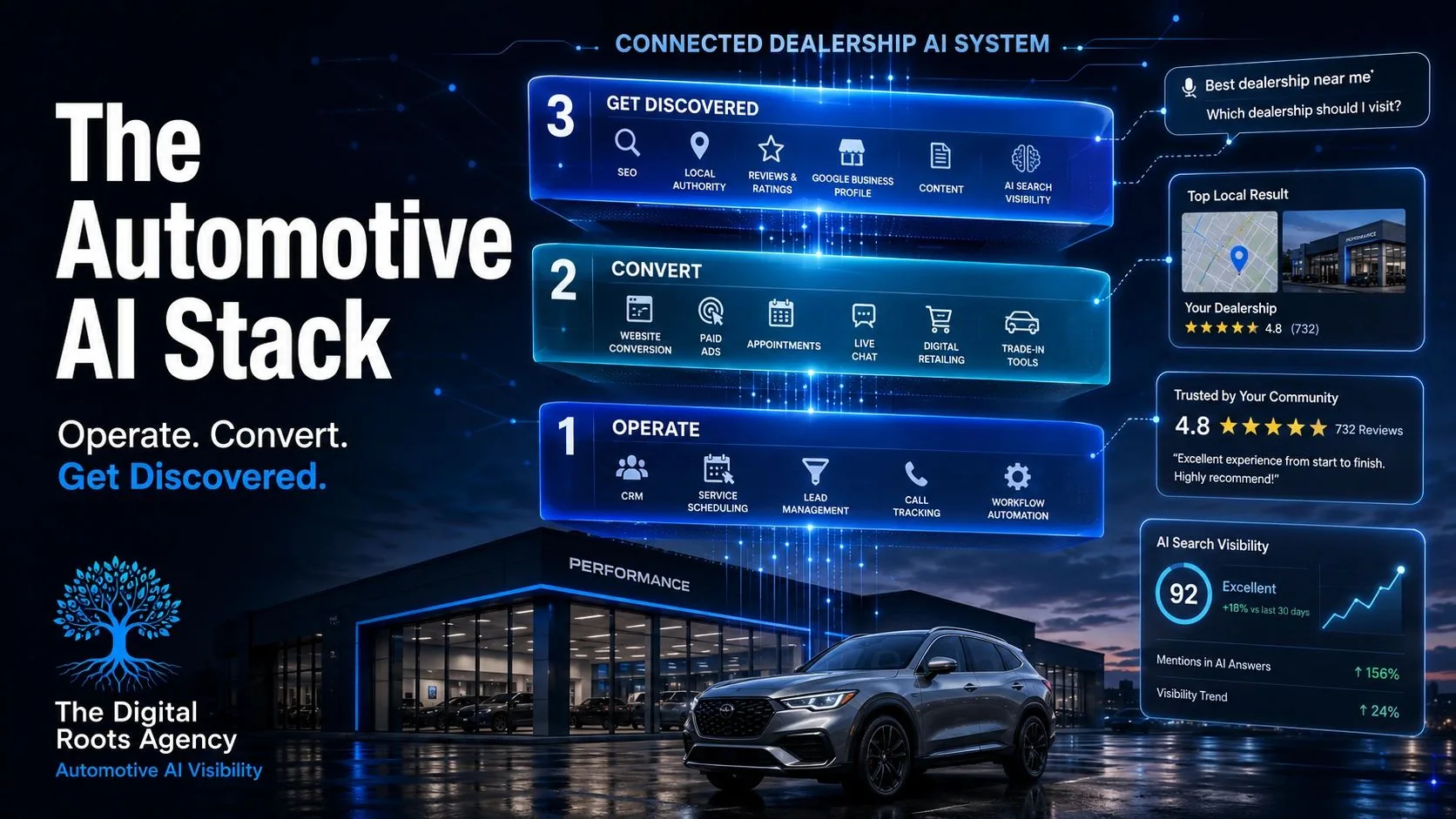
A complete automotive AI strategy must connect three essential layers:
Operate → Convert → Get Discovered
Together, these layers form the Automotive AI Stack.
What Is the Automotive AI Stack?
The Automotive AI Stack is a framework for understanding how different dealership technologies and marketing strategies work together.
It includes three connected layers:
Operate
Technology that helps dealership teams manage customers, processes and daily responsibilities.
Convert
Technology and marketing systems that help turn customer attention into appointments, leads, service visits and vehicle sales.
Get Discovered
The public digital signals that help customers, search engines and AI platforms find, understand, trust and recommend the dealership.
Most dealerships have invested significantly in the first two layers.
They have tools for operating and converting.
The third layer is frequently underdeveloped.
That is the Automotive AI Visibility gap.
Why the Stack Matters
Dealership technology is often purchased one platform at a time.
The CRM may be managed by one vendor.
The website may be managed by another.
Paid advertising may be handled separately.
The manufacturer may provide additional systems.
Service may have its own communication tools.
Social media, reviews, content, local SEO and public relations may operate independently.
Each platform may perform its assigned function.
The problem is that customers do not experience the dealership as a collection of disconnected vendors.
They experience one brand.
Search engines and AI platforms also attempt to understand one dealership entity.
When the systems, content and public information do not align, the dealership can create unnecessary friction.
The Automotive AI Stack provides a shared framework for connecting those efforts.
Layer One: Operate
The first layer contains the systems that help the dealership function efficiently.
These technologies primarily serve employees, existing customers and known opportunities.
They may include:
- Customer relationship management
- Dealer management systems
- Lead management
- AI-powered follow-up
- Call tracking
- Voice assistants
- Service scheduling
- Customer data platforms
- Inventory management
- Vehicle inspections
- Reporting dashboards
- Workflow automation
- Employee communication
- Customer retention tools
These systems help the dealership organize activity and reduce repetitive work.
How AI Supports Dealership Operations
AI can help dealership teams:
- Prioritize leads
- Identify unanswered opportunities
- Recommend follow-up actions
- Summarize customer communication
- Route calls
- Schedule service
- Identify customers approaching lease maturity
- Match customers with available inventory
- Detect service opportunities
- Analyze dealership performance
- Automate routine messages
These capabilities can improve speed and consistency.
For example, a customer may submit a lead after normal business hours.
An automated system can immediately acknowledge the inquiry, provide basic vehicle information and begin the appointment process.
That may create a better experience than waiting until the following morning.
However, the operational system did not necessarily generate the customer’s original interest.
It managed the opportunity after the customer arrived.
What the Operate Layer Cannot Do Alone
Operational technology cannot independently create:
- Organic search rankings
- Local media coverage
- Community authority
- Customer trust
- Helpful website content
- Third-party mentions
- Non-branded AI recommendations
- Accurate public business information
- Strong local relevance
- A differentiated dealership identity
The Operate layer is essential.
But it primarily works inside the dealership’s existing ecosystem.
It manages known customers and known opportunities.
Questions to Ask About the Operate Layer
Dealership leadership should evaluate:
- Are employees consistently using the technology?
- Does the system reduce work or create more work?
- Are customers receiving faster responses?
- Are automated messages accurate and appropriate?
- Do platforms integrate with one another?
- Is customer data clean?
- Are opportunities being routed correctly?
- Can leadership measure the impact?
- Are employees trained to take over when human judgment is needed?
- Does the technology improve the customer experience?
The goal is not maximum automation.
The goal is better dealership performance.
Layer Two: Convert
The second layer helps transform attention into action.
This layer becomes active when a shopper sees an advertisement, visits the dealership website, views inventory, engages with content or communicates with the store.
Conversion systems may include:
- Website personalization
- Digital retailing
- Inventory merchandising
- Lead forms
- Online chat
- Retargeting
- Paid search
- Paid social advertising
- Offer personalization
- Trade-in tools
- Payment calculators
- Appointment scheduling
- Email marketing
- Text message campaigns
- Landing pages
- Lead scoring
- Call conversion tools
These tools attempt to move the customer toward the next meaningful step.
What Conversion Looks Like in Automotive Retail
A conversion is not always a completed vehicle sale.
It may be:
- A phone call
- A test-drive request
- A service appointment
- A trade-in submission
- A financing application
- A vehicle inquiry
- A showroom visit
- A chat conversation
- A directions request
- A video view
- A return website visit
- An email subscription
Different dealership departments may value different actions.
The sales department may prioritize appointments and vehicle inquiries.
The service department may prioritize scheduled visits.
Marketing may evaluate traffic quality, engagement and assisted conversions.
The conversion layer should support those objectives without creating unnecessary obstacles for the customer.
How AI Supports Conversion
AI may help dealerships:
- Personalize offers
- Recommend relevant inventory
- Adjust advertising audiences
- Score customer intent
- Optimize campaign budgets
- Change website content based on behavior
- Generate merchandising assets
- Continue customer conversations
- Reengage abandoned leads
- Identify likely trade-in opportunities
- Predict service needs
The value of these systems depends heavily on the quality of the underlying data and dealership process.
Poor data can produce poor recommendations.
Weak offers remain weak even when delivered by sophisticated technology.
An unclear customer experience does not become effective simply because it includes AI.
The Conversion Trap
Dealerships sometimes overinvest in conversion while underinvesting in discovery.
They purchase more tools to improve website lead rates, follow-up speed and advertising performance.
Those investments may help.
But conversion technology cannot convert customers who never encounter the dealership.
A website tool cannot influence a shopper who was directed to a competitor.
A retargeting campaign cannot reach someone who never visited the site.
An automated follow-up system cannot contact a customer who never submitted a lead.
A dealership can become highly efficient at managing a shrinking pool of attention.
That is the conversion trap.
Questions to Ask About the Convert Layer
Dealership leadership should evaluate:
- Are we attracting the right customers?
- Is the website easy to navigate?
- Can shoppers quickly find inventory and service information?
- Are forms unnecessarily complicated?
- Do our offers match customer intent?
- Is advertising connected to useful landing pages?
- Are we measuring appointments rather than only leads?
- Are online and in-store experiences aligned?
- Does personalization improve the experience or create confusion?
- Are conversion tools slowing down the website?
- Can we identify which channels produce valuable customers?
Conversion should be measured by business impact, not merely by the number of widgets installed on the website.
Layer Three: Get Discovered
The third layer determines whether the dealership enters the customer’s consideration set.
This is where Automotive AI Visibility lives.
The discovery layer includes:
- Automotive SEO
- Local SEO
- Google Business Profile
- Answer Engine Optimization
- Generative Engine Optimization
- Website content
- Model research
- Service content
- Local market pages
- Customer reviews
- Digital public relations
- Community partnerships
- Third-party mentions
- Structured business information
- Technical accessibility
- Social and video content
- AI Visibility monitoring
This layer operates publicly.
It provides the information and evidence that help customers, search engines and AI platforms understand the dealership.
Traditional Search and AI Discovery Are Converging
Google’s current guidance states that the foundational practices supporting traditional SEO remain relevant to its generative AI search experiences.
Google recommends maintaining a clear technical structure, creating useful and original content, ensuring pages are crawlable and making business information available through appropriate Google products. Google also explains that its generative search systems may use query fan-out, issuing multiple related searches to develop a more complete response.
For dealerships, that means a single customer question may touch several areas of the digital presence.
Consider this prompt:
“What is the best Toyota dealership near Boston for leasing a reliable three-row family SUV?”
The request may involve:
- The dealership’s automotive brand
- Its location
- Its surrounding market
- Leasing information
- Three-row SUV expertise
- Family vehicle content
- Inventory
- Customer reputation
- Business prominence
- Local relevance
A generic homepage and inventory feed may not provide enough context to answer the entire question.
The dealership needs a connected body of public information.
The Discovery Layer Creates Context
The discovery layer helps establish:
- Who the dealership is
- Where it operates
- Which brand it represents
- Which communities it serves
- Which vehicles it understands
- Which services it provides
- Why customers trust it
- How it participates locally
- What makes it different
- Whether its information is current
- Whether its website can be accessed
- Whether credible sources support its claims
This information can influence traditional search visibility, local discovery and AI-generated recommendations.
Public Accessibility Matters
OpenAI states that any public website can potentially appear in ChatGPT search.
Website owners who want their content eligible for ChatGPT search should allow OAI-SearchBot to access it. OpenAI also explains that publishers permitting access can identify ChatGPT search referral traffic because referral URLs include utm_source=chatgpt.com.
That creates an important technical responsibility for dealerships.
A website may contain useful information but still limit its visibility through:
- Robots.txt restrictions
- Noindex tags
- Security settings
- Content delivery network rules
- Bot protection
- JavaScript rendering issues
- Broken pages
- Incorrect canonical tags
- Platform-level restrictions
Automotive websites are often built and managed through specialized third-party providers.
Dealers should confirm that important content is publicly accessible rather than assuming the platform handles every search and AI requirement automatically.
Website Content Creates Understanding
Technical accessibility allows a page to be found.
Content gives the page meaning.
A complete dealership content system should address:
- Dealership identity
- Automotive brand
- Location
- Communities served
- New vehicles
- Pre-owned vehicles
- Certified pre-owned programs
- Leasing
- Financing
- Trade-ins
- Service
- Parts
- Vehicle ownership
- Model comparisons
- Local driving needs
- Customer questions
- Community involvement
- Dealership advantages
The content should reflect real dealership expertise.
Google recommends creating useful, original and non-commodity content for generative AI search rather than relying on specialized “AI hacks.” It specifically states that website owners do not need special AI files, artificial content chunking or inauthentic mentions to appear in Google’s generative search experiences.
That is an important distinction.
Automotive AI Visibility is not about filling the website with awkward content written for machines.
It is about making the dealership’s genuine expertise and local relevance clear online.
Local Authority Creates Trust
A dealership’s website is only one part of its digital identity.
Customers and AI platforms may also encounter information through:
- Customer reviews
- Local news
- Community organizations
- Chambers of commerce
- Charitable partners
- Manufacturer directories
- Event listings
- Social platforms
- Video platforms
- Automotive publications
- Business directories
- Local sponsorships
These sources can validate the dealership’s public claims.
Suppose a dealership says it is deeply involved in the community.
That claim becomes more credible when the dealership:
- Hosts local events
- Supports charities
- Partners with schools
- Sponsors community organizations
- Receives local coverage
- Publishes event recaps
- Shares original photography and video
- Is mentioned by participating organizations
The real-world activity creates the story.
The connected marketing strategy turns it into lasting public authority.
Reviews Connect Experience With Discovery
Customer reviews provide public evidence of the dealership experience.
The star rating matters, but the language inside the reviews can be equally informative.
Reviews may repeatedly associate a dealership with:
- Helpful employees
- Transparent communication
- Efficient service
- Easy purchasing
- Family-friendly treatment
- Convenient appointments
- Strong follow-up
- Fair pricing
- Long-term customer relationships
- Successful problem resolution
These recurring themes help future customers understand what the dealership is known for.
They can also reveal whether the dealership’s marketing promises match the actual customer experience.
The Stack Must Work in Both Directions
The Automotive AI Stack should not operate as three isolated layers.
Information should move in both directions.
Discovery Creates Customer Activity
SEO, local authority, reviews and content help new customers encounter the dealership.
Conversion Captures Intent
Website experiences, advertising and digital tools turn that attention into measurable actions.
Operations Manage the Relationship
CRM, follow-up and dealership processes help employees serve the customer and move the opportunity forward.
Customer Experience Creates New Authority
Successful experiences produce reviews, testimonials, referrals, stories and insights that strengthen future discovery.
The process becomes a cycle:
Get Discovered → Convert → Operate → Build More Authority
That is how the stack compounds.
What a Connected Automotive AI Stack Looks Like
Consider a dealership preparing to promote a customer appreciation event.
A disconnected approach might involve:
- One social media post
- An internal CRM email
- A few event photos
- No website content
- No local media outreach
- No follow-up coverage
- No measurement beyond attendance
A connected Automotive AI Stack would involve all three layers.
Operate
The dealership uses its CRM to:
- Identify existing customers
- Segment invitations
- Send reminders
- Track responses
- Assign employee responsibilities
- Follow up with attendees
Convert
The dealership creates:
- A clear event landing page
- Registration or appointment options
- Paid social promotion
- Retargeting
- Email campaigns
- Calls to action
- On-site lead-capture opportunities
Get Discovered
The dealership develops:
- A professional press release
- Local media outreach
- Community partner promotion
- Google Business Profile updates
- Website event content
- Social and video coverage
- Post-event recap content
- Internal links
- Local authority signals
- Search and AI monitoring
The event is no longer only a single-day activity.
It becomes a long-term marketing asset.
The Data Layer Connecting the Stack
Every layer produces useful information.
The CRM provides:
- Customer questions
- Lead locations
- Popular models
- Lost-sale reasons
- Customer objections
- Appointment activity
- Retention patterns
The website provides:
- Traffic
- Engagement
- Conversion paths
- Search queries
- Landing-page activity
- Content performance
Reviews provide:
- Customer sentiment
- Recurring praise
- Recurring complaints
- Employee recognition
- Experience trends
AI Visibility monitoring provides:
- Prompt visibility
- Competitor recommendations
- Cited sources
- Local discovery trends
- Content gaps
- Incorrect information
These insights should inform the entire stack.
For example, if CRM data shows growing interest in three-row SUVs, the dealership can create:
- Model comparison content
- Family SUV videos
- Relevant paid campaigns
- Updated inventory pathways
- Local ownership guides
- AI search prompts for monitoring
- Employee training resources
The same insight improves operations, conversion and discovery.
Measuring the Automotive AI Stack
A complete measurement strategy should not depend on a single platform or score.
Each layer requires different metrics.
Operate Metrics
Track:
- Response time
- Contact rate
- Appointment rate
- Show rate
- Follow-up completion
- Lead aging
- Service retention
- Customer satisfaction
- Employee adoption
- Closed opportunities
Convert Metrics
Track:
- Website engagement
- Lead-form completion
- Calls
- Appointment requests
- Vehicle-detail-page activity
- Trade-in submissions
- Service bookings
- Cost per appointment
- Advertising efficiency
- Assisted conversions
Discovery Metrics
Track:
- Organic visibility
- Local rankings
- Google Business Profile activity
- Non-branded search traffic
- Review growth
- Local media mentions
- Referral traffic
- AI prompt visibility
- Competitor recommendations
- Cited dealership pages
- Branded search growth
Measurement options for AI discovery are also expanding.
Google’s current guidance references a Generative AI performance report in Search Console for understanding how content performs in Google’s generative search experiences.
Microsoft introduced an AI Performance dashboard in Bing Webmaster Tools in February 2026. The report can show citation totals, cited pages, grounding queries and citation trends across supported Microsoft AI experiences. Microsoft notes that citation activity does not by itself indicate ranking, authority or placement within an answer.
These tools provide useful evidence, but they should be combined with dealership-specific prompt monitoring and business outcomes.
Common Automotive AI Stack Problems
Dealerships should watch for several recurring issues.
Problem One: Too Many Disconnected Tools
Each platform promises a separate improvement.
Over time, the dealership may accumulate systems that do not share data, duplicate responsibilities or create conflicting reports.
The result can be:
- Increased costs
- Employee confusion
- Inconsistent messaging
- Duplicate customer communication
- Incomplete attribution
- Slower decision-making
- Poor platform adoption
More technology is not automatically better technology.
Problem Two: Automation Without Oversight
Automated systems may send inaccurate, repetitive or poorly timed messages.
Human oversight remains essential when communication involves:
- Pricing
- Customer complaints
- Financing
- Vehicle availability
- Service problems
- Sensitive customer situations
- Negotiation
- Complex ownership questions
Automation should support dealership employees, not eliminate accountability.
Problem Three: Conversion Without Discovery
The dealership invests heavily in website tools and advertising but lacks:
- Strong organic visibility
- Useful local content
- Review momentum
- Community authority
- Technical accessibility
- AI recommendation visibility
The conversion system is prepared for traffic that the dealership is not consistently earning.
Problem Four: Discovery Without Conversion
The dealership earns traffic but provides a frustrating customer experience.
Potential problems include:
- Slow pages
- Difficult navigation
- Intrusive popups
- Broken forms
- Unclear calls to action
- Missing inventory pathways
- Inconsistent phone numbers
- Weak mobile experiences
Visibility creates the opportunity.
The website and dealership process must convert it.
Problem Five: Technology Without Differentiation
Competitors may use similar:
- Website platforms
- CRM systems
- Advertising tools
- Inventory feeds
- Chat products
- Manufacturer content
- Automation systems
Technology alone may not create a lasting competitive advantage.
The dealership’s unique advantage comes from:
- Its people
- Its reputation
- Its local involvement
- Its customer experience
- Its expertise
- Its content
- Its history
- Its conveniences
- Its relationships
- Its ability to communicate those strengths
The stack should amplify what makes the dealership different.
How to Audit Your Automotive AI Stack
Dealership leadership can begin with three columns.
Column One: Operate
List every platform used for:
- CRM
- DMS
- Customer communication
- Service scheduling
- Inventory
- Reporting
- Retention
- Call tracking
- Internal automation
For each platform, document:
- Purpose
- Owner
- Cost
- Integration
- Adoption
- Measured outcome
- Overlapping tools
- Current problems
Column Two: Convert
List every system or channel used for:
- Website conversion
- Paid search
- Paid social
- Retargeting
- Digital retailing
- Chat
- Lead forms
- Trade-ins
- Appointments
- Email campaigns
- Landing pages
Evaluate whether each one produces meaningful customer actions.
Column Three: Get Discovered
Evaluate:
- SEO
- Local SEO
- Google Business Profile
- Website content
- Model research
- Service resources
- Customer reviews
- Local public relations
- Community partnerships
- Structured business information
- Technical crawler access
- AI search visibility
- Competitive recommendations
- Measurement
Most dealerships will quickly see where the stack is unbalanced.
A 90-Day Automotive AI Stack Plan
A dealership does not need to replace every platform at once.
Start by connecting the systems already in place.
Days 1–30: Map the Stack
Document:
- All dealership technology
- Vendor responsibilities
- Monthly costs
- Data sources
- Employee owners
- Current reporting
- Customer communication
- Visibility channels
- Major gaps
- Duplicate tools
During this phase, test whether AI and search platforms can accurately identify the dealership.
Days 31–60: Fix the Connections
Prioritize:
- CRM and website handoffs
- Accurate business information
- Analytics and attribution
- Broken forms
- Crawler accessibility
- Review processes
- Local-market content
- Service information
- Internal linking
- Employee ownership
Make sure each system supports a defined dealership objective.
Days 61–90: Build Discovery
Develop:
- Useful dealership content
- Local market resources
- Model comparisons
- Service education
- Community partnerships
- Local public relations
- Review campaigns
- Video content
- Google Business Profile activity
- AI Visibility monitoring
- Competitor comparisons
The goal is to strengthen the top of the customer journey while improving the systems that manage and convert the resulting demand.
Questions Dealership Leaders Should Ask
Before purchasing another AI platform, ask:
- Which part of the stack does this tool support?
- What specific problem does it solve?
- Do we already own a tool with the same capability?
- Will employees actually use it?
- Does it integrate with our current systems?
- Will it improve the customer experience?
- How will success be measured?
- Does it help us operate, convert or get discovered?
- What happens when automation produces an incorrect answer?
- Are we investing enough in public visibility and authority?
- Can customers and AI platforms clearly understand what makes us different?
These questions help separate useful technology from expensive distraction.
Frequently Asked Questions
What is the Automotive AI Stack?
The Automotive AI Stack is a framework connecting the systems dealerships use to operate, convert customers and get discovered.
It includes internal dealership technology, customer-facing conversion systems and the public SEO, content, review and authority signals that support search and AI Visibility.
What are the three layers of the Automotive AI Stack?
The three layers are:
- Operate
- Convert
- Get Discovered
Operate includes CRM, customer communication and dealership workflow technology.
Convert includes websites, digital retailing, advertising and appointment tools.
Get Discovered includes SEO, local authority, reviews, content, public relations and AI Visibility.
Does a dealership need AI tools in every department?
No.
Dealerships should adopt technology based on measurable needs rather than attempting to add AI everywhere.
A simpler system that employees consistently use may create more value than a sophisticated platform that remains disconnected from dealership processes.
Is Automotive AI Visibility part of SEO?
Automotive AI Visibility builds on many of the same foundations as SEO, including technical accessibility, useful content, local relevance, structured information and public authority.
It also includes monitoring how dealerships appear in conversational prompts, recommendations and AI-generated answers.
Can AI replace dealership employees?
AI can automate repetitive tasks, organize information and support customer communication.
Human employees remain essential for judgment, relationships, negotiation, problem resolution, expertise and customer trust.
Which layer should a dealership prioritize first?
The answer depends on the dealership’s current weaknesses.
A dealership with strong visibility but poor lead handling may need to improve operations and conversion.
A dealership with sophisticated internal technology but weak traffic and local authority may need to prioritize discovery.
The audit should identify the largest constraint.
How do dealerships measure AI Visibility?
Dealerships can monitor:
- Branded and non-branded prompts
- Competitor recommendations
- Cited sources
- AI referral traffic
- Organic search performance
- Local rankings
- Review growth
- Third-party mentions
- Search Console data
- Bing Webmaster Tools AI Performance
- Business outcomes
No single metric provides the complete picture.
The Dealership With the Most Tools Will Not Automatically Win
The automotive industry is entering a period of rapid technology adoption.
Dealerships will continue adding tools for:
- Automation
- Customer communication
- Advertising
- Personalization
- Service
- Inventory
- Reporting
- Artificial intelligence
Some of these tools will create real value.
Others will create more cost and complexity.
The winning dealerships will not necessarily be the ones using the most AI.
They will be the ones that connect their technology with:
- Strong processes
- Useful content
- Local authority
- Customer trust
- Technical accessibility
- Clear measurement
- A complete discovery strategy
They will operate efficiently.
They will convert customer attention effectively.
Most importantly, they will make sure customers can discover them before a competitor captures the opportunity.
That is the purpose of the Automotive AI Stack.
Build a Complete Automotive AI Strategy
The Digital Roots Agency helps dealerships strengthen the discovery layer of the Automotive AI Stack while connecting it with their existing marketing and dealership technology.
Our approach brings together:
- Automotive SEO
- Automotive AI Visibility
- Local SEO
- Answer Engine Optimization
- Generative Engine Optimization
- Content strategy
- Review development
- Digital public relations
- Community authority
- Technical accessibility
- Competitive monitoring
- Performance measurement
Your dealership may already have the tools to operate and convert.
We help make sure customers and the AI platforms guiding them can find you in the first place.
Get Your AI Visibility Score
If AI can’t understand your dealership, it can’t recommend it.