
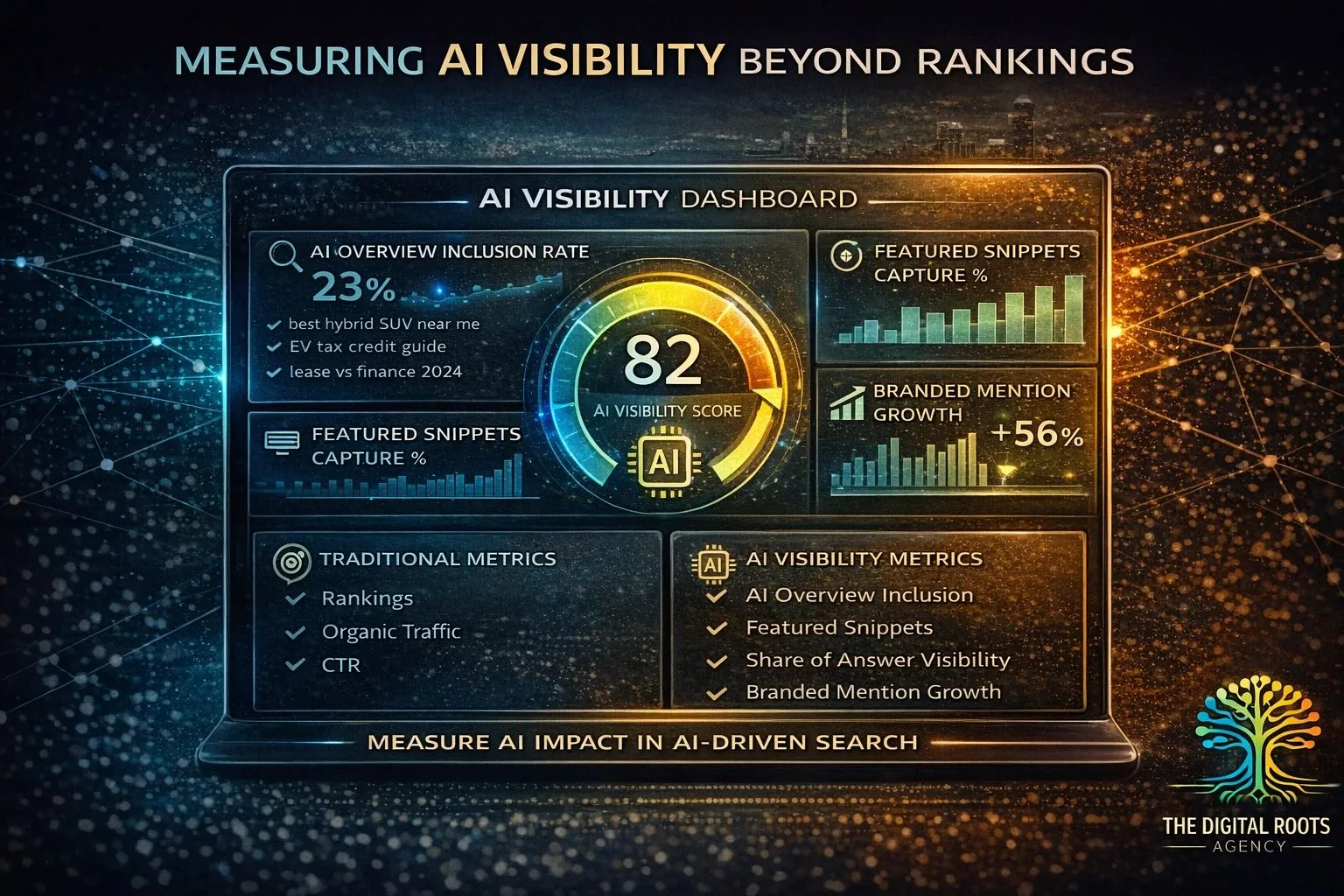
Rankings are no longer the full story.
In an AI-driven search environment, visibility extends beyond blue links and position tracking.
You may rank #1 and still lose clicks. You may rank #4 and still dominate the answer layer.
The question dealerships must ask in 2026 is:
How visible are we inside AI-driven search experiences?
Here’s how to measure it.
Why Rankings Alone Are Incomplete
Traditional SEO reporting focuses on:
- Keyword position
- Organic traffic
- Click-through rate
- Impressions
But AI search introduces:
- AI Overviews
- Featured snippets
- Generative summaries
- Follow-up question panels
Your brand can appear in these without ranking #1 — or fail to appear even when you do.
That requires new metrics.
The 5 Core AI Visibility Metrics
1.) AI Overview Inclusion Rate
Measure:
- How often your domain appears inside AI-generated summaries
- Which queries trigger AI answers
- Whether your brand is cited
Track:
- High-intent model searches
- Financing questions
- Service-related queries
- Local “near me” variations
This is your new “featured snippet” layer — amplified.
2.) Featured Snippet Capture %
Featured snippets are often source material for AI summaries.
Track:
- Number of snippets owned
- Queries where you are eligible but not selected
- Snippet volatility
Snippet growth often correlates with AI citation probability.
3.) Branded Mention Growth Across Platforms
Generative systems evaluate distributed authority.
Measure:
- Mentions in local press
- Industry directories
- Automotive publications
- Partner websites
- Review platform references
This becomes your Generative Authority Index.
4.) Share of Answer Visibility (SAV)
This is a more advanced concept.
Instead of “Share of Voice,” think:
Share of Answer Visibility
Ask:
- Across top 20 buying-intent queries
- How often is our dealership cited?
- How often is a competitor cited?
Authority is comparative.
5.) AI-Influenced Traffic Behavior
Watch for:
- Stable impressions but declining clicks
- Increased branded searches
- Higher average time on site
- More bottom-of-funnel conversions
AI may reduce early-stage clicks but increase intent quality. You need to measure both.
How to Build an AI Visibility Dashboard
Your reporting stack should now include:
Traditional Metrics:
- Rankings
- Organic traffic
- CTR
Plus AI Metrics:
- AI Overview inclusion
- Featured snippet count
- Citation presence
- Branded mention growth
- Share of Answer Visibility
This layered reporting model reflects:
SEO → AEO → GEO
What Most Agencies Aren’t Tracking Yet
Most agencies still send:
“Here are your rankings.”
Very few report:
“Here’s how often AI systems reference your brand.”
The market will shift toward AI visibility dashboards.
Dealerships that measure early will adapt faster.
The Strategic Shift
Search visibility now exists in three layers:
Layer 1: Ranking Layer 2: Extraction Layer 3: Citation
If you only measure Layer 1, you’re blind to two-thirds of the ecosystem.
The dealerships that win in 2026 will measure all three.
Final Takeaway
AI search is not eliminating SEO.
It is expanding the definition of visibility.
The real question is no longer:
“Where do we rank?”
It’s:
“Are we being extracted, cited, and reinforced across AI systems?”
Visibility has evolved.
Measurement must evolve with it.
FAQ: Measuring AI Visibility
How do I know if my dealership appears in AI Overviews?
Manually test high-intent queries, monitor AI summary panels, and track when your domain is cited within generative search experiences.
Are rankings still important?
Yes, rankings ensure eligibility. But extraction and citation visibility now require additional structured optimization.
What is Share of Answer Visibility?
Share of Answer Visibility measures how often your brand appears in AI-generated summaries compared to competitors across key queries.
Can AI visibility be tracked over time?
Yes. By documenting AI overview inclusion, featured snippet ownership, citation mentions, and branded search growth, dealerships can monitor AI visibility trends.
Does AI visibility impact revenue?
Indirectly, yes. Increased citation and authority often lead to stronger brand recall, higher-intent traffic, and improved conversion quality.