
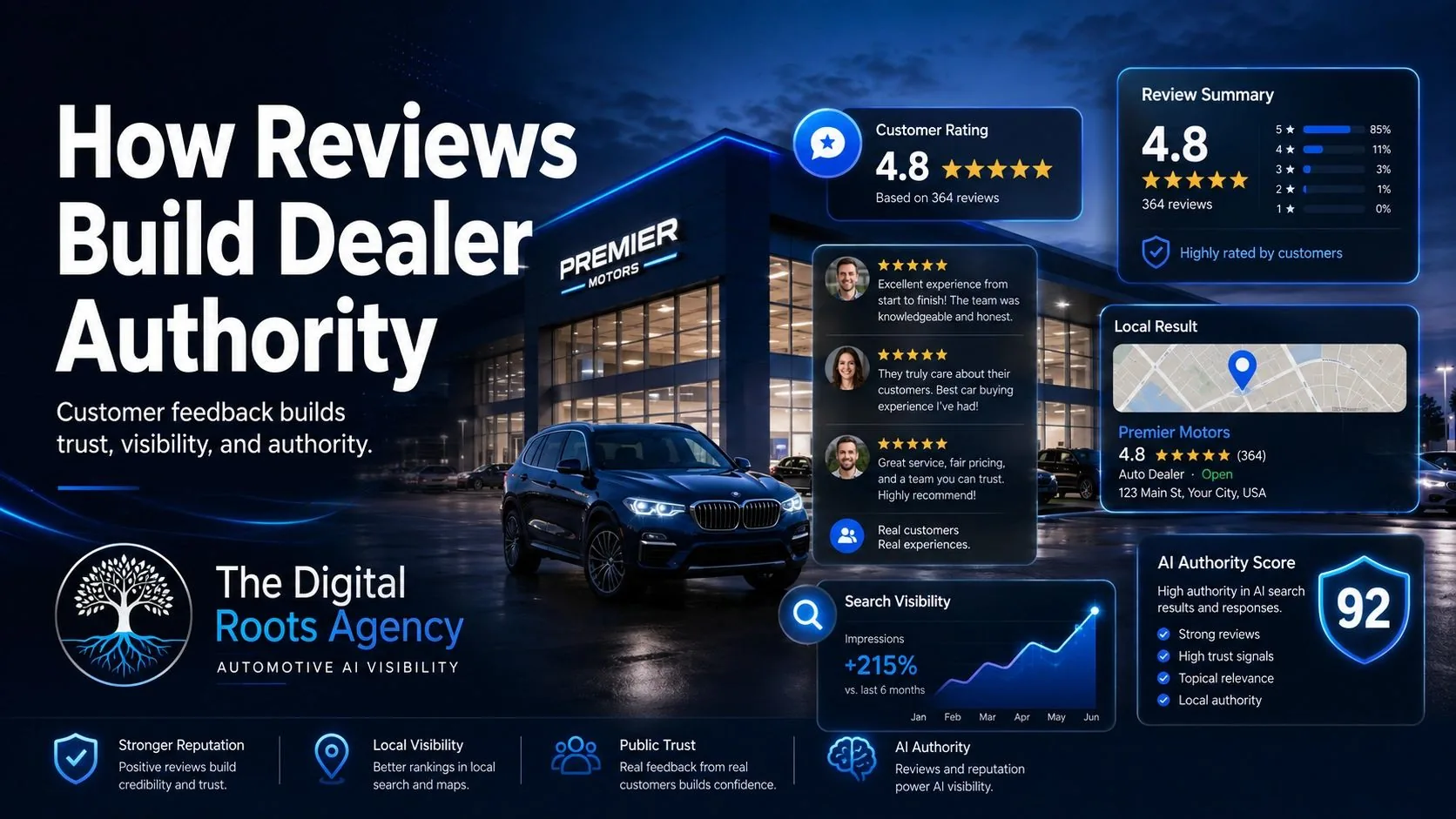
A dealership’s customer reviews are often treated like a scoreboard.
Leadership looks at:
- The average star rating
- The total number of reviews
- How the dealership compares with competitors
- Whether the most recent review was positive or negative
Those numbers matter.
But reviews provide much more than a public rating.
They create an ongoing record of how customers experience the dealership.
Reviews can help customers, search engines and AI platforms understand:
- Whether the dealership is trustworthy
- What its employees are known for
- How customers experience the sales process
- Whether the service department communicates effectively
- Which vehicle categories customers purchase
- What communities the dealership serves
- Which conveniences customers value
- How the dealership handles problems
- Whether its marketing claims match reality
A strong dealership review strategy does not simply collect more stars.
It builds public evidence.
That evidence can strengthen customer trust, local prominence, search visibility and Automotive AI Visibility.
Reviews Are Public Evidence of the Dealership Experience
Every dealership website makes promises.
It may promise:
- Exceptional customer service
- Transparent communication
- A stress-free buying process
- Certified automotive expertise
- Convenient service
- Competitive pricing
- Long-term customer care
- Strong community relationships
Customers expect dealerships to describe themselves positively.
Reviews matter because they reveal whether actual customer experiences support those promises.
A customer who writes about a smooth trade-in experience provides evidence.
A service customer who praises clear communication provides evidence.
A family who describes finding the right three-row SUV provides evidence.
A longtime owner who mentions returning for years provides evidence.
One review does not define the entire dealership.
Over time, however, recurring customer themes can create a recognizable public identity.
How Reviews Support Local Dealership Visibility
Google explains that local search results are primarily based on relevance, distance and prominence.
Prominence considers how well known a business is and can be influenced by information Google finds across the web. Google specifically states that review count and review score can affect local search ranking and that more reviews and positive ratings may support stronger local visibility.
That does not mean the dealership with the highest rating automatically ranks first.
Local visibility can also depend on:
- Search relevance
- Customer location
- Website performance
- Business information
- Organic search visibility
- Links
- Articles
- Directories
- Competitive strength
Reviews are one part of a larger local authority system.
They are valuable because they simultaneously support discoverability and customer decision-making.
Reviews and Automotive AI Visibility
There is no published rule stating that a specific number of dealership reviews will cause ChatGPT or another AI platform to recommend a business.
No agency should guarantee a dealership recommendation based solely on review volume.
However, reviews are publicly available information that can help establish the dealership’s reputation and customer experience.
OpenAI states that public websites may appear in ChatGPT search when their content is accessible to OAI-SearchBot, although inclusion and placement are not guaranteed.
That means dealerships should think about reviews as part of the wider public evidence available across the web.
When a customer asks:
“Which dealership near me has the best customer service?”
An AI platform may need to evaluate publicly accessible information about:
- Customer reputation
- Review themes
- Business location
- Services offered
- Website content
- Third-party mentions
- Local relevance
- Overall credibility
Reviews can strengthen that evidence.
They should not be treated as a secret AI ranking hack.
The Language Inside Reviews Matters
The star rating provides a quick summary.
The written review provides context.
Compare these two reviews:
Review One: “Great dealership. Five stars.”
Review Two: “Chris helped us compare the Toyota Highlander and Grand Highlander, explained the lease options clearly and made the entire process easy for our family. We drove from West Roxbury and would gladly return for service.”
Both reviews are positive.
The second review communicates much more.
It reinforces:
- Employee expertise
- Specific vehicle knowledge
- Leasing assistance
- Family-focused service
- Geographic relevance
- Future service intent
- Customer satisfaction
Dealerships should never tell customers exactly what to write.
But they can create experiences that naturally produce specific and useful feedback.
What a Strong Dealership Review Profile Looks Like
A strong review profile is not defined by one number.
It contains several connected qualities.
1. Consistent Review Activity
A dealership should earn reviews continuously rather than through occasional campaigns.
A profile with recent, steady feedback looks more representative of the current business than one that received hundreds of reviews several years ago and very few since.
Consistent activity also helps leadership identify changes in:
- Customer experience
- Staffing
- Communication
- Sales processes
- Service efficiency
- Facility conditions
- Appointment handling
- Vehicle availability
The goal is not to overwhelm customers with requests.
The goal is to make review collection a normal part of the customer journey.
2. Genuine Customer Experiences
Reviews should reflect actual customer experiences.
Google prohibits fake engagement, including reviews that do not represent genuine experiences. Its policies also prohibit offering payments, discounts, free goods or services in exchange for reviews.
The dealership should never:
- Purchase reviews
- Ask employees to pose as customers
- Offer a gift for a five-star rating
- Tell customers what rating to leave
- Create fake customer accounts
- Ask vendors to review the dealership without a genuine customer experience
- Pressure customers to post while still inside the dealership
Shortcuts may temporarily improve a visible number while weakening long-term credibility and creating policy or legal risk.
3. Reviews Across Sales and Service
Many dealerships collect significantly more sales reviews than service reviews.
That creates an incomplete public picture.
The service department may represent the dealership’s longest customer relationship.
Service reviews can reinforce:
- Technician expertise
- Scheduling convenience
- Communication
- Repair transparency
- Pickup and delivery
- Express service
- Recall support
- Genuine parts
- Long-term ownership care
Dealerships should build review opportunities throughout the ownership journey, not only after vehicle delivery.
4. Detailed Customer Feedback
Useful reviews frequently mention:
- Employee names
- Vehicles purchased
- Services completed
- Customer questions
- Communities served
- Problems resolved
- Dealership conveniences
- Reasons for choosing the business
- Previous dealership experiences
- Long-term relationships
The dealership should not script these details.
Instead, employees should create memorable and specific experiences worth describing.
5. Professional Dealership Responses
Google encourages businesses to reply to reviews because helpful responses demonstrate that customer feedback matters. Businesses can manage and respond to reviews directly through their Business Profile.
A response is not written only for the original reviewer.
It is also written for:
- Future customers
- Searchers comparing dealerships
- Employees
- Dealership leadership
- Community partners
- Anyone evaluating how the dealership communicates
A thoughtful response can reinforce professionalism, accountability and customer care.
6. Honest Feedback Rather Than Perfection
A flawless rating can look attractive.
It is not always realistic.
Customers understand that dealerships serve thousands of people and that occasional problems occur.
What matters is how the business responds.
A critical review can become an opportunity to demonstrate:
- Professionalism
- Empathy
- Accountability
- Willingness to investigate
- Respect for the customer
- Commitment to resolution
The goal should not be to eliminate every negative comment.
The goal should be to reduce preventable problems and respond well when issues arise.
The Dealership Review Authority Framework
The Digital Roots Agency recommends a six-stage review process:
Earn → Ask → Respond → Learn → Publish → Monitor
This turns review management into a dealership-wide authority strategy.
Stage One: Earn the Review
The customer experience begins before the review request.
Dealership teams must create an experience worth discussing.
That includes:
- Setting clear expectations
- Responding promptly
- Communicating honestly
- Respecting customer time
- Explaining pricing and financing
- Keeping customers updated
- Making vehicle delivery memorable
- Following through on promises
- Resolving concerns
- Maintaining professional facilities
The review strategy cannot compensate for a broken customer experience.
Marketing may generate the request.
Operations earn the response.
Stage Two: Ask at the Right Moment
Google allows businesses to create and share a direct review-request link or QR code through their Business Profile.
Dealerships can include that link in:
- Post-purchase emails
- Service completion messages
- Customer follow-up
- Thank-you pages
- Printed materials
- Delivery packets
- QR-code displays
- CRM workflows
- Event follow-up
- Employee email signatures
The best time to ask is typically after the dealership has delivered value and confirmed that the customer’s immediate needs were addressed.
The request should remain neutral.
A simple request could say:
“Thank you for choosing our dealership. We value your feedback and would appreciate an honest review of your experience.”
It should not say:
“Please leave us a five-star review.”
Stage Three: Respond Professionally
Every dealership should establish clear ownership for review responses.
Possible owners include:
- General manager
- Customer experience manager
- Internet director
- Marketing manager
- Service manager
- Department leadership
- Agency partner with dealership oversight
Response responsibilities should include:
- Daily monitoring
- Response-time expectations
- Escalation procedures
- Privacy guidelines
- Department routing
- Approval requirements
- Documentation of serious complaints
How to Respond to Positive Reviews
A strong positive response should:
- Thank the customer
- Reference something specific
- Recognize the employee when appropriate
- Reinforce the dealership experience
- Welcome the customer back
- Avoid excessive keyword repetition
Example:
“Thank you for sharing your experience, Maria. We are glad Daniel helped you compare the Pilot and Passport and made the financing process easy to understand. We appreciate you choosing our team and look forward to seeing you again for service.”
That sounds human because it responds to the actual customer.
How to Respond to Negative Reviews
A strong negative response should:
- Remain calm
- Acknowledge the concern
- Avoid arguing
- Avoid exposing private information
- Offer an appropriate next step
- Identify a contact person when possible
- Move detailed resolution offline
- Follow through internally
Example:
“Thank you for bringing this to our attention. The delay you described does not reflect the experience we want customers to receive. Our service manager would appreciate the opportunity to review what happened and speak with you directly. Please contact us at [phone number] so we can work toward a resolution.”
The response should not reveal:
- Financing details
- Credit information
- Repair history
- Personal information
- Internal notes
- Employee disciplinary information
- Private conversations
Even when the customer’s description feels unfair, the dealership’s public response should remain professional.
Stage Four: Learn From Review Patterns
Reviews should become a source of operational intelligence.
Leadership should regularly analyze:
- Common praise
- Common complaints
- Frequently mentioned employees
- Sales versus service sentiment
- Waiting-time concerns
- Communication issues
- Pricing confusion
- Facility feedback
- Appointment problems
- Delivery experiences
- Vehicle knowledge
- Follow-up consistency
A single complaint may be an isolated incident.
Repeated complaints reveal a process problem.
For example:
- Repeated comments about service delays may indicate scheduling or communication issues.
- Repeated praise for one employee may reveal a training opportunity.
- Frequent confusion about financing may indicate that expectations are not being explained clearly.
- Positive mentions of pickup and delivery may identify a differentiator worth promoting more visibly.
Review management should inform dealership operations, not remain trapped inside the marketing department.
Stage Five: Turn Review Insights Into Content
Reviews reveal the questions, concerns and outcomes customers care about.
Those insights can support dealership content.
For example, if reviews repeatedly mention that employees helped families compare three-row SUVs, the dealership could create:
- A three-row SUV comparison guide
- A family vehicle video series
- Model-specific FAQs
- Local family-driving resources
- Employee expert interviews
- Related inventory pathways
If service reviews frequently praise pickup and delivery, the dealership could improve:
- Service pages
- Google Business Profile information
- Service-area pages
- Customer emails
- Appointment instructions
- AI Visibility prompts
The dealership should not copy an entire customer review without permission.
It can use aggregated themes to create more useful public information.
Sharing Customer Reviews
Google allows businesses to share direct links to individual customer reviews.
With appropriate care and platform compliance, dealerships may also feature customer feedback through:
- Website testimonial sections
- Social media posts
- Employee recognition
- Sales pages
- Service pages
- Email campaigns
- Internal training
- Dealership presentations
The dealership should accurately represent the review and avoid changing its meaning.
When customer identity, images or detailed stories are used in promotional material, obtain appropriate permission.
Stage Six: Monitor Reputation and Visibility
Review performance should be monitored alongside search and AI Visibility.
Track:
- Average rating
- Total reviews
- New reviews per month
- Review recency
- Sales review volume
- Service review volume
- Response rate
- Response time
- Employee mentions
- Positive themes
- Negative themes
- Competitor ratings
- Competitor review growth
- AI recommendation prompts
- Local search visibility
- Branded search activity
Review volume without analysis is just a number.
Monitoring reveals whether the dealership’s reputation is becoming stronger, weaker or more differentiated.
Review Volume vs. Review Quality
Dealerships often ask:
“How many reviews do we need?”
There is no universal target.
A small rural dealership and a high-volume metropolitan dealership operate in very different competitive environments.
The more useful question is:
“Does our review profile accurately represent our current customer volume and experience compared with the dealerships competing for the same customers?”
A complete competitive review should compare:
- Rating
- Total review count
- Recent review velocity
- Service review presence
- Response quality
- Customer detail
- Recurring themes
- Employee recognition
- Unresolved complaints
- Competitive growth
A dealership with fewer but more recent and detailed reviews may present a stronger current story than a dealership with a large but stagnant profile.
Reviews Should Support Dealership Differentiation
Most dealerships advertise similar benefits:
- Great customer service
- Large inventory
- Competitive pricing
- Friendly employees
- Convenient service
Reviews can reveal which differentiators customers actually believe.
Suppose customers repeatedly mention:
- Complimentary pickup and delivery
- Fast service communication
- A low-pressure sales experience
- Bilingual employees
- Commercial vehicle expertise
- Family-friendly treatment
- Easy online purchasing
- Long-term employee relationships
Those recurring themes should influence:
- Website content
- Advertising
- Employee training
- Local SEO
- Social media
- Public relations
- AI Visibility monitoring
The dealership’s strongest positioning may already be hidden inside its customer feedback.
Avoid Review Gating
Review gating occurs when a business attempts to direct happy customers toward public reviews while preventing or discouraging dissatisfied customers from leaving feedback.
Google’s policies prohibit merchants from discouraging negative reviews or selectively soliciting positive ones.
A dealership should not:
- Send review links only to customers who selected a high survey score
- Ask unhappy customers to contact management while inviting only happy customers to Google
- Prevent customers from reviewing after a complaint
- Require employees to predict whether a customer will leave five stars
- Use software designed to filter out negative reviewers
The dealership can ask every legitimate customer for honest feedback.
It can also provide direct resolution options.
Those processes should not be used to manipulate the public review profile.
Do Not Incentivize Reviews
Offering a discount, payment, gift, free service or contest entry in exchange for a review can violate platform rules.
Google prohibits incentives in exchange for reviews, regardless of whether the requested review is positive or negative.
The Federal Trade Commission’s Consumer Reviews and Testimonials Rule went into effect on October 21, 2024. It addresses deceptive conduct involving fake and false reviews and allows civil penalties for knowing violations.
Dealership review programs should be reviewed carefully by leadership and legal counsel when necessary.
The safest long-term approach is straightforward:
- Serve the customer well
- Ask for honest feedback
- Make the process convenient
- Respond professionally
- Never purchase or manipulate reviews
Reviews Should Not Be Employee Competitions
Some dealerships turn reviews into employee contests.
That can create unintended behavior.
Employees may:
- Pressure customers
- Focus only on likely positive reviewers
- Tell customers what to write
- Compete over attribution
- Request reviews before the experience is complete
- Ignore customers who appear dissatisfied
Employee recognition can still be part of the process.
But incentives should emphasize:
- Customer satisfaction
- Accurate follow-up
- Professional communication
- Process compliance
- Issue resolution
- Overall experience
The public review should remain voluntary and authentic.
Sales Reviews and Service Reviews Tell Different Stories
Sales reviews often focus on:
- Vehicle selection
- Pricing
- Trade-ins
- Financing
- Employee communication
- Test drives
- Delivery
- Overall purchasing experience
Service reviews may focus on:
- Scheduling
- Wait times
- Repair communication
- Technician expertise
- Pricing expectations
- Pickup and delivery
- Parts availability
- Problem resolution
- Facility convenience
Both are important.
A dealership known only for vehicle purchases may be missing the opportunity to establish long-term ownership authority.
AI and traditional search users ask service questions throughout the ownership lifecycle.
The review profile should reflect the complete dealership.
Reviews and Employee Authority
Customer reviews can help establish individual employee expertise.
When customers repeatedly mention a salesperson, service advisor or technician, the dealership gains an opportunity to highlight its people.
That can support:
- Employee profile pages
- Expert videos
- Customer education content
- Model walkarounds
- Service FAQs
- Social media recognition
- Leadership development
- Internal training
A dealership’s people are often its greatest differentiator.
Reviews help make their impact visible.
A 90-Day Dealership Review Plan
Days 1–30: Audit the Current Reputation
Review:
- Google Business Profile
- Manufacturer review platforms
- Major automotive review sites
- Social reviews
- Department-level reviews
- Competitor profiles
- Response quality
- Recent customer themes
Document:
- Average rating
- Total volume
- Monthly review growth
- Review recency
- Sales and service balance
- Response rate
- Response time
- Common complaints
- Common praise
- Employee mentions
Identify any review-request practices that may violate platform policies.
Days 31–60: Build the Process
Create:
- A dealership-wide review policy
- Customer follow-up timing
- Sales review requests
- Service review requests
- Direct review links
- QR codes
- CRM workflows
- Response templates
- Escalation procedures
- Employee training
- Privacy guidelines
- Management reporting
Google officially provides businesses with tools to generate review links and QR codes, making it possible to build a convenient request process without relying on questionable third-party tactics.
Days 61–90: Connect Reviews With Authority
Use review insights to improve:
- Website content
- Service pages
- Model comparisons
- Employee profiles
- Local market pages
- Customer FAQs
- Advertising
- Event planning
- Operational training
- Automotive AI Visibility prompts
Begin monitoring recommendation questions such as:
- Which dealership near me has the strongest reviews?
- What is the best dealership for customer service?
- Which local dealer offers convenient service?
- Where should I buy a family SUV?
- Which dealership is known for transparent communication?
Compare the answers with what customers are actually saying.
Frequently Asked Questions
Do Google reviews help dealership SEO?
Google states that review count and review score can influence local search ranking. Reviews are only one part of local visibility, which also considers relevance, distance, web prominence and other signals.
Do customer reviews influence ChatGPT recommendations?
OpenAI does not publish a dealership-specific ranking formula or guarantee recommendations based on reviews.
Reviews are part of the public information available about a business and may help establish reputation, but they should be treated as one component of a complete Automotive AI Visibility strategy.
Can dealerships offer incentives for reviews?
Google prohibits offering payments, discounts, free goods or services in exchange for reviews. Federal rules also prohibit several forms of deceptive review conduct.
Can dealerships ask customers for five-star reviews?
Dealerships should ask for honest feedback rather than requesting a particular rating.
The review should represent the customer’s genuine experience.
Should dealerships respond to every review?
Responding consistently demonstrates that feedback matters.
Responses should be personalized when possible, professional and free from private customer information.
How quickly should a dealership respond?
Dealerships should establish an internal standard that allows reviews to be acknowledged promptly while giving management enough time to investigate serious concerns.
Negative reviews involving complex disputes may require internal research before a detailed response is posted.
Can a dealership remove a negative review?
A dealership can report a review that violates the platform’s content policies.
A review should not be reported simply because it is negative.
Legitimate criticism should be addressed professionally.
Should salespeople ask customers for reviews?
Salespeople can invite customers to leave honest feedback when the dealership has a consistent, policy-compliant process.
Customers should never be pressured, coached or offered incentives.
How can a dealership get a direct Google review link?
Google allows verified businesses to access a review-request link or QR code through the Business Profile’s review-management section.
Your Reviews Are Already Telling Your Story
Every day, dealership customers publish information about:
- Your employees
- Your processes
- Your communication
- Your facilities
- Your vehicles
- Your service department
- Your strengths
- Your weaknesses
The question is whether dealership leadership is listening.
A strong review strategy does not attempt to manufacture a perfect image.
It creates a consistent system for:
- Delivering strong experiences
- Requesting honest feedback
- Responding professionally
- Identifying operational trends
- Recognizing employees
- Strengthening public authority
- Improving future customer experiences
Reviews are not simply stars beside the dealership’s name.
They are customer-generated evidence of what the dealership represents.
Turn Customer Experience Into Authority
The Digital Roots Agency helps automotive dealerships connect reputation management with SEO, local authority and Automotive AI Visibility.
Our approach includes:
- Dealership review strategy
- Competitive reputation analysis
- Google Business Profile optimization
- Automotive SEO
- Local SEO
- Customer-experience insights
- Review-response guidance
- Content development
- Employee authority
- AI Visibility monitoring
- Local public relations
- Performance measurement
Your customers are already describing your dealership.
We help make sure that the public story supports discovery, trust and long-term growth.
Build Your Dealer Authority
If AI can’t understand your dealership, it can’t recommend it.