
A newsroom may have covered a subject for years.
A reader arriving at the latest article may see only one story.
If the article provides no path to earlier reporting, the journalist’s work or a useful topic page, much of the publication’s depth remains hidden from that visit.
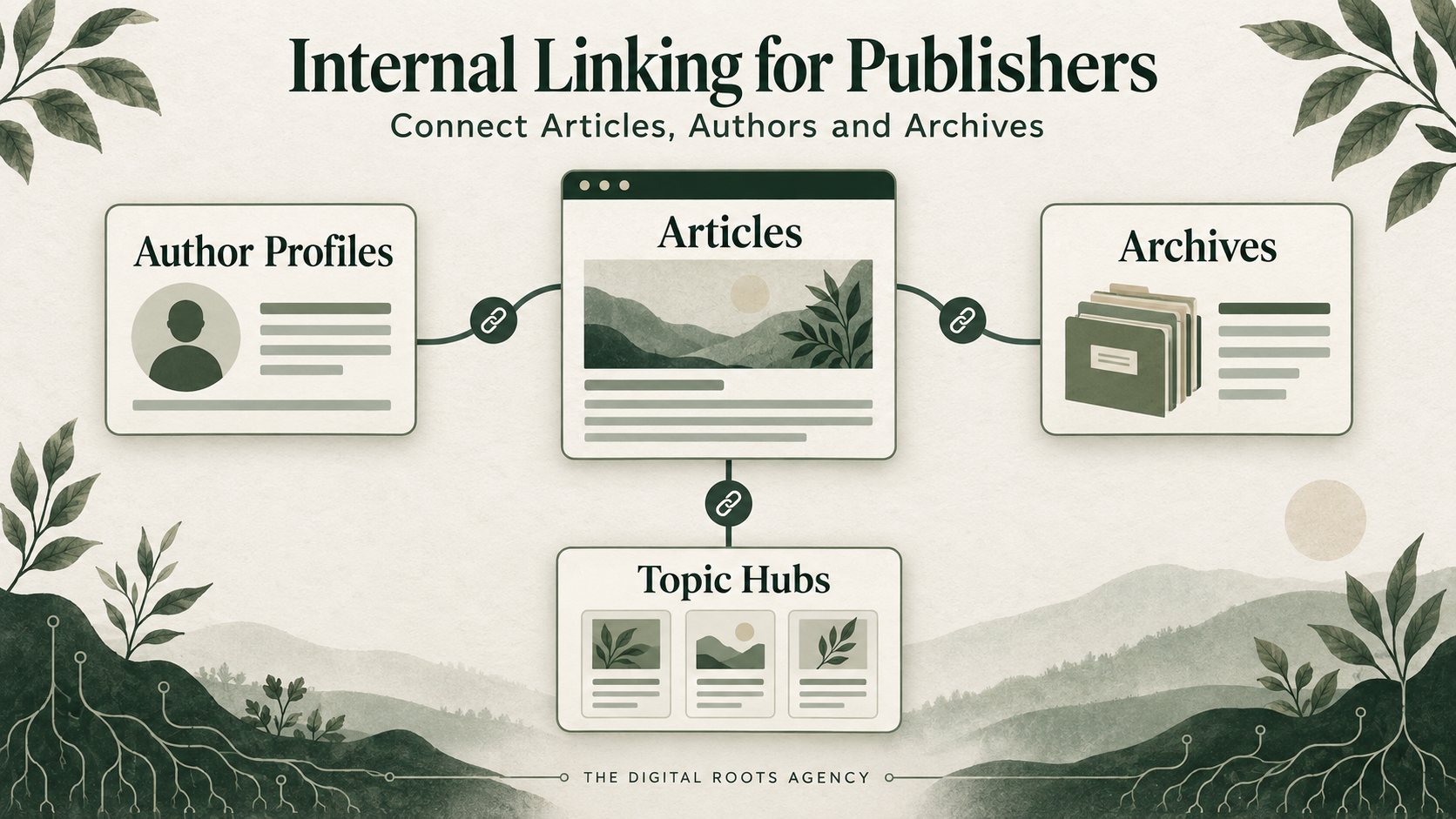
Internal linking for publishers connects editorial pages within a publication’s website. Done thoughtfully, it helps readers follow a developing subject and find the people and evidence behind the coverage.
Start With the Reader’s Next Question
The best place for an editorial link is often where a reader needs context.
A new article may mention an earlier decision, refer to a recurring local issue or introduce an expert whose prior reporting adds value.
Ask what someone unfamiliar with the story would need to understand next.
That question produces better links than a rule requiring every article to contain a fixed number.
A link should earn its place by helping the reader.
Connect Five Parts of the Publishing System
1. Articles and Relevant Prior Reporting
When a story builds on an earlier development, link to the original coverage where it supplies context.
Describe the destination clearly. “The council’s earlier vote” is more informative than a generic “click here.”
Do not link an old article as though it describes the current situation. Introduce its historical role.
2. Articles and Topic Hubs
A topic hub can help readers follow a subject across individual publication dates.
It should have a clear scope, useful context and a maintained selection of coverage.
An automatically generated tag page may offer a starting point, but it may also contain loosely related material or provide little guidance. Review whether it actually serves the topic.
3. Bylines and Author Profiles
A byline should help readers identify who produced the work.
Where author profiles are used, connect them to accurate biographies and relevant reporting. Distinguish current staff, contributors and former staff without rewriting the publication’s history.
Do not invent credentials to make a profile seem more authoritative.
4. Current Coverage and Archives
Archives can reveal what changed, what remained unresolved and how a subject developed.
Connect older material when that history serves the current article. Make its age and role clear in the surrounding language.
Preserving access to the past is different from presenting old information as current advice.
5. Publications and the Wider Organization
Readers may need to understand who publishes a title or how it relates to a parent company.
Provide accurate organizational context through appropriate About and publication pages.
When a parent company lives on a different domain, that link is an external connection rather than an internal link on the publication’s site. It can still help explain the relationship.
Make Links Work Beyond Their Appearance
A link that looks clickable may not be implemented in a way that works consistently for readers and crawlers.
Google recommends standard crawlable links and useful anchor text. Have the technical team review shared templates as well as links added by editors.
Check bylines, related-story modules, category navigation and archive pagination. A template issue can affect many pages at once.
Keep accessibility in mind: a reader should understand the destination from the label and surrounding sentence.
Use Related-Story Modules With Editorial Judgment
Automated recommendations can help discovery, but they can also surface stale or tangential material.
Review whether modules select stories by a meaningful relationship or merely a shared tag.
A story about a specific zoning decision may need prior reporting on that decision more than the latest article in a broad real-estate category.
Give editors a way to choose essential context where the publishing system supports it.
Also distinguish sponsored material clearly. A reader looking for reporting should understand when a destination has a different editorial status.
Add Linking to the Existing Workflow
A practical pre-publication review can ask:
- Does this article need background coverage?
- Does the byline lead to the correct profile?
- Is there a useful topic hub?
- Are linked articles accurately characterized?
- Do the destinations work on mobile?
After publication, identify an existing central resource that should include the new story.
This is easier to sustain when responsibilities are clear. Editors can own relevance, while product or engineering handles template behavior and technical defects.
Keep Structured Information Aligned
Google’s Article structured-data guidance covers properties such as authorship, headlines, images and dates.
That information should agree with what a reader sees.
An accurate byline link and an accurate author reference in markup serve related purposes, but one does not make errors in the other acceptable.
Structured data also does not guarantee an AI citation. Treat it as part of clear publishing information.
Review the Archive Without Erasing Context
Before changing or removing older pages, understand their editorial and technical role.
They may be cited elsewhere, linked from current reporting or important to the historical record.
If material moves, coordinate the transition and update relevant links. Avoid sending every retired story to the homepage, where readers lose the context they expected.
Frequently Asked Questions
How many internal links should an article contain?
Use the links needed to support understanding and navigation. There is no single count appropriate for every story.
Should every mention of a topic link to its hub?
No. Repetitive links can distract from the reading experience. Choose the places where the destination adds value.
Are author pages enough to establish expertise?
No. Profiles should accurately connect people to their work. Their usefulness depends on the substance and accuracy of that information.
Can old articles still support current coverage?
Yes, when they provide relevant history and are presented with appropriate context.
Do internal links guarantee AI citations?
No. They can make relationships clearer, but no linking pattern guarantees source selection.
Let Readers Follow the Reporting
A publisher’s depth becomes visible through the paths it provides.
Connect the new story to the relevant history, the work to its author and the subject to a maintained body of coverage.
Sources Used
Strengthen Your Publisher’s Digital Connections
The Digital Roots Agency helps media companies examine how their editorial assets support search and AI discovery. Explore additional guidance in our SEO and AI visibility blog.
Your archive has more value when readers can find the story behind the story.