
A website can have dozens of useful articles and still feel difficult to navigate.
One post explains the basics. Another answers a buying question. A third introduces a relevant service. Yet nothing tells the reader how those pieces fit together.
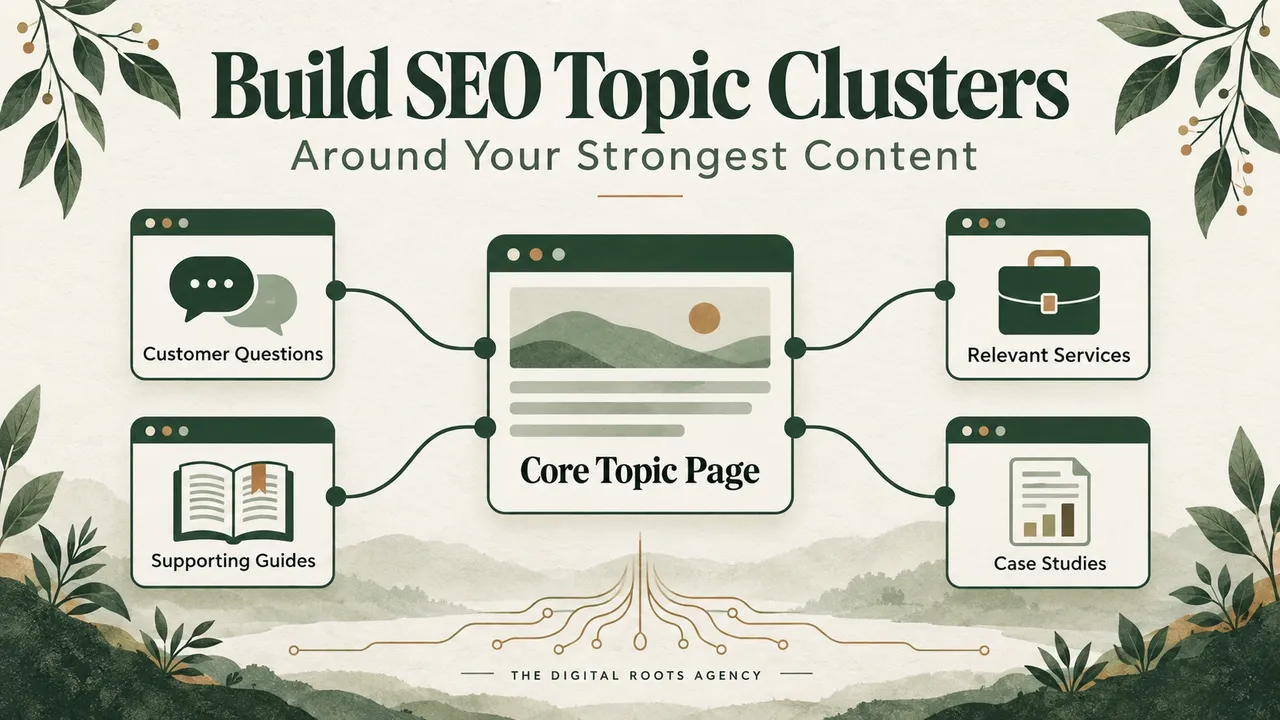
A topic cluster organizes related pages around a central subject and connects them through useful internal links.
It is a content-planning approach, not a special search-engine feature or a guaranteed ranking formula. Its practical value comes from making a body of knowledge easier to explore and maintain.
Choose the Subject Before the Center Page
Start with a subject your business understands and your audience needs.
“Marketing” is usually too broad to create a useful first cluster. “Helping a dealership improve service discovery” gives the work a clearer boundary.
Ask what the reader is trying to accomplish and which decisions fall within that scope.
Then inspect the content you already have. Your central page may exist. It could be a useful guide or a service overview that already introduces the subject clearly.
Do not automatically select the article with the most traffic. A narrow, popular post may be a strong supporting resource while lacking the breadth to orient a new visitor.
Inventory What Each Page Actually Does
For every related URL, record:
- The reader it serves.
- The primary question it answers.
- The depth and accuracy of its answer.
- The next step it offers.
- Whether it overlaps with another page.
Read the content rather than sorting only by title. Two different headlines may lead to nearly identical advice.
Also identify pages that contain useful information but are no longer easy to reach through normal navigation.
This review can reveal that the cluster needs better connections and a few targeted updates rather than a large new publishing commitment.
Build a Center That Helps People Navigate
The central page should explain the subject and help readers choose the resource they need.
It does not need to repeat every supporting article in full.
A useful structure might introduce the problem, describe the main decisions and link to more detailed guidance at the appropriate point.
For example, a hypothetical dealership service cluster could include:
- A service overview explaining the department and scheduling options.
- A preparation guide for a first service visit.
- Distinct pages for services the department actually provides.
- A guide to communicating vehicle concerns when booking.
- Accurate information about the location and arrival process.
Each page contributes something different. The cluster should reflect how people use the information, not merely a diagram of keywords.
Give Supporting Articles Their Own Purpose
Write a one-sentence job description for each supporting page.
“Help a driver prepare for an appointment” is different from “explain which services this department provides.”
If the descriptions become interchangeable, reconsider the boundaries.
Do not add a new article solely because a keyword tool offers a slightly different phrase. The new page should have a reason to exist for the reader.
You can address closely related wording naturally within the same answer.
Add Links at Real Decision Points
Google’s link guidance recommends crawlable links and descriptive anchor text. That supports a straightforward editorial practice: tell readers what the destination provides.
A sentence about preparing for a visit is a natural place to link to a preparation guide.
A paragraph about evaluating a provider can connect to relevant service information or evidence.
Avoid placing the same cluster links in every paragraph. A resource should be connected where it helps the reader understand or act.
Connect the Cluster to the Business
Educational content should lead toward a relevant next step without forcing every reader into an immediate sales conversation.
Someone learning the basics may need another guide. Someone evaluating assistance may want a service page, an example of the work or a consultation.
For Digital Roots readers, our AI visibility case studies provide a different type of resource from the educational material in the agency blog.
That distinction illustrates a useful principle: explanation and evidence play different roles in the same customer journey.
Maintain the Connections
A cluster becomes less useful when old links point to retired pages or the central guide overlooks newer resources.
Assign responsibility for reviewing its key pages.
When publishing a supporting article, update the relevant older pages where a link adds value. Check that the new article also points back to useful context.
When retiring or consolidating content, review the links that depend on it.
The result should feel like a maintained resource rather than a collection of posts that happened to share a category.
Measure the Cluster as a Group and as Individual Pages
Review discovery, engagement and relevant actions across the subject area.
Then inspect page-level performance to understand where readers enter, what they use and where they struggle.
A central guide and a specialist article may attract different types of visits. Judge each against its role.
Do not assume growth proves the cluster structure caused it. Publishing, seasonality, competition and other website changes can also affect the result.
Frequently Asked Questions
How many articles does a topic cluster need?
There is no universal number. Start with the pages required to address the audience’s important decisions without unnecessary repetition.
Is a category page a topic cluster?
It can help organize related posts, but a useful central resource usually provides context and guidance beyond a list of recent articles.
Do all supporting pages need to link to each other?
No. Add links where there is a relevant connection. Complete cross-linking can create clutter without helping the reader.
Can I build a cluster from older articles?
Yes. Review their accuracy and purpose, improve gaps and connect the useful pages before commissioning more content.
Will a topic cluster guarantee AI visibility?
No. Clear organization is useful, but it does not guarantee selection by an AI platform.
Make Your Existing Knowledge Easier to Use
A strong topic cluster gives each page a purpose and each reader a path.
Start with one important subject. Improve the resources you have, add what is genuinely missing and keep the connections useful.
Sources Used
Build More Connected Digital Roots
The Digital Roots Agency helps businesses organize content around expertise, audience needs and meaningful next steps.
Authority becomes more useful when people can follow the connections.