
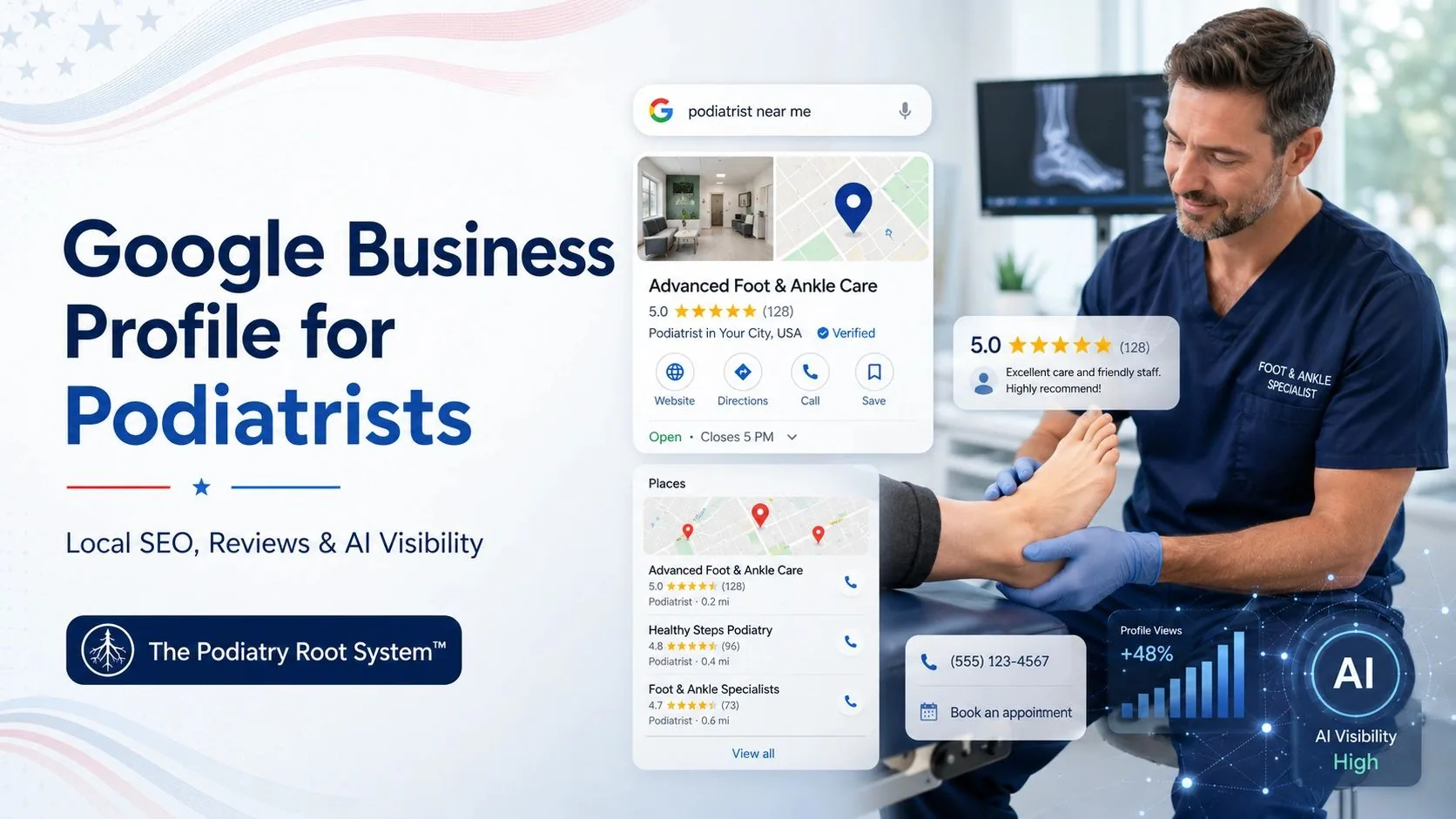
When a patient searches for a podiatrist, they are usually not browsing casually.
They may have heel pain that will not go away. They may be dealing with an ingrown toenail. They may need diabetic foot care, custom orthotics, bunion treatment, or help with an ankle injury.
In other words, podiatry searches are often high-intent searches.
And in many cases, those searches start with Google.
A patient might type:
- podiatrist near me
- foot doctor near me
- heel pain treatment near me
- diabetic foot care near me
- ingrown toenail treatment in Rochester NY
- podiatrist in Naples FL
- plantar fasciitis doctor Fort Myers
- foot and ankle specialist Sarasota
Before that patient ever visits your website, they may see your Google Business Profile.
That profile may show your location, phone number, hours, reviews, photos, services, directions, and appointment options. It may also sit directly beside competing podiatry practices in the local map results.
For podiatrists in Upstate New York and Florida, your Google Business Profile is no longer just a basic listing.
It is one of the most important parts of your local SEO and AI Visibility strategy.
Why Google Business Profile Matters for Podiatry Practices
Your Google Business Profile helps your practice appear in Google Search and Google Maps when patients are looking for care nearby.
For podiatry practices, this matters because local search behavior is immediate.
Patients are not just looking for general information. They are often looking for a provider they can call, visit, or book with soon.
If your profile is incomplete, outdated, poorly optimized, or missing important services, your practice may be overlooked even if you are a strong provider.
A well-optimized Google Business Profile can help communicate:
- What your practice does
- Where you are located
- What conditions you treat
- When you are open
- How patients can contact you
- What other patients say about your practice
- Whether your office feels professional and trustworthy
- Whether you are relevant to the patient’s specific search
This is why Google Business Profile optimization should be treated as an ongoing marketing asset, not a one-time setup task.
The Difference Between Ranking and Being Chosen
There is an important difference between showing up and being chosen.
A podiatry practice may appear in the local map results, but that does not automatically mean the patient will call.
Patients compare.
They look at reviews. They scan photos. They check office hours. They read service details. They compare location convenience. They look for signs that the practice treats their specific issue.
If a patient is dealing with plantar fasciitis and your profile only says “podiatrist,” that may not be enough.
If a competitor’s profile clearly references heel pain, plantar fasciitis, custom orthotics, sports injuries, and foot and ankle care, that competitor may feel more relevant to the patient’s need.
Local SEO is not just about visibility.
It is about clarity.
Your Google Business Profile should quickly answer the patient’s silent question:
“Is this the right podiatry practice for my problem?”
Start With Accurate Practice Information
The foundation of any Google Business Profile is accurate information.
For podiatry practices, that includes:
- Practice name
- Address
- Phone number
- Website
- Appointment link
- Office hours
- Holiday hours
- Primary category
- Secondary categories
- Business description
- Services
- Photos
- Accessibility details when available
This sounds basic, but small inconsistencies can create confusion.
If your website lists one phone number, your profile lists another, and a healthcare directory lists a third, that creates friction for both patients and search engines.
For practices with multiple offices across Upstate NY or Florida, consistency becomes even more important.
Each office should have accurate local information that matches the corresponding location page on your website.
For example, a podiatry group with offices in Rochester, Canandaigua, and Victor should not send every Google Business Profile to the same generic homepage if each office has its own location page.
A better structure would be:
- Rochester profile links to the Rochester podiatry location page
- Canandaigua profile links to the Canandaigua podiatry location page
- Victor profile links to the Victor podiatry location page
The same logic applies to Florida practices with offices in Fort Myers, Naples, Sarasota, Cape Coral, or Tampa.
The clearer your local footprint is, the easier it becomes for Google, AI platforms, and patients to understand where you serve.
Choose the Right Primary Category
Your primary category is one of the most important fields in your Google Business Profile.
For most podiatry practices, the primary category should be closely aligned with podiatry or foot care, depending on the options available in your profile.
The goal is to choose the category that best describes your core business.
Do not overthink this and do not try to add categories for every single service. Categories should describe the business, not every condition you treat.
For example, a podiatry practice may treat plantar fasciitis, bunions, diabetic foot concerns, ingrown toenails, toenail fungus, and ankle pain.
That does not mean each of those should be handled like a business category.
Those should be reflected in your services, website content, FAQs, and posts.
Your category tells Google what type of business you are.
Your services and content tell Google what specific patient needs you support.
Build Out the Services Section
The services section is where many podiatry practices miss a major opportunity.
Too often, a practice profile lists only broad terms like:
- Podiatry
- Foot care
- Surgery
That is not enough.
Patients search with much more specific language.
Your services should reflect the way real patients describe their concerns.
Examples of podiatry services to consider adding include:
- Heel pain treatment
- Plantar fasciitis treatment
- Diabetic foot care
- Ingrown toenail treatment
- Bunion treatment
- Hammertoe treatment
- Custom orthotics
- Toenail fungus treatment
- Wound care
- Ankle sprain treatment
- Neuropathy foot care
- Sports foot injuries
- Pediatric foot care
- Geriatric foot care
- Foot and ankle surgery
Each service should be written clearly and naturally.
This is not about keyword stuffing.
It is about helping Google and patients understand the full range of care your practice provides.
Use Photos to Build Trust
Photos matter more than many healthcare practices realize.
A patient may be nervous about visiting a new podiatrist. They may want to know what the office looks like, who they will meet, whether the practice feels clean and professional, and whether the location is easy to recognize.
Strong photo content can help with that.
Podiatry practices should consider adding:
- Exterior office photos
- Interior waiting room photos
- Exam room photos
- Provider and team photos
- Signage photos
- Front desk photos
- Equipment photos when appropriate
- Professional lifestyle images that reflect patient care
- Local community photos when relevant
For practices in Upstate NY and Florida, local context can also help.
A Fort Myers podiatry practice may want photos that reflect a bright, accessible, patient-friendly office. A Rochester practice may want exterior signage and seasonal updates so patients recognize the building year-round.
The goal is simple:
Make the patient feel comfortable before they ever walk in.
Reviews Are Local Trust Signals
Reviews are one of the strongest trust signals on a Google Business Profile.
For podiatry practices, reviews can influence whether a patient chooses your office over another provider nearby.
However, healthcare reviews need to be handled carefully.
A podiatry practice should never pressure patients, offer incentives, or ask for reviews in a way that creates privacy concerns. Review requests should be simple, ethical, and optional.
A clean review strategy might include:
- Sharing a review link after appropriate patient interactions
- Adding a review request to general follow-up workflows
- Training staff to ask in a natural, compliant way
- Avoiding any mention of specific medical conditions in public replies
- Responding professionally and generally
- Thanking patients without confirming private details
- Monitoring reviews regularly
For example, instead of replying:
“We’re glad your plantar fasciitis is better after treatment.”
A safer response would be:
“Thank you for sharing your experience. We appreciate your kind words and are grateful you chose our practice.”
The difference matters.
You can show appreciation without revealing or confirming any private health information.
Use Posts to Keep the Profile Active
Google Business Profile posts are another underused tool for podiatry practices.
These updates can help keep your profile fresh and give patients timely information.
Post ideas include:
- Tips for managing heel pain
- When to see a podiatrist for an ingrown toenail
- Diabetic foot care reminders
- Seasonal foot care tips
- New office hours
- New provider announcements
- Community involvement
- Blog post promotions
- Holiday hours
- Appointment availability
- Custom orthotics education
- Sports injury prevention tips
For example, a Florida podiatry practice might publish seasonal posts about sandal-related foot pain, diabetic foot care during hotter months, or foot health for active retirees.
An Upstate NY practice might post about winter footwear, ankle sprains from icy sidewalks, running injuries, or back-to-school foot care for kids.
These posts do not need to be complicated.
They need to be consistent, helpful, and locally relevant.
Connect Your Profile to Strong Website Pages
Your Google Business Profile should not operate by itself.
It should connect directly to a strong website structure.
If your profile lists plantar fasciitis treatment, your website should have a plantar fasciitis page.
If your profile lists diabetic foot care, your website should have a diabetic foot care page.
If your profile lists a Fort Myers office, your website should have a Fort Myers location page.
This creates alignment across your digital presence.
That alignment helps Google understand your services and locations. It also helps AI platforms connect your business entity to the conditions, treatments, and communities you serve.
A strong podiatry website should support the Google Business Profile with:
- Location pages
- Service pages
- Condition pages
- Provider bios
- FAQs
- Blog content
- Contact information
- Appointment pathways
- Internal links
Your profile gets the patient’s attention.
Your website helps earn the patient’s trust.
Multi-Location Podiatry Practices Need a Clear Strategy
If your podiatry practice has multiple locations, each office should have its own clearly managed local presence.
That means each location needs:
- Its own Google Business Profile
- Its own location page
- Accurate local phone and address information
- Relevant office photos
- Location-specific services when applicable
- Local reviews
- Local content
- Clear driving directions
- Consistent naming structure
Avoid sending every location to one generic page with little detail.
A patient searching for “podiatrist in Sarasota” wants Sarasota-specific information.
A patient searching for “foot doctor in Canandaigua” wants to know whether your office is actually convenient for them.
Local relevance matters.
Provider Listings Can Help, But They Need to Be Managed Carefully
For podiatry practices with multiple doctors, individual provider listings may also appear in Google.
This can be useful, but it can also create confusion if not handled correctly.
Provider profiles should be accurate, consistent, and connected to the right practice location.
If a podiatrist leaves the practice, changes office locations, or has duplicate listings, that can create issues for both visibility and patient experience.
For larger podiatry groups, provider listings should be part of the overall local SEO strategy, not ignored until they become a problem.
This is especially important in competitive markets where individual doctors may rank separately from the practice itself.
How Google Business Profile Supports AI Visibility
Google Business Profile optimization is not only about traditional local SEO.
It also supports AI Visibility.
AI-driven search tools look for clear, consistent signals across the web. Your Business Profile can help reinforce:
- Your practice name
- Your location
- Your services
- Your reviews
- Your hours
- Your patient-facing relevance
- Your connection to specific local searches
- Your connection to specific podiatry conditions
When your profile, website, reviews, service pages, blog content, and directory listings all tell the same story, AI platforms have more confidence in understanding your practice.
For example, if your profile says you offer diabetic foot care, your website has a diabetic foot care page, your blog answers diabetic foot care questions, and your local citations consistently identify you as a podiatry practice, that creates a stronger digital footprint.
AI search is built on context.
The stronger your context, the easier it is for your practice to be understood.
Common Google Business Profile Mistakes Podiatrists Make
Many podiatry practices have a Google Business Profile, but that does not mean it is optimized.
Common mistakes include:
- Missing services
- Outdated hours
- No appointment link
- Weak or missing photos
- Generic business descriptions
- No regular posts
- Poor review response strategy
- Duplicate provider listings
- Incorrect categories
- No location-specific website pages
- Inconsistent phone numbers across the web
- Ignoring holiday hours
- Not tracking profile performance
- Treating the profile as “set it and forget it”
These issues may seem small individually, but together they can make a practice look less active, less relevant, and less trustworthy.
What Podiatrists Should Prioritize First
If your podiatry practice wants to improve Google Business Profile performance, start with the basics.
First, make sure your profile is accurate.
Then, build it out with the information patients actually care about.
A strong starting checklist includes:
- Confirm your name, address, phone number, and website
- Choose the best primary category
- Add relevant secondary categories when appropriate
- Complete your business description
- Add detailed services
- Upload high-quality photos
- Add an appointment link
- Review your hours and holiday hours
- Create a review request process
- Respond to reviews in a privacy-safe way
- Publish regular posts
- Connect the profile to strong service and location pages
- Monitor performance over time
This is the foundation.
Once it is in place, your practice can build more advanced local SEO and AI Visibility strategies around it.
Local Search Is a Patient Experience
At the end of the day, Google Business Profile optimization is not just an SEO task.
It is a patient experience task.
When someone is in pain, worried, or searching for care, your digital presence should make the next step easy.
They should quickly understand:
- Where you are
- What you treat
- When you are open
- How to contact you
- Whether other patients trust you
- Whether your office feels professional
- Whether you are the right fit for their concern
For podiatry practices in Upstate NY and Florida, this matters more than ever.
Patients are searching across Google, Maps, AI platforms, and local directories before making decisions.
The practices that show up clearly and consistently will have the advantage.
Want to Improve Your Podiatry Practice’s Local Visibility?
The Digital Roots Agency helps podiatry practices improve local SEO, Google Business Profile performance, and AI Visibility across Google, Google Maps, ChatGPT, Gemini, Perplexity, and other AI-driven search experiences.
If your practice wants to rank for searches like “podiatrist near me,” “foot doctor near me,” “heel pain treatment,” “diabetic foot care,” or “plantar fasciitis specialist,” we can help build the local visibility system to get you found.