
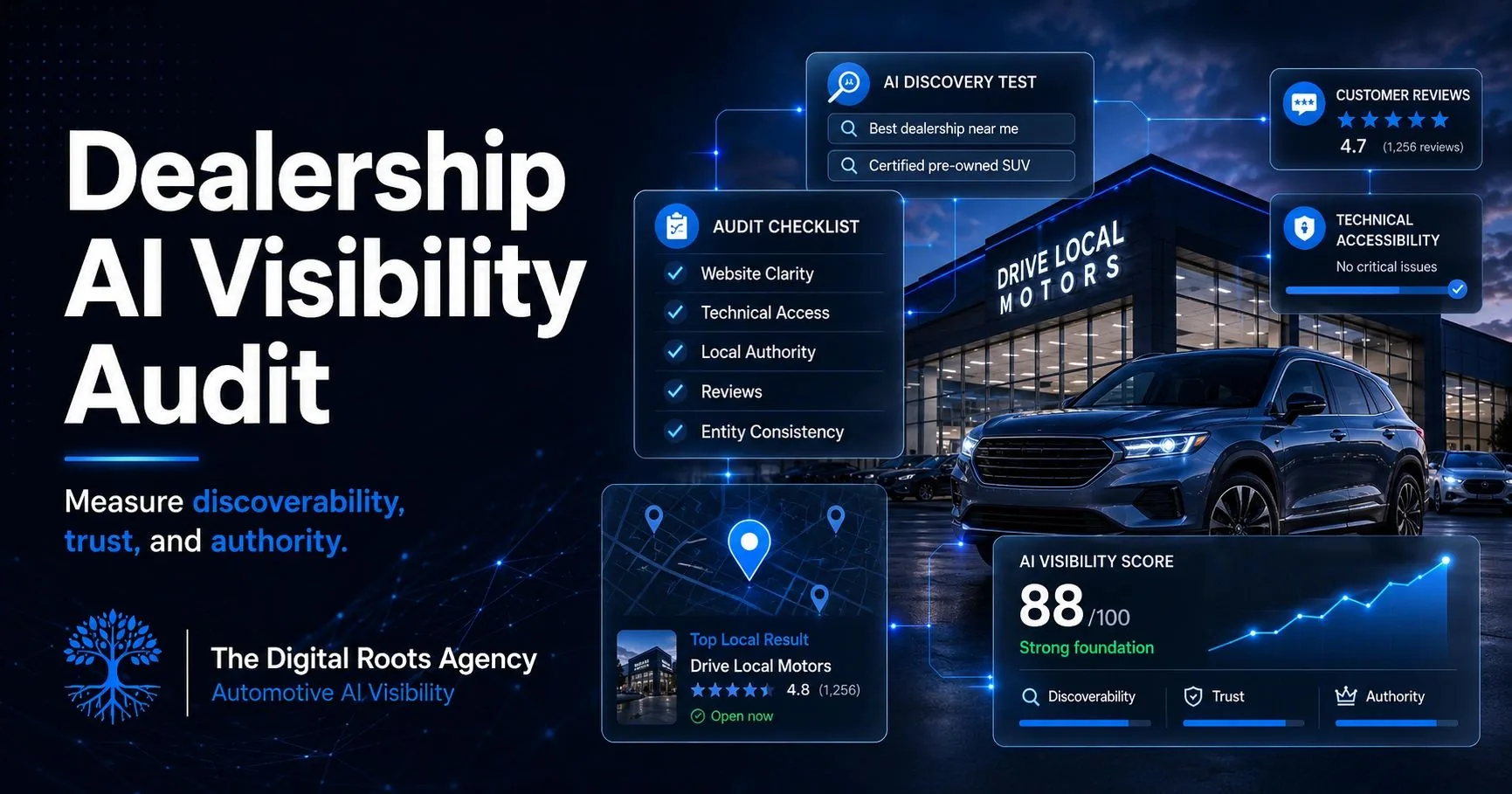
Your dealership has a website.
It has an inventory feed, a Google Business Profile, social media accounts, customer reviews and pages describing your sales and service departments.
But can AI platforms connect all of that information?
Can they clearly determine:
- Who your dealership is?
- Where it operates?
- Which communities it serves?
- What vehicles and services it offers?
- What makes it different?
- Why customers trust it?
- Whether it deserves to be recommended?
Those questions form the foundation of an Automotive AI Visibility audit.
Traditional SEO audits typically focus on rankings, keywords, traffic, backlinks and technical website issues. Those areas remain essential, but AI-driven discovery introduces another layer.
Dealerships must now evaluate whether their public information is accessible, consistent, understandable and supported by enough credible evidence to appear in conversational answers and recommendations.
The purpose of an AI Visibility audit is not to produce another vanity score.
It is to identify where your dealership is being understood correctly, where competitors are gaining an advantage and which gaps may prevent customers from discovering you.
What Is an Automotive AI Visibility Audit?
An Automotive AI Visibility audit evaluates how effectively search engines and AI platforms can find, interpret and use publicly available information about a dealership.
The audit should examine more than whether ChatGPT recognizes the dealership’s name.
It should test whether the dealership appears for non-branded questions related to:
- Its automotive brand
- Its primary market
- Nearby cities and communities
- New and pre-owned vehicles
- Specific models
- Leasing and financing
- Service and maintenance
- Customer reputation
- Convenience features
- Community involvement
- Commercial or specialty vehicles
- Customer needs and vehicle categories
It should also examine the dealership’s website, external profiles, local authority, technical accessibility and measurement systems.
A dealership may be easy to find by name while remaining invisible during broader customer research.
That difference is where the audit becomes valuable.
Why Dealerships Need a Different Kind of Audit
A customer researching a dealership no longer has to begin with a short Google search.
They can ask:
“What is the best Toyota dealership near Boston for a family looking to lease a three-row SUV?”
That prompt combines:
- Brand
- Location
- Purchase method
- Vehicle category
- Customer profile
- Recommendation intent
The AI platform must interpret the entire request and identify businesses supported by relevant information.
Google explains that the same foundational SEO practices used for traditional search also apply to its generative AI experiences, including AI Overviews and AI Mode. Google recommends creating helpful content, ensuring pages are accessible, supporting strong page experiences and using structured data that accurately matches visible content.
OpenAI similarly states that public websites may appear in ChatGPT search when their content is accessible to OAI-SearchBot, although inclusion and placement are not guaranteed.
The lesson is not that dealerships need to abandon SEO and chase an entirely new set of tricks.
The lesson is that strong SEO must now support a broader goal:
Making the dealership easy for both people and machines to understand.
The Digital Roots Agency 100-Point Audit Framework
The Digital Roots Agency evaluates Automotive AI Visibility across seven connected areas.
Each category reveals a different part of the dealership’s digital identity.
Audit Categories
- AI Discovery Testing: 25 points
- Website Clarity and Content: 20 points
- Technical Accessibility: 15 points
- Local Authority: 15 points
- Reviews and Reputation: 10 points
- Entity Consistency: 10 points
- Measurement and Monitoring: 5 points
A score should never be treated as a guaranteed prediction of AI recommendations.
Instead, it provides a structured way to identify strengths, weaknesses and priorities.
Category One: AI Discovery Testing
Maximum Score: 25 Points
The first step is testing whether AI platforms can find and describe the dealership.
Do not begin by asking only about the dealership by name.
That measures recognition, not discovery.
A complete audit should include five prompt groups.
1. Branded Identity Prompts
Start with basic questions:
- What is [dealership name]?
- Where is [dealership name] located?
- Which automotive brand does [dealership name] represent?
- What services does [dealership name] provide?
- What communities does [dealership name] serve?
- Is [dealership name] an authorized dealership?
- What makes [dealership name] different?
Review each answer for accuracy.
Look for:
- Incorrect addresses
- Outdated phone numbers
- Missing service information
- Confusion with similarly named businesses
- Incorrect ownership information
- Missing location context
- Unsupported claims
- Outdated hours or policies
A dealership should not assume that an answer is accurate simply because the business name appears.
2. Non-Branded Local Prompts
These prompts test actual discovery.
Examples include:
- Best Toyota dealership near Boston
- BMW dealership on Long Island
- Honda dealer near West Roxbury
- Mercedes-Benz dealership near Massapequa
- Best dealership near me for a family SUV
- Local dealership with certified pre-owned vehicles
- Dealership offering convenient service appointments
Document:
- Whether the dealership appears
- Which competitors appear
- The order in which businesses are mentioned
- The reasons provided for each recommendation
- The sources used
- Important dealership advantages that are missing
This is often the most revealing part of the audit.
A dealership may dominate branded questions but disappear when its name is removed.
3. Vehicle and Model Prompts
Test the vehicles the dealership wants to be known for.
Examples include:
- Where can I buy a Toyota Grand Highlander near Boston?
- Best dealership for a certified pre-owned BMW X5
- Where can I lease a Honda Pilot near me?
- Dealership with electric vehicles on Long Island
- Best family SUV dealership near Boston
- Where can I compare hybrid SUVs locally?
These prompts test whether the dealership is associated with important inventory categories beyond individual vehicle listings.
Inventory changes constantly.
The dealership’s expertise and market relevance should be more durable.
4. Service Prompts
Service departments should receive their own audit.
Test questions such as:
- Where should I service my BMW on Long Island?
- Certified Honda service near Boston
- Dealership offering service pickup and delivery
- Where can I get a Mercedes-Benz recall repaired?
- Toyota brake service near me
- Dealership with convenient online service scheduling
Many dealership websites underrepresent their service departments, even though fixed operations may generate long-term customer value.
5. Reputation and Differentiation Prompts
Finally, test what customers may ask before making a decision:
- Which dealership has the best customer service?
- What dealership near me has strong reviews?
- Which local dealership supports the community?
- What makes [dealership name] different?
- Is [dealership name] trustworthy?
- Which dealership is best for first-time buyers?
- What local dealership offers a low-pressure experience?
These prompts reveal whether the dealership’s differentiators are supported by public evidence.
AI Discovery Scoring
Award up to five points for each prompt group:
- Five points: Accurate, visible and well-supported
- Four points: Usually visible with minor gaps
- Three points: Inconsistent visibility
- Two points: Limited or mostly branded visibility
- One point: Rarely found or frequently inaccurate
- Zero points: Not found or seriously misrepresented
Category Two: Website Clarity and Content
Maximum Score: 20 Points
The dealership website should clearly explain the business without forcing customers or machines to piece together scattered information.
Review the following areas.
Homepage Clarity
Within the main visible content, can a visitor determine:
- The dealership’s official name
- Its automotive brand
- Its location
- The broader market it serves
- Whether it sells new and pre-owned vehicles
- Whether it provides service and parts
- Its main customer advantages
Many automotive homepages are dominated by rotating offers, inventory widgets and manufacturer campaigns.
Those elements may support conversion, but they do not always provide a clear explanation of the dealership.
About Page Quality
The About page should communicate more than a generic promise of excellent service.
It can include:
- Dealership history
- Ownership or dealer-group background
- Years in the market
- Communities served
- Customer philosophy
- Local involvement
- Awards and certifications
- Staff experience
- Meaningful differentiators
- Links to supporting pages
Every claim should be accurate and defensible.
Sales and Inventory Pathways
Review whether customers can easily find:
- New inventory
- Pre-owned inventory
- Certified pre-owned vehicles
- Model research
- Current incentives
- Financing information
- Trade-in information
- Vehicle comparison resources
- Electric or hybrid vehicles
- Commercial inventory, when applicable
Inventory pages should not exist in isolation.
They should connect to useful model, ownership and local-market information.
Service and Parts Content
Review whether the site clearly documents:
- Service department location
- Hours
- Scheduling process
- Available services
- Certified technicians
- Genuine parts
- Warranty work
- Recall support
- Pickup and delivery
- Express service
- Seasonal maintenance
- Brand-specific expertise
Generic service text copied across thousands of dealership websites does little to differentiate one location from another.
Local Market Content
The dealership should clearly establish its relationship with the surrounding market.
Strong local content can address:
- Communities served
- Driving directions
- Local ownership needs
- Popular vehicles in the area
- Nearby landmarks
- Seasonal driving conditions
- Community events
- Pickup and delivery areas
- Local partnerships
- Frequently asked questions
Avoid creating dozens of thin pages that only replace one city name with another.
Local pages should provide original and useful information.
Google’s guidance for generative AI features continues to emphasize helpful, reliable, people-first content rather than special AI-only markup or shortcuts.
Question-Based Content
Review whether the dealership answers real customer questions, including:
- Is it better to lease or finance?
- What should I bring when buying a car?
- How does certified pre-owned coverage work?
- Which SUV is best for a family?
- Are hybrid vehicles good for local driving?
- How often should my vehicle be serviced?
- What does a dashboard warning light mean?
- Can I trade in a vehicle with a loan balance?
- Do I need an appointment for service?
This content helps customers while giving search and AI systems clearer context about the dealership’s expertise.
Website Content Scoring
Award up to four points in each area:
- Homepage and identity
- Sales and inventory pathways
- Service and parts information
- Local market content
- Educational and question-based content
Category Three: Technical Accessibility
Maximum Score: 15 Points
Excellent content cannot support visibility when crawlers cannot access or interpret it.
Dealership websites often rely on complex automotive platforms, inventory scripts, third-party widgets, security layers and content delivery networks.
These systems require careful review.
Crawler Access
Check whether important dealership pages are blocked by:
- Robots.txt rules
- Noindex tags
- Login requirements
- Security settings
- Firewall rules
- Bot protection
- Content delivery network restrictions
OpenAI states that publishers wanting their content eligible for ChatGPT search should allow OAI-SearchBot to access their websites.
Google also notes that pages must be crawlable and indexable to be considered for its search and AI features.
Indexing and Canonicalization
Review whether:
- Important pages are indexed
- Duplicate pages use appropriate canonical tags
- Redirects work correctly
- Old URLs resolve properly
- Inventory and content pages are not accidentally excluded
- XML sitemaps are current
- Broken internal links are repaired
Page Rendering
Verify that important information is visible when pages are rendered by search crawlers.
Pay close attention to:
- JavaScript-loaded text
- Inventory widgets
- Expandable content
- Tabs
- Embedded review feeds
- Service menus
- Location information
- Mobile experiences
Structured Data
Structured data can help search engines understand and classify page information.
Google supports structured data for organizations, local businesses, products, articles and other eligible page types. It recommends validating implementation and ensuring the markup accurately reflects visible page content.
Dealerships should review appropriate markup for:
- Organization information
- Local business details
- Departments
- Articles
- Breadcrumbs
- Products and offers where appropriate
- Employee or author profiles where appropriate
Structured data is not a shortcut to rankings or AI recommendations.
It is one way to reduce ambiguity.
Page Experience
Review:
- Mobile usability
- Loading performance
- Intrusive popups
- Broken page elements
- Accessibility
- Secure HTTPS delivery
- Navigation
- Readability
A technically accessible page should also be usable by real customers.
Technical Scoring
Award up to three points in each area:
- Crawler access
- Indexing and canonicalization
- Rendering
- Structured data
- Page experience
Category Four: Local Authority
Maximum Score: 15 Points
A dealership cannot establish local authority only by repeatedly claiming to be the best dealership in its market.
Authority requires evidence.
Review whether the dealership is connected to credible external sources such as:
- Local news publications
- Chambers of commerce
- Community organizations
- Charities
- Schools
- Youth sports organizations
- Business associations
- Automotive publications
- Manufacturer websites
- Local event pages
- Sponsorship partners
Audit Your Community Activity
Create a list of dealership activities from the past year:
- Charitable donations
- Community events
- Sponsorships
- Employee volunteer work
- Vehicle donations
- School partnerships
- Customer appreciation events
- Cars and coffee events
- Holiday drives
- Local awards
- Dealership milestones
Then determine how many were documented through:
- A dealership website article
- Social media
- Google Business Profile
- Partner websites
- Local news
- Event calendars
- Video
- Photography
- Internal links
- Follow-up coverage
A dealership may be doing meaningful work locally but receiving almost no lasting digital value from it.
Evaluate Third-Party Mentions
Look beyond backlink quantity.
Ask:
- Is the dealership mentioned by trusted local sources?
- Are those mentions accurate?
- Do they connect the dealership with its city and automotive brand?
- Do they describe meaningful activity?
- Do they link to an appropriate dealership page?
- Are there recent mentions, or only outdated ones?
- Do competitors have stronger local media coverage?
The goal is not to manufacture mentions.
It is to make legitimate dealership activity visible and verifiable.
Local Authority Scoring
Award up to five points in each area:
- Community involvement
- Local media and publication coverage
- Partnerships and third-party validation
Category Five: Reviews and Reputation
Maximum Score: 10 Points
Reviews are one of the clearest public records of customer experience.
Audit:
- Overall rating
- Total review volume
- Review recency
- Review frequency
- Response rate
- Response quality
- Sales versus service feedback
- Repeated customer themes
- Location accuracy
- Major unresolved complaints
Do not focus only on the average star rating.
Review language may reveal whether customers consistently associate the dealership with:
- Transparency
- Convenience
- Responsiveness
- Fairness
- Expertise
- Friendly employees
- Efficient service
- Easy financing
- Strong communication
- Long-term relationships
These themes can reinforce the dealership’s positioning when they appear naturally and consistently.
Review Response Quality
Responses should be:
- Professional
- Specific
- Timely
- Respectful
- Written for future readers
- Free from private customer information
Avoid posting the same automated response to every customer.
Repetitive responses make the dealership appear less engaged and may miss opportunities to reinforce meaningful service details.
Reputation Scoring
Award up to two points in each area:
- Rating and volume
- Recency
- Review frequency
- Response quality
- Consistent positive themes
Category Six: Entity Consistency
Maximum Score: 10 Points
An entity is a recognizable person, place, organization or concept.
For a dealership, entity consistency means that public sources agree about the dealership’s identity.
Audit the following information:
- Official business name
- Address
- Phone number
- Website
- Hours
- Automotive brand
- Department information
- Leadership
- Social profiles
- Service area
- Dealer-group relationship
Compare this information across:
- Dealership website
- Google Business Profile
- Manufacturer directory
- Bing Places
- Apple Business Connect
- Social accounts
- Major directories
- Review platforms
- Local organizations
- Press mentions
Conflicting information can create confusion for customers and machines.
Department Consistency
Sales, service, parts and collision departments may have different:
- Phone numbers
- Hours
- Entrances
- addresses
- Appointment links
- Business profiles
These differences should be intentional and clearly documented.
Google’s LocalBusiness structured-data guidance allows organizations to provide information about business hours and departments, helping clarify how a local business is organized.
Entity Scoring
Award up to two points in each area:
- Business name
- Address and location
- Phone numbers and contact information
- Hours and department details
- Brand, ownership and profile consistency
Category Seven: Measurement and Monitoring
Maximum Score: 5 Points
AI Visibility should not be treated as a one-time project.
Search results, AI answers, competitors, websites and customer behavior change.
A dealership needs an ongoing measurement process.
Track Prompt Visibility
Maintain a defined list of prompts related to:
- Brand
- Location
- Models
- Vehicle categories
- Leasing
- Financing
- Service
- Reputation
- Community
- Customer needs
Record:
- Whether the dealership appears
- Which competitors appear
- Sources cited
- Changes over time
- Incorrect information
- New opportunities
Track Referral Traffic
OpenAI states that referrals from ChatGPT search include utm_source=chatgpt.com, allowing publishers who permit OAI-SearchBot to identify relevant referral traffic in analytics platforms.
Dealerships should review analytics for traffic from:
- ChatGPT
- Bing
- Microsoft Copilot-related sources when identifiable
- Other AI and referral platforms
- Local publications
- Community partners
Referral traffic is only one measurement.
A customer may receive a recommendation and later visit the dealership through a branded search, direct visit or separate device.
Use Available Platform Reporting
Bing Webmaster Tools now provides an AI Performance report that can show pages cited in supported Microsoft AI experiences, citation trends and grounding queries associated with a website’s content.
This can help dealerships understand which pages are being used and where content opportunities exist.
Traditional tools remain important as well:
- Google Search Console
- Bing Webmaster Tools
- Website analytics
- Local ranking tools
- Review monitoring
- Call tracking
- CRM attribution
- Google Business Profile reporting
Measurement Scoring
Award one point for each capability:
- Defined prompt set
- Recurring visibility testing
- AI referral tracking
- Search platform monitoring
- Competitor comparison
How to Interpret Your Score
85–100: Strong Foundation
The dealership has a clear and well-supported digital identity.
Priorities should focus on:
- Expanding non-branded visibility
- Building stronger local authority
- Improving high-value model and service content
- Monitoring competitors
- Maintaining technical performance
70–84: Competitive but Inconsistent
The dealership has many strong assets, but gaps may limit recommendations.
Common issues include:
- Weak non-branded visibility
- Thin service content
- Inconsistent local pages
- Limited third-party mentions
- Missing dealership differentiators
- Incomplete measurement
50–69: Significant Visibility Gaps
The dealership is online but may not be clearly understood.
Priorities typically include:
- Website clarity
- Local relevance
- Technical accessibility
- Review activity
- Content quality
- Entity consistency
- Better prompt tracking
Below 50: Weak or Fragmented Presence
The dealership may struggle to appear outside branded searches.
The first priority should be fixing foundational issues rather than producing large volumes of new content.
Turn the Audit Into a 90-Day Action Plan
An audit only creates value when it leads to focused action.
Days 1–30: Fix the Foundation
Prioritize:
- Incorrect business information
- Crawler restrictions
- Indexing issues
- Broken pages
- Missing dealership identity content
- Inconsistent hours and phone numbers
- Major review-response gaps
- Weak internal linking
Days 31–60: Build Relevance
Create or improve:
- Local market pages
- Service resources
- Model comparisons
- Customer FAQs
- Dealership differentiation
- About-page content
- Community pages
- Structured data
Days 61–90: Build Authority
Focus on:
- Local public relations
- Community partnerships
- Event coverage
- Review generation
- Expert dealership commentary
- Third-party mentions
- Prompt monitoring
- Competitor comparison
The dealership should then repeat the audit to measure what changed.
Frequently Asked Questions
What is an AI Visibility audit for a dealership?
An AI Visibility audit evaluates whether search engines and AI platforms can access, understand and potentially recommend a dealership based on its website, external profiles, content, reputation, local authority and technical foundation.
Is an AI Visibility audit the same as an SEO audit?
No. The two overlap, but they are not identical.
An SEO audit typically focuses on organic search performance, keywords, crawling, indexing, content and backlinks.
An AI Visibility audit adds conversational prompt testing, entity clarity, recommendation visibility, cited sources, local authority and AI-specific measurement.
Can a dealership guarantee a ChatGPT recommendation?
No reputable agency can guarantee that a dealership will appear in every ChatGPT response.
Answers can vary based on the user’s question, location, available sources and other factors. The goal is to strengthen the dealership’s public information and improve its eligibility and relevance.
How often should a dealership perform an AI Visibility audit?
A complete audit can be performed quarterly, with important prompts and competitive changes monitored more frequently.
Dealerships should also perform additional reviews after:
- Website redesigns
- Platform migrations
- Major content changes
- Business information updates
- Location changes
- New service launches
- Significant ranking declines
Should dealerships create content with AI?
AI can assist with research, organization and drafting, but dealership content should be reviewed, improved and supported by real expertise.
Google warns that producing large volumes of automated content without adding value may violate its policies on scaled content abuse.
Does structured data guarantee AI Visibility?
No.
Structured data can help clarify page information, but it does not guarantee rankings, citations or recommendations. It must also match the content visible to users.
Your Dealership Cannot Improve What It Does Not Measure
Automotive AI Visibility is not about chasing a secret prompt or tricking an AI platform.
It is about building a dealership presence that is:
- Accessible
- Accurate
- Relevant
- Consistent
- Helpful
- Credible
- Locally supported
- Easy to understand
The audit reveals where those qualities are strong and where they break down.
It also changes the conversation inside the dealership.
Instead of asking:
“Are we using AI?”
Leadership can begin asking:
“Can AI find enough trustworthy information to recommend us?”
That is the question that will increasingly influence automotive discovery.
See How AI Understands Your Dealership
The Digital Roots Agency helps automotive dealerships evaluate and improve their visibility across traditional search and emerging AI platforms.
Our Automotive AI Visibility audits examine:
- ChatGPT and AI discovery prompts
- Dealership SEO
- Local search visibility
- Website content
- Technical accessibility
- Structured information
- Customer reviews
- Local authority
- Competitive recommendations
- Ongoing performance
We identify where your dealership appears, where competitors are gaining visibility and which improvements should be prioritized.
Because your dealership cannot strengthen what it does not measure.
Get Your AI Visibility Score
If AI can’t understand your dealership, it can’t recommend it.