
A podiatry website should do more than look professional.
It should help patients find answers, understand your services, trust your providers, and take the next step toward scheduling an appointment.
It should also help Google and AI platforms understand who you are, where you are located, what you treat, and why your practice is relevant to local patient searches.
That is where website structure becomes important.
Many podiatry practices have websites that are visually clean but structurally weak. They may have a homepage, an about page, a contact page, and one broad services page. That might be enough to explain the practice at a basic level, but it is usually not enough to build strong organic SEO or AI Visibility.
Patients search in specific ways.
They search for symptoms, conditions, services, locations, and provider trust.
They may search:
- podiatrist near me
- foot doctor near me
- heel pain treatment near me
- plantar fasciitis doctor
- diabetic foot care in Rochester NY
- ingrown toenail treatment in Fort Myers
- bunion treatment Naples FL
- custom orthotics near Sarasota
- foot and ankle specialist in Buffalo
If your website does not have clear pages that match those searches, your practice may be harder to find.
For podiatry practices in Upstate New York and Florida, strong website structure is one of the most important parts of ranking organically and being understood by AI search platforms.
Why Website Structure Matters for Podiatrists
Website structure is the way your pages are organized, connected, and explained.
A strong structure helps three audiences at once:
- Patients
- Search engines
- AI platforms
Patients need a website that is easy to navigate. They should be able to quickly find the condition or service they care about, learn whether your practice can help, and understand how to schedule.
Search engines need a website that is easy to crawl and interpret. Google should be able to understand your major services, office locations, providers, and content topics.
AI platforms need clear context. Tools like Google AI Overviews, ChatGPT, Gemini, and Perplexity are looking for structured, trustworthy information they can understand and reference.
If your website is too thin, too vague, or too disorganized, it becomes harder for all three audiences to understand your practice.
In simple terms:
A strong website structure helps your practice become easier to find, easier to understand, and easier to choose.
The Problem With One Generic Services Page
One of the most common podiatry website mistakes is relying on one broad services page.
That page may list items like:
- Heel pain
- Bunions
- Diabetic foot care
- Ingrown toenails
- Orthotics
- Toenail fungus
- Foot surgery
But if each service only gets a bullet point or a sentence, there is not enough depth for strong SEO.
A patient searching for “heel pain treatment near me” wants more than a bullet point.
They want to know:
- What might be causing heel pain?
- Does a podiatrist treat heel pain?
- When should they schedule an appointment?
- What happens during an evaluation?
- Does the practice offer custom orthotics?
- Where is the office located?
- How can they book?
A single generic page usually cannot answer all of that well.
That is why podiatry websites should have dedicated pages for major services and conditions.
Core Pages Every Podiatry Website Should Have
A strong podiatry website should start with a clear foundation.
At minimum, most practices should have:
- Homepage
- About the Practice page
- Provider bio pages
- Services overview page
- Individual service or condition pages
- Location pages
- Contact page
- Appointment page or request form
- FAQ page
- Blog or resource center
- Reviews or testimonials page, when appropriate
Each page has a job.
The homepage introduces the practice.
The service pages explain what you treat.
The location pages connect your services to local markets.
The provider pages build trust.
The blog answers patient questions.
The FAQ page supports SEO, AI Visibility, and patient clarity.
When these pages work together, your website becomes a visibility system instead of a digital brochure.
The Homepage Should Be Clear and Local
Your homepage is often the first impression of your practice.
It should quickly explain:
- Who you are
- What type of practice you are
- Where you are located
- What major services you provide
- What types of patients you help
- How patients can schedule
- Why patients trust your practice
For podiatry practices, the homepage should clearly mention foot and ankle care, podiatry services, local office areas, and your most important treatment categories.
A strong homepage should not be vague.
Instead of saying:
“We provide comprehensive care for your needs.”
A stronger podiatry homepage might say:
“Our podiatry practice helps patients in Rochester and Canandaigua with heel pain, plantar fasciitis, diabetic foot care, ingrown toenails, bunions, custom orthotics, and foot and ankle concerns.”
Or:
“Our Fort Myers podiatry office provides foot and ankle care for patients dealing with heel pain, diabetic foot concerns, toenail issues, sports injuries, and other common podiatry conditions.”
This type of language helps patients immediately understand the practice.
It also helps Google and AI platforms connect your services to your location.
Service Pages Should Be Specific
Dedicated service pages are one of the biggest SEO opportunities for podiatry practices.
Instead of listing every service on one page, build individual pages for major topics.
Examples include:
- Heel Pain Treatment
- Plantar Fasciitis Treatment
- Diabetic Foot Care
- Ingrown Toenail Treatment
- Bunion Treatment
- Custom Orthotics
- Toenail Fungus Treatment
- Hammertoe Treatment
- Neuropathy Foot Care
- Wound Care
- Ankle Sprain Treatment
- Sports Foot Injuries
- Pediatric Foot Care
- Geriatric Foot Care
- Foot and Ankle Surgery
Each service page should answer the most common patient questions around that topic.
A strong service page may include:
- A clear H1 title
- A short intro explaining the condition or service
- Common symptoms or concerns
- When to contact a podiatrist
- What the practice may evaluate
- Treatment or care options offered by the practice
- Provider information
- Location information
- FAQs
- Internal links to related services
- A clear appointment CTA
The goal is to make the page useful, not just keyword-rich.
Good SEO content should help the patient understand the next step.
Condition Pages Can Capture Symptom-Based Searches
Podiatry is highly symptom-driven.
Many patients do not immediately know what service they need.
They know what hurts.
That means condition pages can be extremely valuable.
For example, a patient may not search “plantar fasciitis treatment” at first.
They may search:
- why does my heel hurt in the morning?
- pain on bottom of foot
- sharp heel pain after standing
- foot pain when I wake up
- heel pain after running
A condition-focused content strategy can help capture those searches.
This could include pages or blogs around:
- Heel pain
- Ball of foot pain
- Arch pain
- Ankle pain
- Toe pain
- Foot numbness
- Toenail problems
- Foot wounds
- Pain while walking
- Pain after running
These pages should be written carefully and reviewed by the practice for clinical accuracy.
The goal is not to diagnose online.
The goal is to educate patients and guide them toward appropriate care.
Location Pages Are Essential for Local SEO
For podiatry practices with multiple offices, location pages are critical.
Each office should have its own page.
A strong location page should include:
- Office name
- Address
- Phone number
- Hours
- Directions or nearby landmarks
- Parking information when helpful
- Services available at that location
- Provider names at that office
- Local appointment CTA
- Embedded map when appropriate
- Photos of the office
- FAQs specific to the location
For example, a practice with locations in Rochester, Canandaigua, and Victor should have separate pages for each location.
A Florida podiatry group with offices in Fort Myers, Naples, and Cape Coral should do the same.
This helps your website rank for local searches like:
- podiatrist Rochester NY
- foot doctor Canandaigua NY
- podiatrist Victor NY
- podiatrist Fort Myers FL
- foot doctor Naples FL
- heel pain treatment Cape Coral
A generic contact page is not enough for strong multi-location SEO.
Each location needs its own local footprint.
Provider Bio Pages Build Trust and Authority
Provider bio pages are often overlooked, but they matter.
Patients want to know who they are seeing.
Google and AI platforms also need to understand the providers connected to the practice.
A strong podiatrist bio page should include:
- Provider name
- Credentials
- Education
- Training
- Areas of focus
- Locations served
- Patient care philosophy
- Professional memberships when appropriate
- Internal links to relevant services
- Internal links to location pages
- Appointment CTA
For example, if a podiatrist focuses on heel pain, diabetic foot care, sports injuries, or surgical care, the bio should explain that clearly.
This does not need to sound overly promotional.
It should sound helpful, credible, and patient-friendly.
Provider pages also help support AI Visibility because they create clearer entity signals around who works at the practice and what they specialize in.
FAQ Pages Help Patients and AI Search
Frequently asked questions are especially valuable for podiatry SEO and AI Visibility.
AI search is conversational.
Patients ask questions like:
- What does a podiatrist treat?
- When should I see a podiatrist?
- Can a podiatrist help with heel pain?
- Do podiatrists treat diabetic foot concerns?
- What should I expect at my first appointment?
- Do I need a referral to see a podiatrist?
- Does insurance cover podiatry visits?
- Can custom orthotics help foot pain?
A dedicated FAQ page can answer broad questions.
Individual service pages should also include FAQs specific to that topic.
For example, a heel pain page should have heel pain FAQs.
A diabetic foot care page should have diabetic foot care FAQs.
An ingrown toenail page should have ingrown toenail FAQs.
This gives patients better information and gives AI platforms clearer answers to process.
Blog Content Should Support the Main Website Structure
A blog should not be random.
It should support your service pages, location pages, and patient search intent.
For podiatry practices, strong blog topics may include:
- Why Does My Heel Hurt When I Wake Up?
- When Should I See a Podiatrist for an Ingrown Toenail?
- What Is the Difference Between a Podiatrist and an Orthopedic Foot Specialist?
- Can Custom Orthotics Help Foot Pain?
- Why Diabetic Foot Care Matters
- What to Expect at Your First Podiatry Appointment
- How to Choose a Foot Doctor Near You
- Common Foot Problems for Runners
- Foot Care Tips for Active Seniors
- When Foot Pain Should Not Be Ignored
Each blog should link to relevant service and location pages.
For example:
A blog about heel pain should link to your heel pain page, plantar fasciitis page, custom orthotics page, and appointment page.
A blog about diabetic foot care should link to your diabetic foot care page, wound care page, provider bio pages, and relevant location pages.
This is how blogs become part of a larger SEO system.
Internal Linking Helps Google and Patients Navigate
Internal links are links from one page on your website to another page on your website.
They are simple but powerful.
A podiatry website should use internal links to connect related content.
For example:
- Heel Pain page links to Plantar Fasciitis, Custom Orthotics, and Appointment Request
- Diabetic Foot Care page links to Wound Care, Provider Bios, and Location Pages
- Bunion Treatment page links to Foot Surgery, Hammertoe Treatment, and FAQs
- Location pages link to services available at that office
- Provider bios link to services and locations
- Blog posts link back to relevant service pages
Internal linking helps patients continue learning.
It also helps search engines and AI platforms understand the relationship between your pages.
Without internal links, your content can feel isolated.
With internal links, your website becomes a connected authority hub.
Page Titles and Meta Descriptions Still Matter
Even with AI search growing, traditional SEO fundamentals still matter.
Every important page should have a clear title tag and meta description.
For example:
Page Title: Heel Pain Treatment in Rochester NY Meta Description: Learn when to see a podiatrist for heel pain, plantar fasciitis, and foot discomfort at our Rochester podiatry practice.
Or:
Page Title: Diabetic Foot Care in Fort Myers FL Meta Description: Our Fort Myers podiatry office provides diabetic foot care, foot exams, wound care support, and patient-focused foot and ankle services.
These elements help search engines understand the page.
They also influence whether patients click.
Clear beats clever.
Schema Can Support Website Clarity
Schema markup is structured data that helps search engines better understand your content.
For podiatry websites, schema may be useful for:
- Local business information
- Medical practice information
- Provider pages
- FAQ pages
- Blog articles
- Service pages
- Reviews, when implemented correctly and appropriately
Schema does not replace good content.
It supports good content.
Think of it as an additional layer of clarity for search engines.
For AI Visibility, that clarity can matter because AI systems benefit from consistent, structured information.
Multi-Location Practices Need Extra Organization
Multi-location podiatry practices need to be especially thoughtful.
A practice with multiple offices should avoid making every page generic.
Instead, connect services to locations clearly.
For example:
- Main Heel Pain Treatment page
- Rochester Podiatry Location page
- Canandaigua Podiatry Location page
- Victor Podiatry Location page
- Fort Myers Podiatry Location page
- Naples Podiatry Location page
Then internally link between the relevant pages.
This helps patients find the office closest to them.
It also helps Google understand which office is relevant for which local search.
Each location should also be connected to the correct Google Business Profile.
That consistency matters across the entire local SEO system.
What a Strong Podiatry Website Structure Looks Like
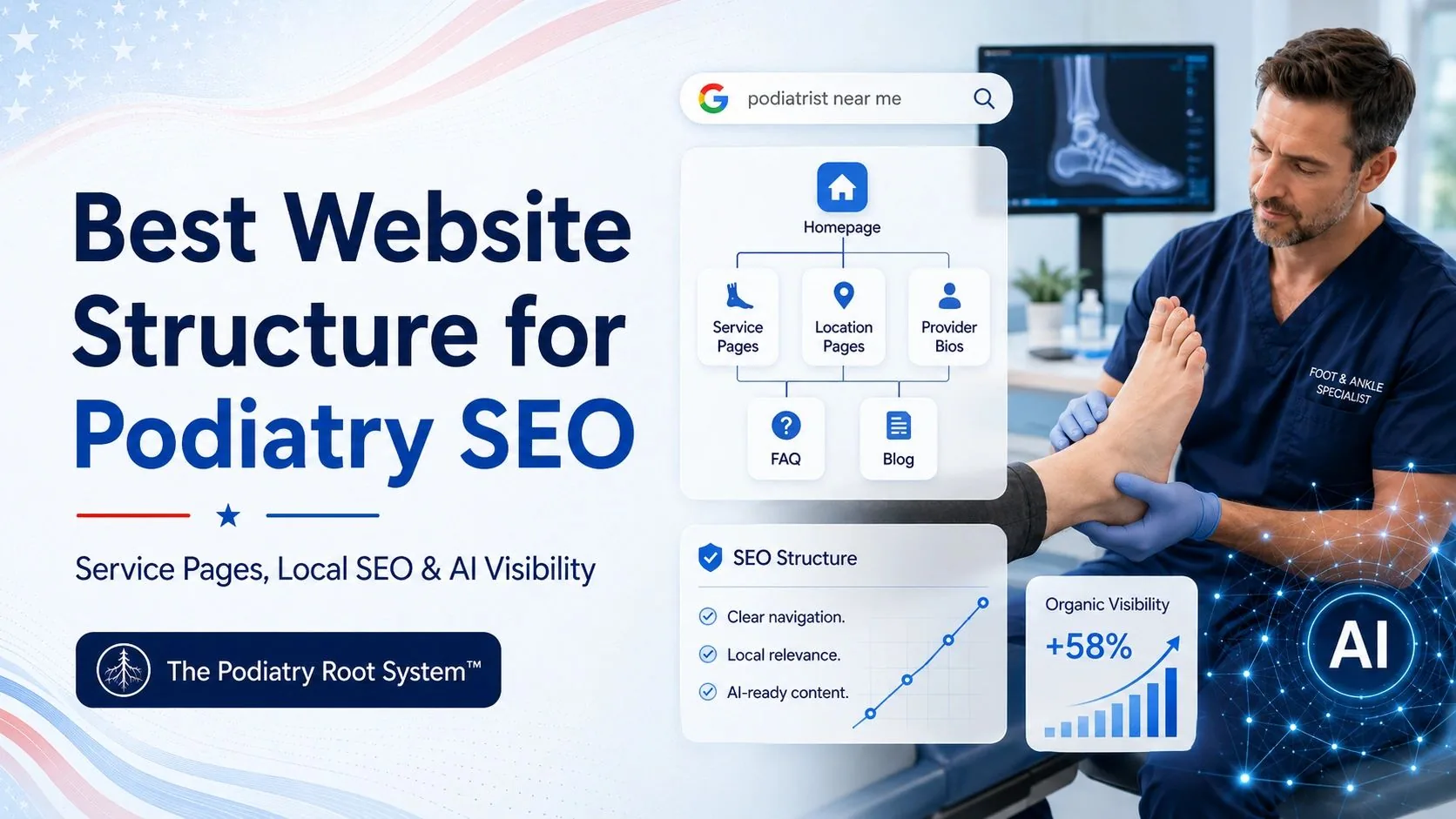
A clean structure may look like this:
Homepage Introduces the practice, services, providers, locations, and appointment path.
About Page Explains the practice story, values, and patient care approach.
Providers Individual bio pages for each podiatrist.
Services A services overview page with links to individual service pages.
Service Pages Heel Pain, Plantar Fasciitis, Diabetic Foot Care, Ingrown Toenails, Bunions, Orthotics, Toenail Fungus, Wound Care, and more.
Locations Individual office pages for each location.
FAQ Page Broad patient questions about podiatry, appointments, insurance, referrals, and treatment expectations.
Blog Educational content that supports service and local search visibility.
Contact / Appointment Page Clear next step for patients ready to schedule.
This structure gives your practice room to grow.
It also gives Google and AI platforms a much clearer understanding of your expertise.
Common Website Structure Mistakes Podiatrists Make
Common mistakes include:
- Relying on one generic services page
- Missing location pages
- Thin provider bios
- No FAQ section
- Blog posts with no internal links
- Service pages with little detail
- No clear appointment CTA
- Duplicate or vague page titles
- Weak local city references
- Missing schema
- Outdated content
- No connection between website and Google Business Profile
- No strategy for AI Visibility
Most of these issues are fixable.
The key is to stop thinking of the website as a static brochure and start treating it as a visibility foundation.
A Better Website Helps Patients Make Decisions
A strong podiatry website does not just help rankings.
It helps patients make decisions.
Someone dealing with heel pain, an ingrown toenail, diabetic foot concerns, or a foot injury may feel unsure about what to do next.
Your website should reduce that uncertainty.
It should make it easy for patients to understand:
- What you treat
- Where you are located
- Which provider they may see
- What to expect
- How to schedule
- Why your practice is trustworthy
That is the real purpose of podiatry SEO.
The goal is not just more traffic.
The goal is better visibility with the right patients.
Want to Improve Your Podiatry Website Structure?
The Digital Roots Agency helps podiatry practices build stronger website structures for organic SEO, local search, Google Business Profile performance, and AI Visibility.
If your practice wants to rank for searches like “podiatrist near me,” “foot doctor near me,” “heel pain treatment,” “diabetic foot care,” “plantar fasciitis specialist,” or “ingrown toenail treatment,” we can help organize your website into a clearer, stronger visibility system.